
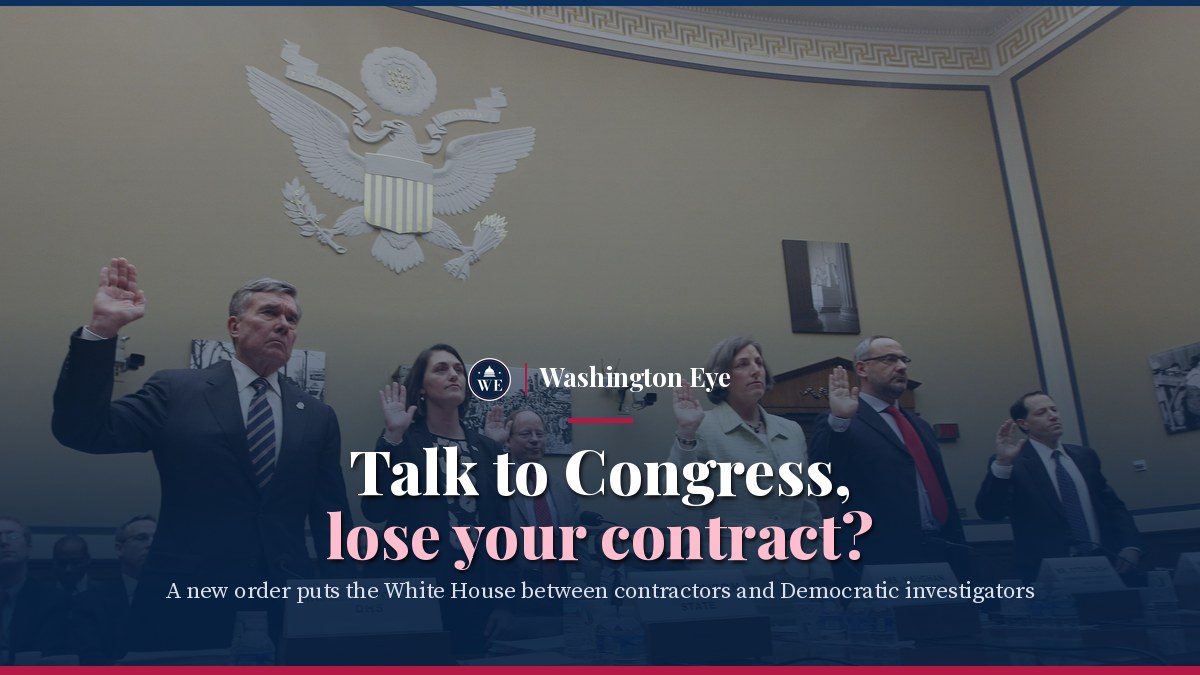
Late on Friday, without a ceremony or a briefing, the White House published a two page document that may shape the next two years of American politics more than most of the laws Congress will pass. Executive Order 14438, signed by President Donald Trump on November 20 and titled "Protecting the Executive's Privileges and Enhancing Efficiencies in Federal Contracting," tells every company that does business with the federal government to check with the White House before it answers questions from Congress.
The order does not mention Democrats by name. It does not need to. Democrats won control of both the House and the Senate in this month's midterm elections, and from January they will hold every committee gavel and every subpoena on Capitol Hill. Their leaders have promised to investigate federal contracts, possible conflicts of interest, immigration enforcement and the administration's handling of the Jeffrey Epstein investigation. Many of those trails run straight through private companies paid with federal money. Friday's order is an attempt to put the White House between those companies and the committees that want to question them.
What the order actually requires
The operative language is short. Under Section 2, all federal contractors must "immediately" notify the White House and the agencies they work for of "any pending or future congressional request respecting the contractors' communications or work with the executive branch." They must then "abide by any instructions received from the White House and contracting agency related to the withholding of communications that the White House or the agency has determined are protected by executive privilege."
The rule reaches beyond the prime contractor. Subcontractors working on a federal contract are covered too, and the order makes the prime contractor responsible for making sure they comply. Agencies must "promptly" tell every contractor and subcontractor about the new obligations and write them into their requirements. The Office of Management and Budget is told to draw up guidance on how agencies should check compliance, though the order sets no deadline for it.
Then comes the stick. If a contractor or subcontractor fails to comply, Section 4 says, contracting agencies "shall consider" enforcement, "including the potential termination or cancellation of contracts and the potential debarment or suspension of contractors." Debarment is the heaviest penalty in federal procurement: it bars a company from winning new government work. For firms that depend on federal business, that is not a theoretical risk.
The administration's case
The White House frames the order as a matter of both principle and housekeeping. On principle, it argues that executive privilege, which it describes as "inextricably rooted in the separation of powers," protects confidential executive branch information, and that this protection does not disappear simply because the information sits in a contractor's files. The order states that Congress "cannot seek information from executive branch departments and agencies, employees, or Federal contractors without a valid legislative purpose that does not intrude on core Executive functions," and that it cannot obtain privileged material "before the executive branch has an opportunity to assert relevant privileges."
It also accuses unnamed lawmakers of overreach. "Certain congressional leaders have threatened to intrude on these Executive prerogatives by seeking confidential executive branch information from agencies and harassing private companies that contract with the Federal Government," the order says. The accompanying fact sheet calls the measure a defence against "congressional overreach." Neither document identifies the lawmakers or the requests it has in mind.
On housekeeping, the order leans on the language of procurement law. Its stated legal authority is the Federal Property and Administrative Services Act, the statute presidents have long used to set conditions for federal contracting, together with "the common law." If contractors respond to Congress on their own, the order argues, the government may have to "intervene or engage in separate litigation to defend its rights," wasting taxpayer money on duplicate legal fights. According to a wire service report, the White House said on Friday that contractors acting independently could expose privileged information, including on national security, and drag the administration into costly disputes.
The order also contains a quieter warning. If agencies cannot trust contractors to keep communications confidential, it says, the executive branch "will thus have to find alternative means of carrying out similar functions, reducing and even eliminating reliance on Federal contractors for certain purposes." Read plainly, that is a signal to the contracting industry that cooperation with Congress could cost more than any single contract.
The third move in two weeks
Friday's order did not come out of nowhere. It is the third step in a fortnight by the White House to control what reaches Capitol Hill once Democrats take charge.
On November 9, White House Counsel Will Scharf wrote to Representative Robert Garcia of California, the senior Democrat on the House Oversight and Government Reform Committee and its expected chairman in January. The letter argued that Congress has limited authority to investigate an administration and warned that some threatened Democratic probes "may cross the line into blatant criminality." A week later, Mr Scharf sent a memo to every agency's general counsel requiring White House approval before any agency employee agrees to appear before a congressional committee.
Each step widened the circle. The letter addressed lawmakers. The memo covered the government's own workforce. The new order reaches outside government altogether, to private companies and their subcontractors. Together they amount to a single strategy: route every request for information through the White House, and make saying yes to Congress without permission expensive.
Democrats have been moving just as fast. On November 18, Mr Garcia sent 12 letters to members of the president's family, top aides and allies, including Vice President JD Vance, White House Chief of Staff Stephen Miller, Attorney General Todd Blanche and former chief of staff Susie Wiles, asking them to preserve documents ahead of investigations next year. On Friday, Representative Jamie Raskin of Maryland, expected to chair the House Judiciary Committee, made public letters to the Justice Department and federal law enforcement agencies warning against deleting records kept on disappearing message apps.
When the Scharf letter arrived, Mr Garcia answered that "Congress' authority comes from Article I of the Constitution, not from the permission of the White House." Mr Raskin said at the time that the administration was "overstating their powers in a huge way and setting themselves up for embarrassment." The offices of Mr Garcia, House Minority Leader Hakeem Jeffries and Senate Minority Leader Chuck Schumer did not immediately respond on Friday night to requests for comment on the new order, according to the wire service report.
Where the order runs into the law
The White House is on its firmest ground on the narrow point its order stresses. The Supreme Court has recognised executive privilege as a real constitutional doctrine since the Watergate era, and it has also held that congressional investigations must serve a legitimate legislative purpose. In its 2020 ruling over subpoenas for Mr Trump's financial records, the Court said courts must weigh separation of powers concerns when Congress seeks a president's information. An administration asking to see a request before privileged documents leave a contractor's hands is not, on its face, outlandish.
The harder questions start where the order goes further. Executive privilege belongs to the executive branch, and it typically covers communications tied to presidential decision making. The order asks contractors to withhold whatever the White House or an agency decides is privileged, but it does not explain how a company should respond if a committee rejects that claim and issues a subpoena. A contractor caught between a congressional subpoena and a White House instruction could face contempt of Congress on one side and the loss of its contracts on the other. Ultimately, those standoffs tend to end up in court, which can take months or years.
Federal law also protects the people inside contractors who talk to Congress. A whistleblower statute covering contractor employees, 41 U.S.C. 4712, bars reprisals against workers who report fraud, waste or abuse to, among others, a Member of Congress or a congressional committee. The order says it must be carried out "consistent with applicable law," which means it cannot lawfully override that protection. But the order speaks to companies, not individual employees, and it is not yet clear how agencies will tell the difference between a company's response to a committee and a worker's protected disclosure.
Then there is the scale. Federal contracting runs to hundreds of billions of dollars a year and touches nearly every industry, from defence and technology to health care and consulting. An order that reaches every contractor and subcontractor could, depending on how agencies write it into contracts, create a notification duty for a vast number of firms. Much will depend on the guidance from the Office of Management and Budget, which has not yet been written.
What happens next
For now the order is mostly a warning shot. It announces no penalties against any company and names no investigation. Its enforcement clause tells agencies only to "consider" action. It also states that it creates no rights anyone can enforce in court, a standard clause that may make an immediate legal challenge harder until an agency actually applies it to a company.
The real test will come in January. The first time a Democratic committee asks a contractor for documents and the White House tells that contractor to hold them back, both sides will have to decide how far they are willing to go. Companies will be watching closely, because they are the ones who could lose either way. Democrats can threaten subpoenas and contempt. The White House can threaten contracts.
The administration says it is protecting confidential government business and saving taxpayers from wasteful litigation. Democrats say Congress does not need the president's permission to ask questions. Friday's order makes one thing clear: the fight over oversight will not stop at the edge of the federal government. It now runs through the boardrooms of the companies that work for it.