
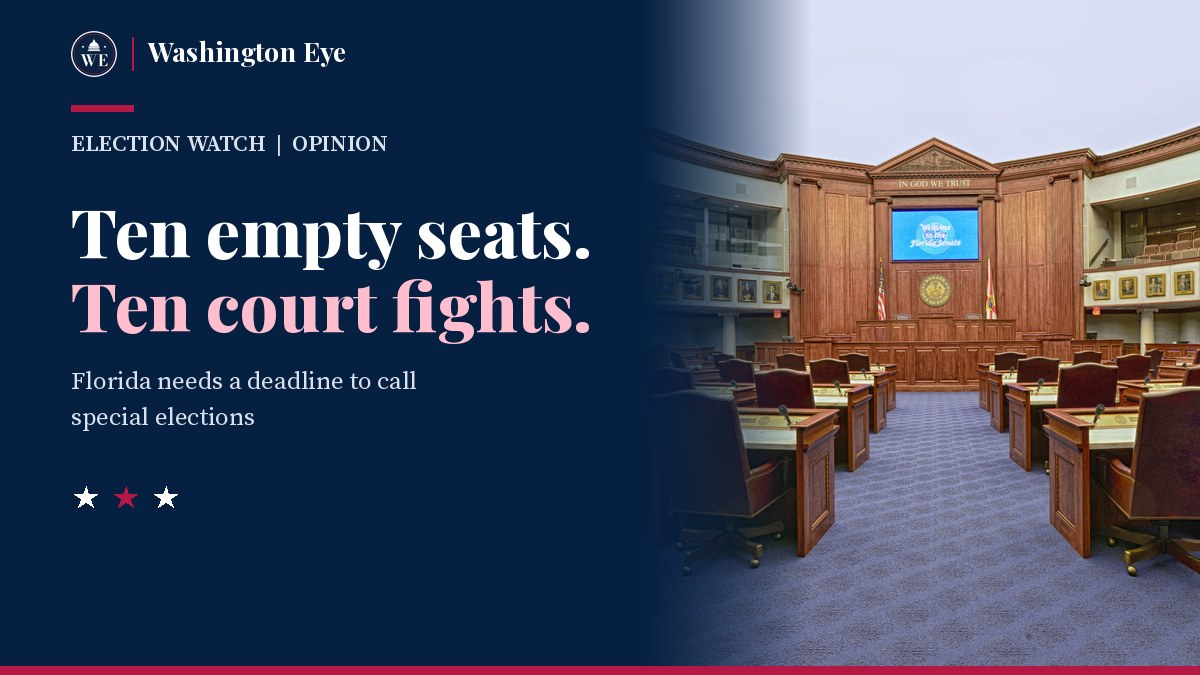
On 25 August, Bryan Ávila resigned from the Florida Senate, effective immediately, to run for lieutenant governor on Byron Donalds's ticket. The two men won on 3 November. Their seat in the state Senate, District 39 in northwest Miami-Dade, has been empty ever since. For almost three months the governor who had the legal duty to schedule an election to fill it did not do so.
Then, on 17 November, a Doral voter named Alejandro Peñuela asked the Florida Supreme Court to order Governor Ron DeSantis to act. Two days later, on 19 November, the governor signed an executive order setting a special primary for 26 January and a special general election for 6 April. The seat had been vacant for 86 days.
That is not a scandal on its own. It is the tenth time it has happened. According to Mr Peñuela's petition, this is the tenth vacancy over which Florida voters have had to go to court to get Governor DeSantis to call an election. We think that pattern should end, and we think Republicans in Tallahassee, not Democrats or the courts, are the ones who should end it.
What half a million people lost
District 39 takes in all or part of Hialeah, Doral, Hialeah Gardens, Medley, Miami Lakes, Miami Springs, Sweetwater and Virginia Gardens. The petition puts its population at about half a million. It is not a swing seat. Republicans make up 44 percent of its registered voters and Democrats 22 percent, according to the most recent county rolls, and Ávila won it in 2024 by nearly 40 points. The two declared candidates, state Representatives David Borrero and Alex Rizo, are both Hialeah Republicans. The governor endorsed Mr Rizo on 11 September.
Look at the calendar the governor finally chose. Interim committee weeks, when bills are shaped before anyone votes on them, begin on 30 November. The bill-filing deadline falls in late February. The regular session opens on 2 March and is scheduled to end on 30 April. Unless one candidate wins outright in the January primary and takes office early, the district will have no senator through the committee weeks, past the filing deadline and for roughly half of the session.
That matters in a concrete way. A senator files bills, fights for local projects in the budget, sits on committees and votes on everything from property insurance to school funding. A district with no senator has none of that. Its residents still pay their taxes. They simply have no one in the room when the money is divided.
The voters of the district understood this. “The Governor’s refusal to call a Special Election denies us our right to representation and ignores decades of precedent,” Mr Peñuela said in a statement released through his lawyers. “That hurts all of us, regardless of party. It’s anti-Republican, goes against our democracy, and is wrong.”
A habit, not an accident
Florida law is short on this point. When a legislative seat falls vacant and a special election is required, section 100.111 of the state statutes says the governor, after consulting the secretary of state, “shall fix” the dates of a special primary and a special election. It does not say within how many days. For most of modern Florida history that gap did not matter, because governors treated the duty as routine.
The numbers in the petition make the point. Between 1999 and 2020 there were 65 congressional and legislative vacancies filled by special election in Florida. On average the governor of the day called the election 7.6 days after the seat opened. In more than 25 cases it took fewer than five days. That period covers the governorships of Jeb Bush, Charlie Crist and Rick Scott, and the first two years of Governor DeSantis himself.
Governor DeSantis broke that habit early. When Congressman Alcee Hastings died in April 2021, he waited 30 days to act, and only after a would-be candidate filed a federal lawsuit. He then set the election for 11 January 2022, more than nine months after the death. Later in 2021, three legislators resigned to run for that congressional seat, and he waited more than 90 days to call elections to replace them, acting only after district residents asked a court for a writ of mandamus and a judge ordered him to explain himself.
The list continued. In 2023 a Miami-Dade House seat, District 118, waited 38 days, again until a court ordered the governor to show cause. In January 2025 voters sued over a Brevard County Senate seat and a Panhandle House seat that had been empty for more than 50 days. In the autumn of 2025 they sued again over a Tampa-area Senate seat and a Palm Beach-area House seat, which got their election orders 73 and 67 days after the vacancies arose. Both of those seats stayed empty through the regular session. According to the petition, across the nine earlier vacancies it cites, the governor took an average of more than 64 days to call the vote.
The worst case of all needed no lawsuit to make the point. House District 113 in Miami-Dade lost its representative in November 2025, when Vicki Lopez left for an appointment to the County Commission. Its voters went nearly a year without a representative, until the regular general election on 3 November this year.
Why conservatives should care most
It would be easy to read all of this as partisan gamesmanship. The trouble with that theory is District 39 itself. This is one of the most Republican seats in South Florida, the heart of the Cuban American conservative vote, and its two candidates are both members of the governor's own party. Whatever drove this delay, it was not a plan to keep a Democrat out of Tallahassee.
That is exactly why conservatives should be the ones to fix it. Our case for limited government has always rested on a simple idea: officials have the powers the law gives them and no more, and the law should be written clearly enough that their personal judgment is not the only thing standing between citizens and their rights. A statute that says “shall” with no deadline invites the very thing conservatives warn about, an executive who treats a duty as a discretion.
Representation is not a favour a governor grants when convenient. The Florida Constitution says the legislature consists of a senate with one senator elected from each senatorial district. The law says the vacancy must be filled by special election. The only open question has been when, and on that question one office holder has been allowed to decide alone, with the courts as the only check.
There is a cost argument too, and it should appeal to anyone who watches public money. The lawyers for Mr Peñuela argue that had the governor acted soon after Ávila resigned, the special primary or general election could have been held alongside municipal elections already scheduled for late November or December. They contend the delay is likely to cost taxpayers more for a standalone vote. Every one of these mandamus actions also consumes the time of state lawyers and judges on a question that should never reach a courtroom.
Nor has there been a public explanation. Shortly after Ávila resigned, the governor's office told a Florida political news site to “stay tuned” and said information on a special election was “coming soon.” Nothing further came until the lawsuit was filed. We could find no public statement from the governor's office giving a reason for the wait.
The fix already exists
The legislature does not need to invent anything. During the 2026 session, Senator Tina Polsky of Boca Raton filed Senate Bill 460. It would have required the governor to fix the dates of a special primary and special election within 14 days of a vacancy. For a legislative seat that opens less than 126 days before the regular session, the governor would have had five days, and both elections would have had to take place before the session began. If the governor missed the deadline, any voter in the district could ask a circuit court to set the dates.
“Delayed elections deny representation,” Senator Polsky told the Senate Ethics and Elections Committee in February. The committee passed her bill 8 to 0. The Judiciary Committee passed it 11 to 0. Then it went to the Rules Committee and died there on 13 March without a vote. Its House companion, filed by Representative Mike Gottlieb, never got a hearing.
Senator Polsky and Representative Gottlieb are Democrats, and both are leaving the legislature. Republicans hold the majorities, the gavels and the governor's mansion. A unanimous committee record suggests there was no principled objection to the bill on either side of the aisle. What it lacked was a sponsor from the majority willing to push it past the last committee.
We would offer that role to the Republicans who represent Hialeah and Doral. Their voters are the ones who have just spent three months without a senator. A Republican sponsor would also make clear that this is a reform about the office, not about one governor. Ron DeSantis leaves office on 5 January. Whatever one thinks of his record, a deadline written into law would bind Governor Donalds and every governor after him, of either party. A good rule should be one you would accept from your opponents.
A first test for the new governor
Governor-elect Donalds has said he wants his tenure to focus on “the people of our state” and on making life more affordable. Backing a simple deadline for special elections would cost him nothing and would tell voters in districts like his running mate's old seat that their representation is not something to be negotiated. His running mate's resignation is what opened this vacancy. It would be fitting for his administration to make sure no district is left in that position again.
The case before the Florida Supreme Court is still listed as open, though the governor's order has given the petitioner most of what he asked for. That should not be the end of it. Ten vacancies taken to court since 2021 is not a functioning system. It is a workaround.
Florida's voters in District 39 will choose a new senator by the spring. The legislature that convenes in March, missing one of its members, can decide whether the next district waits a week or a season. We hope it picks the week, and we hope Republicans lead.