
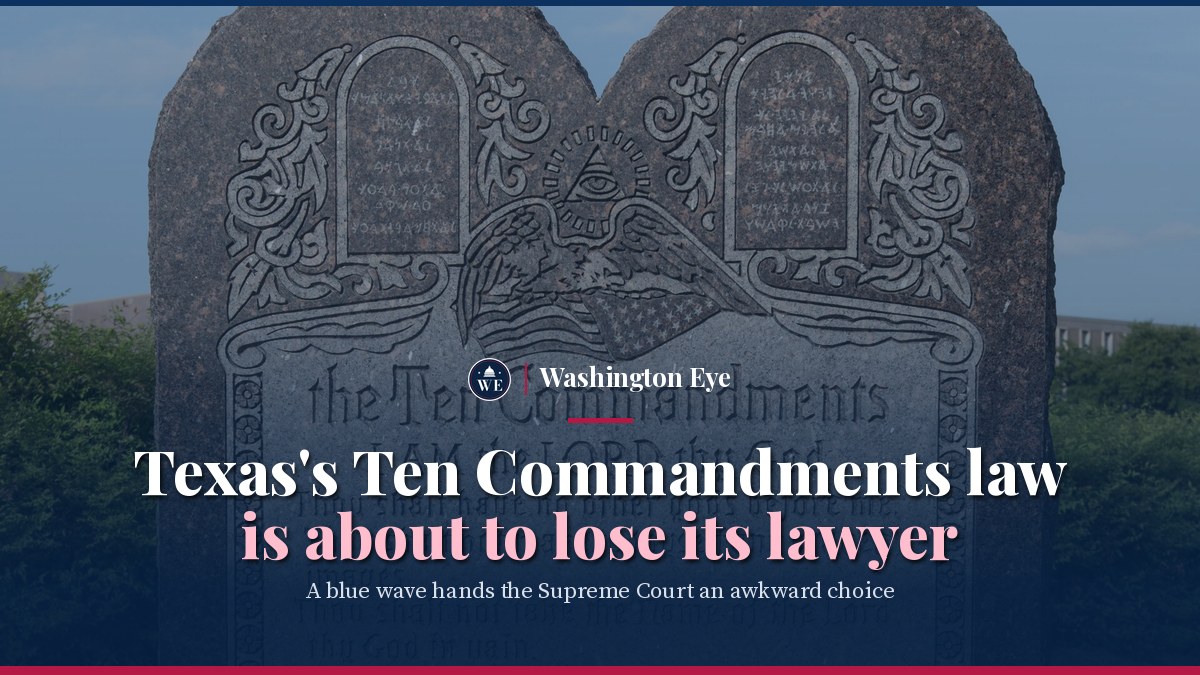
Texas spent two years fighting to hang the Ten Commandments in every public school classroom. Now, with the fight finally knocking on the Supreme Court's door, the state is asking the justices to stay away. The reason is not a change of heart in Austin. It is the midterm election.
In a brief filed on November 10, the office of outgoing Attorney General Ken Paxton told the court that a petition from Texas families challenging the law should be denied, in part because the man taking over the office in January has promised not to defend it. "Among other factors, the recent election in Texas renders this case a particularly poor vehicle," the state's lawyers wrote. It is an unusual argument from a government that won its case in the lower courts, and it turns a long-running culture war into a puzzle about who, exactly, will be standing at the lectern if the justices say yes.
Here is what is at stake, and what could happen next.
What does the Texas law actually require?
The law, known as Senate Bill 10, requires public elementary and secondary schools to post a 16-by-20-inch display of the Ten Commandments in every classroom. The legislature specified the text, which is drawn from a Protestant rendering based on the King James Bible, along with the size and placement of the poster. Displays can be donated or bought by districts. Supporters said the goal was to "restore the history and tradition of the Ten Commandments in our state and our nation" and to remind students of "a fundamental foundation of American and Texas law," language the state repeated in its brief.
A religiously diverse group of families, including Jewish, Christian and nonreligious parents, sued in July 2025. Their petition to the Supreme Court argues that the statute imposes on children, "for nearly every hour they are in school, the state's favored Scripture."
Hasn't the Supreme Court already settled this?
That is the families' core argument. Forty-six years ago this week, on November 17, 1980, the court decided Stone v. Graham, striking down a Kentucky law that required the commandments to be posted in public school classrooms. The justices said the law had "no secular legislative purpose." The Texas petition opens by reminding the court that it "held that permanently posting the Ten Commandments in public-school classrooms violates the Establishment Clause."
But Stone was decided under the test from Lemon v. Kurtzman, which asked whether a law had a secular purpose, advanced or inhibited religion, or entangled government with faith. In 2022, in Kennedy v. Bremerton School District, a 6-3 majority set Lemon aside and told lower courts to read the Establishment Clause in light of historical practice and understanding. Texas argues that this effectively hollowed out Stone. The families say a precedent stands until the justices themselves overrule it.
The families also lean on a newer case. In Mahmoud v. Taylor in 2025, the court sided with religious parents who wanted to pull their children out of lessons using storybooks that conflicted with their faith. The Texas families argue that if parents have a free exercise right to shield children from such books, they also have one against a permanent religious text on the classroom wall.
How did the case reach the justices?
A federal district judge blocked the law in August 2025, finding it likely violated both religion clauses. In April 2026, the full Fifth Circuit Court of Appeals reversed that ruling by a vote of 9 to 7. The majority held that Stone and Lemon no longer govern and that the right question is whether a law bears the hallmarks of a founding-era religious establishment, such as compelled worship, religious taxes or state control of church doctrine. A poster, it concluded, has none of those features.
The majority wrote that the law "authorizes no religious instruction and gives teachers no license to contradict children's religious beliefs (or their parents')" and that no student is "made to recite the Commandments, believe them, or affirm their divine origin." The seven dissenting judges answered that Stone controls until the high court says otherwise, and that the commandments "are plainly religious" and by their nature "plainly instructive." The families filed their petition in August.
Why is Texas now asking the court not to hear it?
The state's main arguments are conventional. There is no split among the federal appeals courts, it says, so there is nothing to resolve. The issue should "percolate" in other circuits first. And the challenge is a facial one, brought largely before any poster went up, rather than a challenge to a specific display in a specific classroom. If the justices want to revisit the question, Texas says, they should wait for a better case. It also concedes that further guidance on what counts as an establishment of religion "may be warranted in the future."
Then comes the political twist. Texas voted for Democrats up and down the ballot in this month's midterms, and among the winners was Nathan Johnson, a Dallas state senator who will become attorney general in January 2027. During the campaign, Johnson said in a television interview that he would not defend the law. "I will not defend the legislature's passage of a requirement that schools place the Ten Commandments in classrooms because it's unconstitutional," he said. Asked whether the state would then need to hire private lawyers, he replied: "Yes. If they want to defend unconstitutional laws."
Paxton's office quoted that pledge back to the justices, warning that a grant of review could leave the court deciding "significant Establishment Clause and Free Exercise Clause issues without the benefit of 'an adversary presentation' from those responsible for the state's enforcement of the law."
Is a missing defender really a problem for the court?
It can be, but it is rarely fatal. The Supreme Court decides cases, not abstract questions, and it relies on two sides arguing hard against each other. When a government drops its defense of a law, the justices have a familiar tool: they can appoint an outside lawyer to argue the abandoned side. That has happened before, and nothing would stop the court from doing it here. Supporters of the law, including outside groups that have already filed friend-of-the-court briefs, would also be eager to help.
Still, the timing creates an awkward picture. If the court took the case this winter, the state's legal position could flip in the middle of the litigation, with one administration having asked to overrule Stone and the next telling the justices the law is unconstitutional. Louisiana, which has its own petitions pending, has already pointed to the problem, writing that the incoming Texas attorney general "appears poised to abandon Texas's defense" of the law and that this creates "intractable vehicle problems."
What about Louisiana and the other states?
Louisiana passed its law, House Bill 71, in 2024. It goes further than Texas by covering public colleges and universities as well as schools. The full Fifth Circuit vacated an injunction against it in February 2026, finding the challenge premature because no one yet knew what the displays would look like. A Louisiana teacher, Chris Dier, has a separate petition before the justices. The state has filed a conditional petition of its own, asking the court to deny review in every case but, if it does take the Texas case, to hear Louisiana's alongside it.
Arkansas is moving on a different track. A federal judge, Timothy Brooks, ruled in March that its 2025 law, Act 573, violates both religion clauses, relying on Stone, and permanently barred six school districts from complying. A three-judge panel of the Eighth Circuit heard the state's appeal on September 22 and has not ruled. At that hearing, the state's solicitor general, Autumn Hamit Patterson, argued: "There's no requirement for teachers, school officials or students to interact with, bring attention to or even acknowledge the posters in any way." A lawyer for the families, Jonathan Youngwood, replied: "This is instruction. These are, after all, commandments, and they are directly religious."
Texas told the court that nine other states have enacted comparable laws, including Tennessee and Alabama. If the Eighth Circuit rules against Arkansas, the circuit split that Texas says is missing could appear, and with it a much stronger case for the justices to step in.
Who else is urging the court to wait?
Not only the state. A group of religious liberty scholars, led by Professor Stephanie Barclay, filed a brief agreeing with the Fifth Circuit on the merits but stressing timing. Their argument is that the court only retired Lemon a few years ago and that lower courts have barely begun the work of applying the new historical test. They warn that the families' proposed approach would amount to Lemon "in all but name." One commentator sympathetic to that view put it simply: the court "should weigh those, not election returns."
On the other side, the families argue that waiting has a cost. Posters are already going up in classrooms across Texas, and children of every faith and none sit in front of them for most of the school day.
Isn't there already a Ten Commandments monument at the Texas Capitol?
There is, and it is a reminder of how fine the court's lines have been. In Van Orden v. Perry in 2005, the justices upheld, by a 5-4 vote, a granite monument of the commandments on the grounds of the Texas State Capitol in Austin. That case involved a single monument among many in a public park, not a mandatory display in front of schoolchildren, which is why Stone survived it. The question now is whether today's court still sees that difference as decisive.
What happens next?
The families can file a final reply brief, after which the justices will consider the petitions at one of their private conferences. It takes four votes to grant review. The court is on no deadline and can take up the Texas case, the Louisiana cases, both or neither. It could also simply wait for the Eighth Circuit.
What to watch: whether the court acts before Johnson is sworn in, which would let Texas's current lawyers shape the opening briefs; whether it names an outside lawyer to defend the law if it grants review; and whether the Arkansas ruling arrives first. For a court that has spent the past several years reshaping the law of religion in public life, a case about a poster may turn out to be the cleanest test yet of how far that project goes.