
On Tuesday, November 3, Texas voters removed James Sullivan from the state's Supreme Court. He had been appointed to the bench by Governor Greg Abbott in January 2025, and in his first campaign for the seat he lost to Chari Kelly, a Democratic appellate judge from Austin, as Democrats swept every statewide office on the ballot. The following day, according to the top Democrat on the Senate Judiciary Committee, the Trump administration delivered Sullivan's completed questionnaire for a lifetime appointment to the federal district court in western Texas.
That sequence is the clearest picture yet of what Senate Republicans intend to do with the last weeks of their majority. Having lost the chamber in the midterm elections, they plan to confirm as many of President Donald Trump's judicial nominees as they can before Democrats take control on January 3. Aides estimate the pipeline at up to 25 nominees, four for appeals courts and 21 for district courts, and Majority Leader John Thune has made the goal plain. "We're going to make the most of the time that we've got," he said.
There is nothing unconstitutional about a lame-duck Senate confirming judges. The president nominates, the sitting Senate consents, and the Senate that sits until January is a Republican one. The problem is not the calendar. It is what Republicans are prepared to skip in order to beat it, and the fact that the people who will carry these robes for decades are being waved through by a majority the voters have just dismissed. Democrats cannot stop the sprint. They can, and should, make it slow, public and costly.
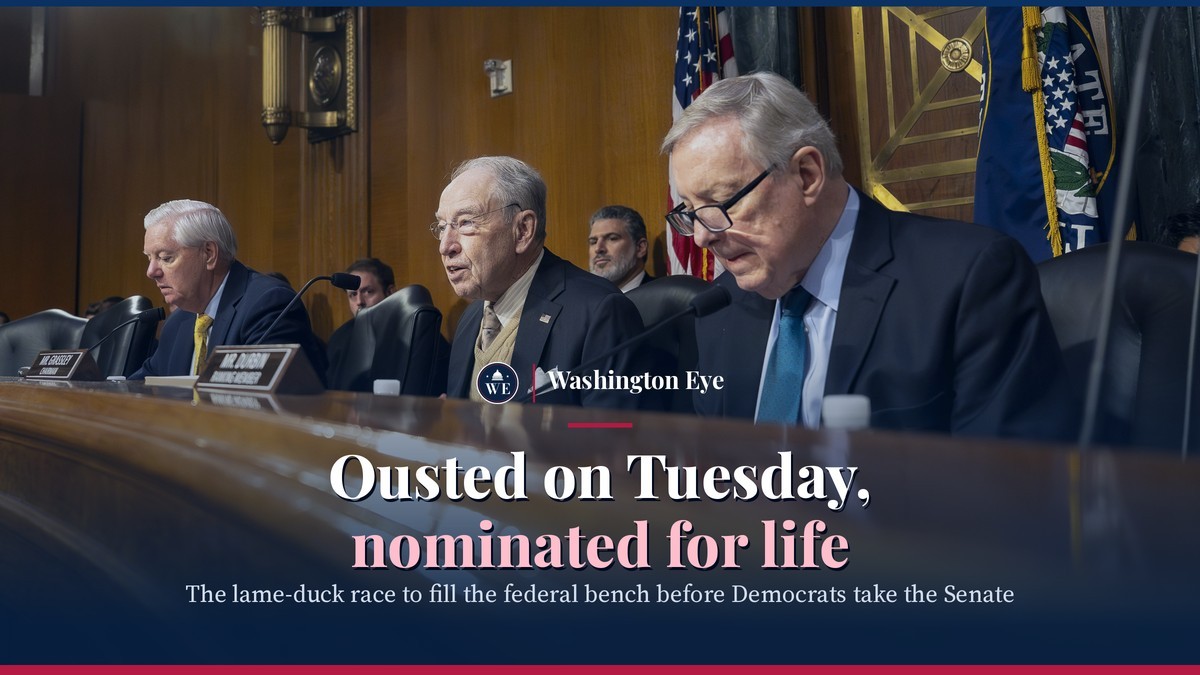
The machinery started moving on Tuesday. The Judiciary Committee sent four district court nominees to the floor: Daniel Ballou for the Eastern District of Kentucky, Richard Bennett for the Southern District of Texas and Courtney Coker for the Northern District of Texas, each on a 12 to 10 party-line vote, and Kyle Reardon for the District of Alaska, who cleared the panel 16 to 6 with four Democrats in support. The same day the committee held a hearing for four more nominees, among them Todd Butler, the president's pick for the Fifth Circuit Court of Appeals. Another hearing is set for November 18, a week later.
That second date is itself a break with practice. The committee has customarily held nominations hearings no closer than two weeks apart, and it has required that a nominee's paperwork sit with senators for 28 days before a hearing, so that members and their staff can actually read it. Senator Dick Durbin of Illinois, the committee's ranking Democrat, laid out the list of shortcuts in his opening statement: back-to-back weekly hearings, two nominees whose questionnaires arrived 10 and 14 days before their hearing, nominees called before staff had cleared their FBI background investigations, and as many as seven nominees packed into a single session.
"Why?" Durbin asked. "Because the Republicans are losing the majority and they're afraid that unqualified MAGA loyalists won't withstand close scrutiny when Democrats are in the majority." He ended with a warning to the chairman, Senator Chuck Grassley of Iowa: "When you have to live with it under a new Chairman, I'm sorry to tell you, but you asked for it."
Grassley does not hide what he is doing. "I'm working hard to get judges confirmed quickly during this lame duck session while we still have time," he said on Tuesday. He used his own opening remarks to attack the American Bar Association, which has rated several pending nominees with a split "Not Qualified" finding, calling its ratings "illogical, inconsistent and plainly tainted by political bias." He noted that the Senate has confirmed nearly 60 lifetime federal judges in this Congress, and said he wanted the committee to "get to work confirming more."
The Texas seats show why the rush matters. On January 3, James Talarico, the Democrat elected to the Senate from Texas last week, will be sworn in. Under the Senate's blue slip tradition, home-state senators can effectively hold up district court nominees they do not support. Durbin argued that two Texas nominees slated for next week's hearing, Sullivan and Elliot Gaiser, are being moved precisely to get around that. Gaiser's own questionnaire, Durbin said, records that Senator Ted Cruz's office contacted him about the nomination the day after the election. "Under the Committee's precedents, these two nominees can't be confirmed before the end of this Congress," Durbin said. "So, Republicans are breaking the rules."
Republicans answer that an election is not a verdict on a lawyer. Senator John Cornyn of Texas, who leaves the Senate in January, wrote online that "an election result does not diminish a record of ability and integrity," pointing out that Sullivan had been approved by the screening committee he and Cruz assembled. "He should be confirmed," Cornyn said. The president called Sullivan "an incredible jurist and lawyer." His résumé is conventional for a conservative judicial nominee: a Harvard law degree, a federal appellate clerkship, and a series of posts under Abbott, rising to the governor's general counsel.
Fair enough as far as it goes. But that is exactly the kind of record a committee should have time to examine, and a nominee whose paperwork appears the morning after his defeat, and whose hearing comes two weeks after it reaches the Senate, is not getting that time. The point of the 28-day rule, honoured by chairs of both parties until now, is to let the minority do its job. Waiving it because the majority is about to become the minority turns a courtesy into a weapon.
The appeals court seats tell a similar story about how carefully the timing has been managed. Judge Leslie Southwick of the Fifth Circuit announced on September 28 that he would take senior status, effective on December 31 or on the confirmation of his successor, whichever comes first. Three days later the White House named Butler, a Mississippi lawyer and former Southwick clerk. Butler's questionnaire shows the conversation began months before the public announcement: Senator Roger Wicker of Mississippi reached out to him in June about a "potential" vacancy, and he interviewed at the White House in July. A progressive legal commentary site called that turnaround unprecedented; a former counsel to Senator Mitch McConnell called the pick the "smart play" given that Republicans looked likely to lose the Senate.
Not every Republican is marching in step, and that is where the real constraint lies. On Tuesday the White House withdrew Judge Lee Rudofsky's nomination to the Eighth Circuit and named Arkansas Supreme Court Justice Cody Hiland instead, after the state's two Republican senators, John Boozman and Tom Cotton, reportedly preferred Hiland. Asked by a reporter whether he had worked with colleagues to block the president's choice, Boozman replied, "Would that be wrong?" Rudofsky bowed out graciously, saying that "without the support of my home-state Senators, confirmation is simply not a practical possibility in today's Senate."
The same day, Senator Alan Armstrong of Oklahoma, a short-term appointee who leaves when Representative Kevin Hern takes the seat on November 30, reversed course and came out against Zach West, the nominee for the Eastern District of Oklahoma. Senator Thom Tillis of North Carolina, another departing member of the Judiciary Committee, said the White House had stumbled in vetting West. "They just need to sort it out or get somebody else," he said.
Those episodes undercut the case for speed. If Republican senators themselves are discovering vetting problems in the middle of the sprint, the argument for dropping the committee's vetting rules collapses. The Senate is not short of nominees who need a closer look. It is short of time, and the shortage is self-inflicted.
Time is the currency here. By one count the Senate was scheduled to sit for only about 30 days in the whole lame-duck session: November 9 and 10, the week of November 16, then three weeks from November 30 to December 18. Into that window Republicans must also fit a government funding bill before the December 11 deadline, any last reconciliation push and a defence bill. Only three judicial nominees, Daniel Domenico for the Tenth Circuit, Anna St. John for the Fifth Circuit and Greg Cook for the Northern District of Alabama, were on the floor and ready for votes when the session opened. Most of the rest still need committee votes, and ten still need hearings.
That is where Democrats have leverage. With full Republican attendance they cannot defeat a nominee on the floor. But Senate procedure runs on unanimous consent, and every nominee whose consent is denied must clear a cloture vote and then wait out debate time before confirmation. Democrats can insist on recorded votes at every step, refuse to bundle nominees, and force the majority to choose, night after night, between judges and the funding bill. Several Republican senators are heading for the exits, and keeping all of them in Washington through mid-December is not a given.
Some on the right will call that obstruction, and Democrats should be honest that their own side confirmed judges in the lame duck after the 2024 election, when Republicans had won the Senate. The difference is in degree and method. Using the last weeks of a majority is ordinary politics. Rewriting the committee's own vetting rules on the way out, so that a judge defeated by Texas voters can be seated before the senator those voters just elected arrives to review him, is something else.
The better path is not complicated. Grassley could restore the 28-day rule and the two-week spacing for the nominees who have not yet had hearings, and let the chips fall. Republicans who have spoken up about vetting, Tillis and Cornyn among them, could make that a condition of their votes. Democrats, for their part, should resist any end-of-year package that trades away scrutiny of the most contested nominees in exchange for an early flight home. In past lame ducks, the party in the minority has been tempted by exactly that kind of deal.
Judges confirmed in the next five weeks could still be on the bench in the 2050s. Voters had their say about who should run the Senate on November 3. The least the outgoing majority owes them is the ordinary scrutiny it has always demanded for itself, and the least Democrats owe them is to insist on it, one recorded vote at a time.