
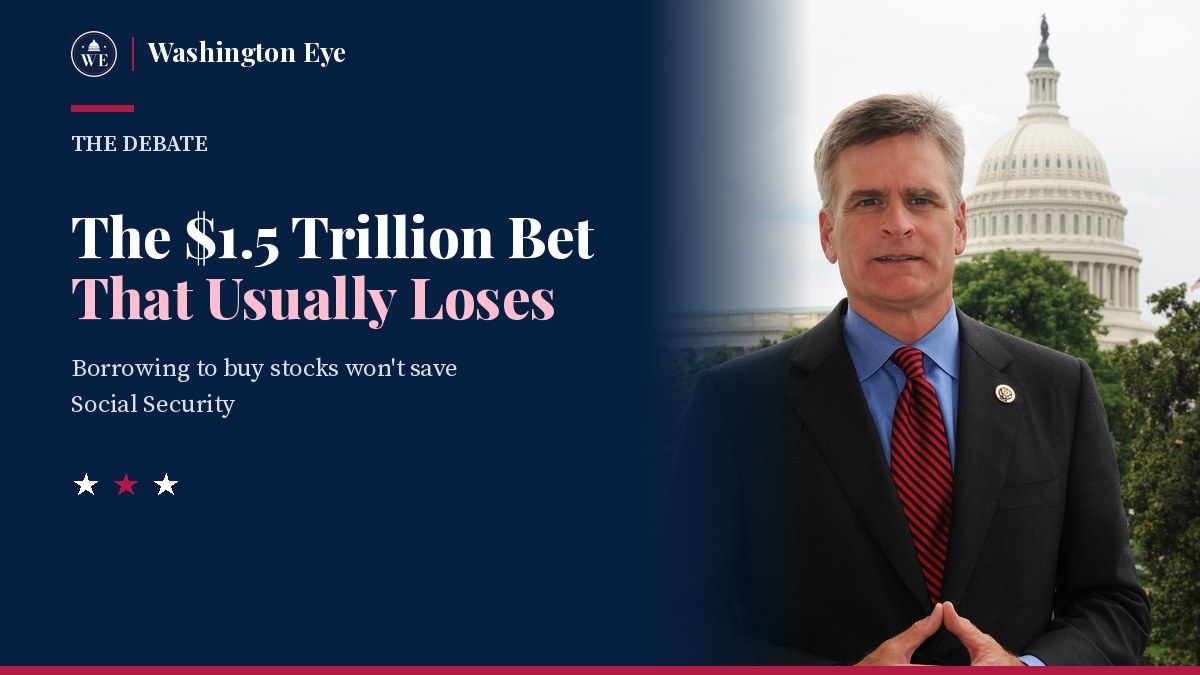
There is a particular kind of Washington idea that arrives in the final weeks of a Congress, when the majority is packing its boxes and nobody has to defend anything at the next election. It is large, it is clever, it promises that nobody will have to give anything up, and it is usually a mistake. Senator Bill Cassidy's plan to rescue Social Security by borrowing $1.5 trillion and putting it into the stock market fits the description perfectly.
Mr Cassidy, the Louisiana Republican who is leaving the Senate in January, deserves credit for one thing. He has spent years warning that the retirement program is running out of road, and he is right. His answer, drafted with Virginia Democrat Tim Kaine and blessed by President Donald Trump, is the wrong one. Conservatives should say so before it becomes the party's official position on the most important fiscal question of the next decade.
The clock is real
Start with the numbers that nobody disputes. The 2026 report of Social Security's own trustees projects that the trust fund that pays retirement and survivor benefits will run dry in the fourth quarter of 2032. At that point, under current law, incoming payroll taxes will cover only 78 per cent of scheduled benefits. Every retiree would face an automatic cut of about 22 per cent, and the share that can be paid keeps falling, to 62 per cent by 2100.
The trustees also spell out what it would take to close the gap. Raising the payroll tax from 12.4 per cent of wages to 16.65 per cent this year would do it. So would cutting benefits for everyone by 25.2 per cent. Wait until 2034 and the medicine gets stronger: a tax rate of 17.3 per cent, or cuts of 28.5 per cent. Mr Cassidy put it plainly. "We're probably now only five years away from insolvency and the longer you wait the deeper the benefit cuts are and the higher the taxes are required to compensate," he said in an interview.
Nobody in Washington likes either of those options. That is exactly why a third option, one that appears to cost nobody anything, has proved so seductive.
What the plan actually does
The proposal would create a new fund, entirely separate from the existing trust funds. The Treasury would borrow about $1.5 trillion and hand it to that fund, which would invest it in stocks, bonds and other assets, in Mr Cassidy's words "the way that your 401k is invested." The money would sit in escrow for 75 years. Over that time, the theory goes, market returns would grow the pot large enough to offset the borrowing needed to keep paying full benefits. Mr Cassidy has estimated that after 65 to 70 years the fund could cover 60 to 65 per cent of the program's unfunded liability. "All risk is borne by the fund; people would get their promised benefits," he has said.
Mr Cassidy says he spoke to the president after the 3 November midterms and that Mr Trump was "all on board." Treasury Secretary Scott Bessent's staff is providing technical help on the legislation. With the backing of the White House, a retiring Republican and a Democratic co sponsor, the plan has the look of a bipartisan breakthrough. It is not.
Borrowing to gamble is not saving
The core of the idea is an old trick. The government borrows at the Treasury rate, invests in stocks, and pockets the difference because stocks have historically returned more than bonds. If that worked, every family could get rich by taking out a second mortgage and buying an index fund. The reason it does not work is risk. Stocks pay more than Treasury bonds because they can fall, sometimes for a very long time. Once you adjust the expected return for that risk, the free money disappears.
Marc Goldwein of the Committee for a Responsible Federal Budget, hardly a partisan outfit, called the plan "a terrible idea" and "a phony arbitrage game." He added: "It's not creating new wealth." Researchers at Boston College's Center for Retirement Research reportedly ran 10,000 simulations of the fund. Under optimistic return assumptions, it failed to repay its own borrowing 64 per cent of the time. Under assumptions they considered more realistic, it failed 83 per cent of the time. Alicia Munnell, a senior adviser at the centre, has pointed out the obvious catch: the plan requires borrowing for the fund on top of all the borrowing needed to keep paying benefits in the meantime.
In other words, the taxpayer would carry a new $1.5 trillion debt for three quarters of a century, pay interest on it every year, and hope that the market delivers. If it does not, the bill lands on our grandchildren, who will already be paying for the shortfall that the plan was meant to fix.
The railroad comparison does not hold
Mr Cassidy's favourite defence is history. In 2001, Congress allowed the railroad retirement system to move its reserves into an independently managed investment trust. The fund has done well, and the senator likes to note that Democrats voted for it. But the railroad system invested money it already had. It did not borrow a sum larger than the annual budget of most countries in order to place a bet. A pension fund that invests its own reserves is prudent. A government that borrows to buy equities is speculating with its credit card.
The comparison to corporate pensions is weaker still. Private pension funds are required to set aside real money against real obligations, and when their bets go wrong, the companies that sponsor them must make up the shortfall or hand the problem to a federal insurer. That discipline is precisely what this plan lacks.
Washington should not own the market
There is a second, deeper reason for conservatives to be wary. A $1.5 trillion fund, growing for 75 years, would make the federal government one of the largest owners of American companies. Its backers promise strict guardrails, independent managers and annual audits. Every such promise is only as good as the next Congress.
And the next Congress belongs to the other party. Democrats take control in January with large majorities, and a rising progressive wing that would love nothing more than a giant pool of federal capital to steer towards favoured industries and away from disfavoured ones. Washington has already taken equity stakes in private companies, Intel among them, and the habit of the state picking corporate winners has grown faster than many on the right expected. A permanent sovereign wealth fund wearing a Social Security badge would turn that habit into an institution. Republicans would be building the machine and handing the keys to their opponents.
The real problem is the benefit formula
What the plan avoids is the one conversation that a serious fix requires. Social Security's benefits are on automatic pilot. Initial benefits are tied to wage growth, which means the retirees of the 2050s are scheduled to receive bigger checks, in real terms, than the retirees of the 2030s. Couples with high lifetime earnings can already collect around $100,000 a year. The program's costs have exceeded its payroll tax income for about 16 years, and the trust fund has been covering the difference.
Republicans are not offering an alternative. Senator Ron Johnson of Wisconsin has called the program a Ponzi scheme, yet has also put forward legislation that would avert the coming cut with more borrowing. Nobody in the party's leadership is willing to say that the highest earners should see their future benefits grow a little more slowly, or that the retirement age should rise gradually as Americans live longer. Those ideas are not radical. The 1983 rescue signed by Ronald Reagan, with a Democratic House, already raised the retirement age, and slower benefit growth for higher earners was proposed by George W. Bush and by bipartisan commissions since. Done well, both protect the people who depend on the program most.
A conservative plan would look something like this. Guarantee today's retirees and those close to retirement exactly what they were promised. Protect low earners in full. Slow the growth of benefits for the most affluent future retirees. Link the retirement age to life expectancy, phased in over decades so that nobody is surprised. And give younger workers the option of personal accounts that they own and control, so that any market returns belong to them rather than to a federal fund run by whoever wins the next election.
Better nothing than this
Senator Thom Tillis, a supporter of the concept, admitted the obvious when asked about its chances in the remaining weeks of the session. "I don't know how you take this big of a plane and get it in the air," he said. He is right, and Republicans should be relieved. Passing nothing this year is better than locking in a $1.5 trillion bet that, by the best available estimates, usually loses.
The trust fund will not wait for anyone. When the new Congress meets, Democrats will own the issue, and they will be tempted to fix it with tax increases alone. Republicans can either meet them with an honest plan that restrains benefit growth for those who can afford it, or they can keep pointing at a casino chip and calling it reform. The first choice is harder. It is also the only one that treats younger Americans, who will pay for all of this, as if they matter.