
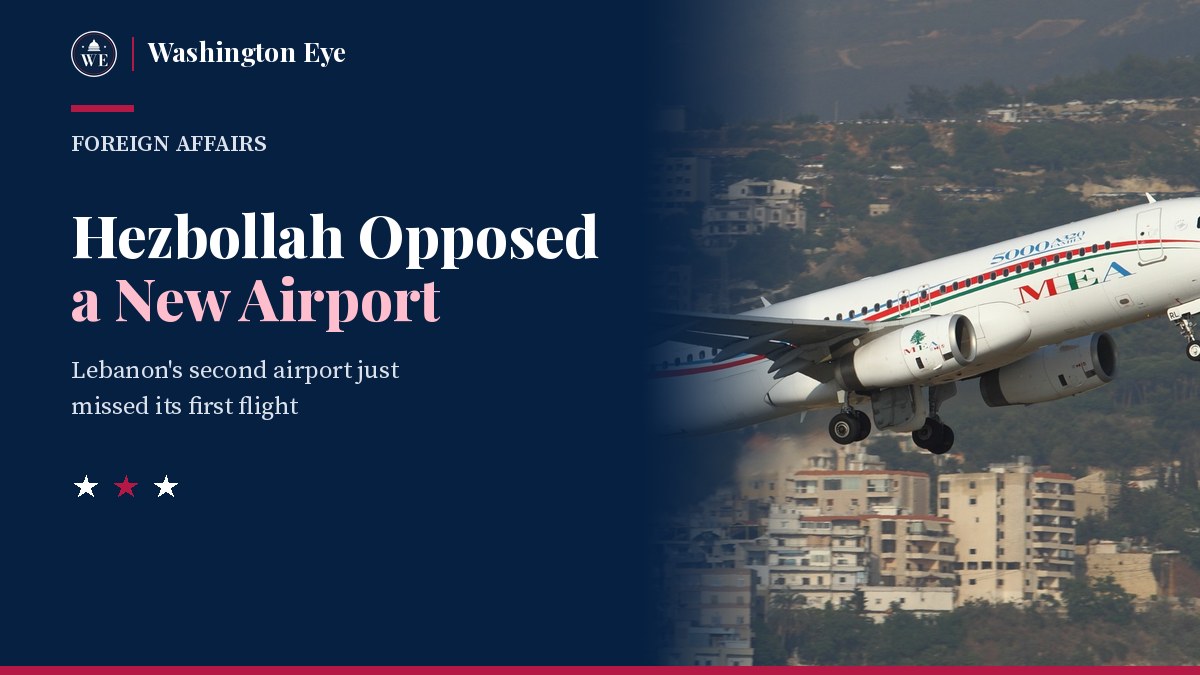
Lebanon had picked the date with care. On November 22, the country's Independence Day and the anniversary of the assassination of the president whose name the new airport carries, a first trial flight was meant to lift off from a long disused military runway in the far north and head for Cairo. It would have been a picture worth a thousand speeches: a state that has spent years watching others decide who flies in and out of the country, finally opening a second door of its own.
The plane did not take off. Instead, the Ministry of Public Works and Transport and the civil aviation authority issued a joint statement saying that technical calibration had begun at President René Mouawad Airport in Kleiat, in the Akkar region. Engineers were checking the lights that guide pilots down the approach slope, the approach and landing procedures and the management of air traffic around the field. Inspection flights, the statement said, would follow once engineering work on the runway was finished and every safety requirement had been met. A Lebanese newspaper reported that the planned flight to Cairo had been quietly shelved after consultants supervising the works and an aviation expert told Prime Minister Nawaf Salam that the airport was not ready.
Three days later, officials were still telling a wire service that the airport would open next month. So what is this airport, why did it take decades, and why does a 113,000 passenger project in one of Lebanon's poorest corners say so much about who now holds power in Beirut? Here is what you need to know.
Kleiat sits on the Mediterranean coast about 20 kilometres from the border crossing into Syria. For decades it served as an air base. Politicians from the north have argued for years that turning it into a civilian airport would bring jobs and money to Akkar, a predominantly Sunni Muslim region of more than 300,000 people that is widely seen as the poorest in the country. The airport is named after René Mouawad, who was elected president in 1989 and assassinated shortly afterwards.
Today Lebanon has a single commercial airport, Rafic Hariri International, which sits in the southern suburbs of Beirut. Those suburbs were heavily bombarded by Israel during the recent wars, and travel through the airport has been disrupted repeatedly. The national carrier is by far the main operator, and members of the Lebanese diaspora have long complained that its fares are painfully expensive.
The economic case for a second airport is simple to state. The government awarded a four year build, operate and transfer concession in May to Sky Lounge Services, part of businessman Ziad Monla's MG Holding group. Work officially began in June, when Mr Salam and a delegation flew in from Beirut on a special flight. Mr Monla, who comes from the northern city of Tripoli, has said his company is investing its own money, between $10 million and $15 million on construction by his account, and expects to earn it back through ground handling, refuelling, catering, duty free sales, parking and other services before the concession ends. The transport minister, Fayez Rasamny, has put the private investment at $5 million to $6 million and said the state would upgrade roads in the region. He called the airport "a national economic need".
The state's share comes in two streams: landing fees and passenger taxes paid directly to the government, plus 10% of the operator's gross revenue. Mr Monla has said he hopes the government can earn up to $20 million over the four years. The operator is aiming for 113,000 passengers in the first year and up to 600,000 by the fourth, with a cargo village planned for a second phase. "The north has been forgotten for 30 or 40 years," he said this week.
A local carrier, Mada Airways, has announced a preliminary schedule of seven weekly return flights: two to Cairo's Sphinx International Airport, three to Istanbul and two to Queen Alia International Airport in Amman. The airline has said bookings would open on December 1, subject to approval from Lebanon's civil aviation authority. Mr Monla says several larger regional carriers, including Turkish Airlines and Air Arabia, have made contact. He also hopes to draw passengers from Syria's coast, for whom northern Lebanon is far closer than Damascus.
If the economics are this straightforward, why did it take so long? This is where the story stops being about runways. A former lawmaker from Akkar, Hadi Hobeich, has said that when he and other northern MPs tried to move the project forward in 2022, every party signed on except one: Hezbollah, the armed Shia Muslim movement backed by Iran that for years held a decisive say over the Lebanese government. According to Mr Hobeich, the group raised questions about who would be responsible for security at the airport and showed "intense hostility" to the idea. Hezbollah's media office did not respond to a request for comment.
A senior politician close to Hezbollah has said that Bashar al-Assad, then Syria's ruler and the group's ally, also opposed the airport, fearing it could fall under a hostile security force. A civilian airport a short drive from the Syrian border, in a Sunni region outside Hezbollah's traditional zone of influence, was never going to look neutral to either of them.
There is a reason airports matter so much in Lebanese politics. In February 2025, after the Lebanese government barred two Iranian planes from landing in Beirut following Israeli claims that Iran was using civilian flights to smuggle cash to Hezbollah, crowds of the group's supporters blocked the road to Rafic Hariri International for days. On the second night, a United Nations peacekeeping convoy heading to the airport was attacked and one of its vehicles was set on fire, injuring the force's outgoing deputy commander. The UN Secretary-General condemned the attack, and Lebanon's president, Joseph Aoun, said those responsible would be punished. The episode showed how a single road into a single airport could become a pressure point for whoever controlled the streets around it.
A second airport in the north would not end that leverage. It is small, and nobody expects it to replace Beirut. But it would give the state an alternative if the capital's airport were closed by war, protest or politics, and that alternative would sit in territory where Hezbollah has little sway.
What changed? In short, almost everything. Since 2024, Israel has fought two wars against Hezbollah in under two years and badly degraded the group. Mr Assad, the group's ally, was ousted in Syria. In early 2025, Lebanon got a new president and a new prime minister. Mr Salam has made the disarmament of Hezbollah a stated aim of his government, and opening Kleiat was on his agenda from the start. "When the country's political conditions changed, we were able to open this airport," Mr Hobeich said.
Seen from that angle, the airport is a quiet test of whether the Lebanese state can deliver something tangible, on its own terms, in a place the old order neglected. That is why the missed Independence Day flight stings. In October, November 15 had been floated for a first commercial flight; the government then set December 14, timed for the winter holidays when many Lebanese abroad fly home. Mr Salam said the airport would "open new prospects for economic and tourism development". Each slipped date hands critics an easy line: that the new leadership is better at announcing than at building.
The newspaper account of the delay suggests something more reassuring, though. It reported that Mr Salam was persuaded to wait by Jalal Haidar, a Lebanese American who has held senior roles at the International Civil Aviation Organization and once ran operations at Chicago's O'Hare International Airport, and by the engineering consultancy overseeing the works, which insisted the runway rehabilitation be completed first. Rushing a ceremonial flight off an unfinished runway to meet a symbolic date would have been the old Lebanese way. Waiting until the airport meets international standards, set out in the aviation organisation's rules on aerodrome design, is a better sign for a state trying to prove it can be trusted with public assets.
So what should readers watch next? First, whether the inspection flights take place in the coming weeks, because without them there is no licence for regular service. Second, whether December 14 holds or slips again; the ministry's November 22 statement notably did not repeat the date. Third, whether bookings genuinely open on December 1 as the local airline has promised. Fourth, whether a larger foreign carrier commits, which would be the clearest sign that the market believes in the project. And finally, whether Hezbollah, which has not commented, chooses to make security at the airport a political issue again.
Why should anyone outside Lebanon care about a small regional airport? Because Lebanon is where some of the biggest questions in the Middle East meet: whether Iran's network of allied militias is in lasting retreat, whether post-Assad Syria can be stitched back into its neighbourhood, and whether fragile Arab states can rebuild institutions after years of war and financial collapse. Governments and investors weighing whether to back Lebanon's recovery will be looking for exactly this kind of proof.
A runway in Akkar will not settle any of those questions. But for the first time in a generation, a project Hezbollah opposed is going ahead anyway, and the main thing holding it back is no longer a militia. It is the ordinary, unglamorous work of meeting safety rules. In Lebanon, that counts as progress.