
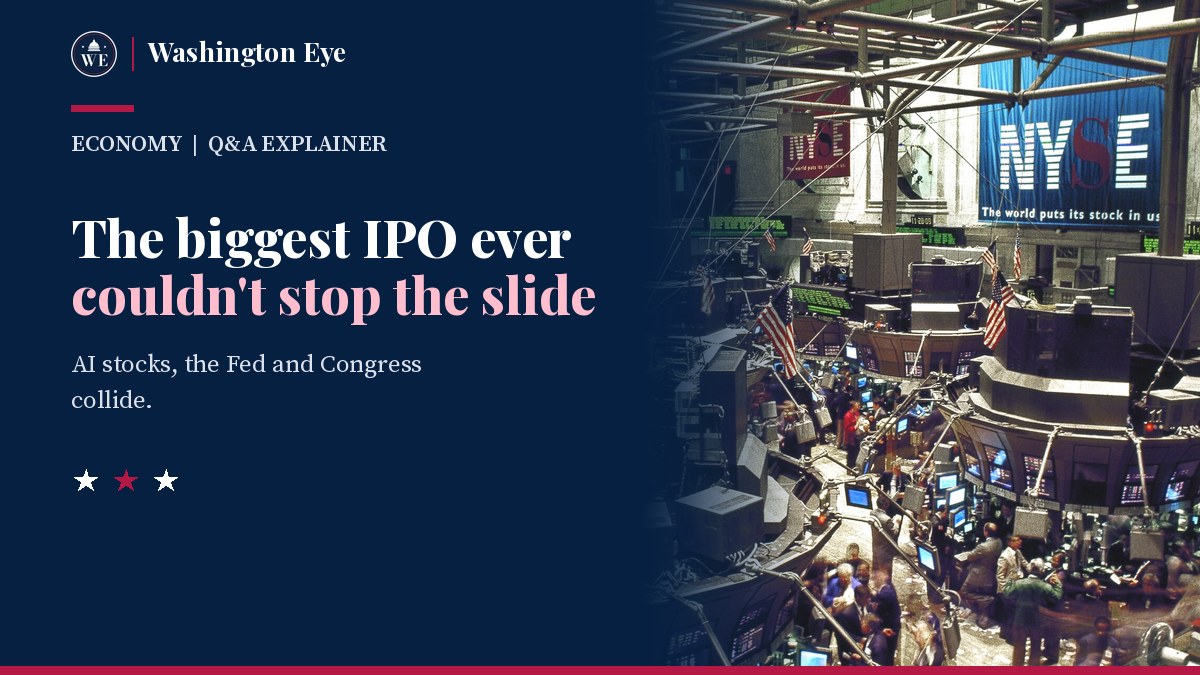
For about ten minutes on Thursday, it looked like the moment the artificial intelligence trade had been waiting for. Anthropic, the company behind the Claude chatbot, opened on the Nasdaq at $111.50 a share, 34% above the price it had set the night before. Then the floor gave way. By the closing bell the Dow Jones Industrial Average had lost 1,101.11 points, the S&P 500 had fallen for a sixth straight session and more than nine in ten of the companies in that index had ended the day lower.
The timing was not a coincidence, traders said, and the reasons reach well beyond one stock listing. A founder has walked out of the world's most important chip company in a spy scandal, the Federal Reserve is preparing to raise interest rates, the 10-year Treasury yield sits above 5% and a Congress about to change hands is lining up hearings on how American chips reached China. Here is what happened, why it matters and what Washington has to do with it.
What exactly happened on Thursday?
The three main indexes all closed down more than 2%. The S&P 500 shed 2.02% to 7,175.83, its longest losing streak in two and a half years, and it now stands 8.2% below the record it set last month. The Dow fell 2.19% to 49,097.06, its first close below 50,000 since June. The tech-heavy Nasdaq Composite dropped 2.25% to 23,879.20 after rising as much as 2% earlier in the day.
The reversal was sharpest in the names most tied to the AI buildout. Micron Technology, the memory maker, swung from a 7.8% gain to a loss of about 2%. CoreWeave, which rents out AI chips through the cloud, went from up 10.5% to down about 6%. Nvidia erased an early gain of 4.7% and closed lower. Advanced Micro Devices lost nearly 8% after an investment firm disclosed a bet against the stock and pointed to alleged breaches of US export controls involving China, allegations that have not been proven. The Cboe Volatility Index, the market's so-called fear gauge, touched nearly 29 during the day, its highest level since March.
If the Anthropic listing went well, why did the market fall?
By most measures the listing went very well. Anthropic priced its shares at $83, above an expected range of $70 to $78, and sold 979.6 million shares to raise $81.3 billion. That makes it the largest initial public offering on record, ahead of the SpaceX listing in June. The stock closed at $97.17, up 17.1% on its first day.
But many investors appear to have treated the debut as the last big event to sell into. "What we saw before that was the latest round of 'sell the rally' trading that has overtaken the more customary 'buy the dip' in recent days," said Steve Sosnick, chief strategist at Interactive Brokers. Once the S&P 500 had broken below the 7,300 level in recent days, he added, selling sped up. "The dam seemed to break once the big event was behind us."
Aleks Spencer, chief investment officer at Bogart Wealth, put it more bluntly. "The enthusiasm comes in, and it's a great moment to sell the rally and take some profits," he said. Dan Ives, an analyst at Yorkville Ives, called it "a very turbulent, white-knuckle period."
There is also a plumbing point. An $81 billion offering soaks up a great deal of cash. Fewer companies are going public this year, 124 so far, down 36% from the same point last year, according to an IPO research firm, yet the money raised has jumped more than fivefold to $230.3 billion because a handful of giant listings took most of it.
Is this really about Jensen Huang?
Partly. Huang co-founded Nvidia and became the public face of the AI boom. On November 11 the company's board accepted his resignation as president, chief executive and director, effective immediately, after reports that he had an affair with a businesswoman whom US intelligence officials believed had been recruited by Chinese intelligence, and later reports of a second relationship with a senior Nvidia executive who reported to him. Huang admitted in an email to staff that he had cheated on his wife. Colette Kress, the chief financial officer since 2013, is serving as interim chief executive, and longtime director Harvey C. Jones became the company's first board chair.
What makes the slide striking is that the business itself is booming. On November 17 Nvidia reported third quarter revenue of $115.8 billion, up 103% from a year earlier, with data center sales of $107.6 billion. It guided to about $130 billion for the current quarter, while assuming no data center computing sales in China, and Kress raised the forecast for next fiscal year's growth from 70% to 75%. "Our momentum is real," she said. The company told analysts it would not take questions on Huang's departure and does not plan to reinstate him. Even so, the stock has lost more than a quarter of its value this month.
That gap between results and share price is the heart of the worry. Investors are no longer asking whether chip demand is strong. They are asking whether the hundreds of billions being spent on data centers will ever earn enough to justify today's prices, and whether the company can keep its edge without its founder.
Where does Washington come in?
In three places: interest rates, Congress and export controls.
Start with rates. Minutes from the Fed's October meeting showed policymakers confident about raising rates in December but still gathering data, and they described AI as "a material source of inflation risk," because the scramble for chips, power and workers is pushing up costs. Fed Governor Christopher Waller said in a television interview on Wednesday that a half-point increase was likely needed at the December 8 and 9 meeting. "I'm very, very concerned about inflation," he said. "It's kind of headed in the wrong direction, and it's spreading out." Chicago Fed President Austan Goolsbee said inflation is still well above the Fed's 2% target and that tariffs have had a more lasting effect than expected. Futures traders put the chance of at least a quarter-point hike at about 95%.
Higher rates hit AI companies twice. They make future profits worth less today, which hurts richly valued stocks most, and they make the borrowing that funds data centers more expensive. The 10-year Treasury yield ended Thursday at about 5.05% and the 2-year at 4.76%, levels that would have looked extreme a few years ago.
The data are not helping. A regional factory survey from the Philadelphia Fed showed the prices manufacturers pay jumping to 58.2 from 43.2, the highest since April, even as new orders slipped into contraction. Weekly jobless claims rose to 203,000, still low, while the number of people already on benefits climbed by 70,000.
What is Congress planning?
A run of hearings that could keep Nvidia and chip exports in the headlines through December. Huang has agreed to a closed-door transcribed interview on December 1 before three House panels: Foreign Affairs, Intelligence and the Select Committee on China. Nvidia's general counsel, Tim Teter, is due before the same panels on December 2. The House Energy and Commerce Committee has asked Kress for a briefing on chip exports by the same date.
In the Senate, Banking Committee chair Tim Scott, a South Carolina Republican, says both Huang and Commerce Secretary Howard Lutnick have agreed to testify in public. Scott had asked for Huang on December 3 and Lutnick on December 10, and says he wants it done "before Christmas." His focus is a company called Megaspeed, where the woman at the center of the scandal worked. "Nvidia seemed to have fairly lax controls," Scott said in a television interview, adding that he wants to know whether the relationship affected the company's "unwillingness or inability, or frankly, just blindness" to chips reaching China.
Some investors see the hearings as a fresh risk. "We expect the stock to come under pressure over the coming weeks during Jensen Huang's Senate testimony, which is likely to bring back AI worries to the forefront," Rebecca Walser, chief investment officer at Walser Wealth Management, said of Anthropic, while adding that her firm is bullish on the company over the long term.
Does the midterm result matter for AI stocks?
It adds uncertainty. Democrats won sweeping victories in this month's midterm elections and take control of Congress in January. Senator Elizabeth Warren, the top Democrat on the Banking Committee and a longtime critic of big tech and Wall Street, is expected to take its gavel in 2027. Some market watchers have cited the prospect of tougher AI rules and deeper investigations into chip exports as one more reason for caution.
So is the AI bubble bursting?
Nobody can say yet, and the honest answer is that both sides have evidence. The bears point to a market that has lost 8% from its peak, a sell the rally mood, record listings draining cash, a leadership crisis at the industry's bellwether and a central bank about to tighten. The bulls point to Nvidia's doubling revenue, its raised forecast and the eager demand for Anthropic's shares, which still closed well above their offer price.
"Today doesn't matter," said Ted Mortonson, a technology strategist at Baird, who likened the first day of Anthropic trading to a casino. "It's a blink of an eye of their journey." What will matter, he said, is how the company performs over the next three years.
What should readers watch next?
Three dates stand out. December 1 to 3 brings Huang's House interview, Nvidia's general counsel and possibly the first public Senate hearing. December 8 and 9 is the Fed meeting, where the debate is now about the size of a rate increase, not whether one comes. December 10 is the date Scott proposed for Lutnick, whose department runs the export control system now under scrutiny.
For ordinary savers, the S&P 500 is the index at the heart of many retirement accounts. A slide of 8% is not a crash. But it is a reminder that a boom built on borrowed money, cheap power and a few famous founders is also a boom that Washington can cool with a rate decision, a subpoena or an export rule.