
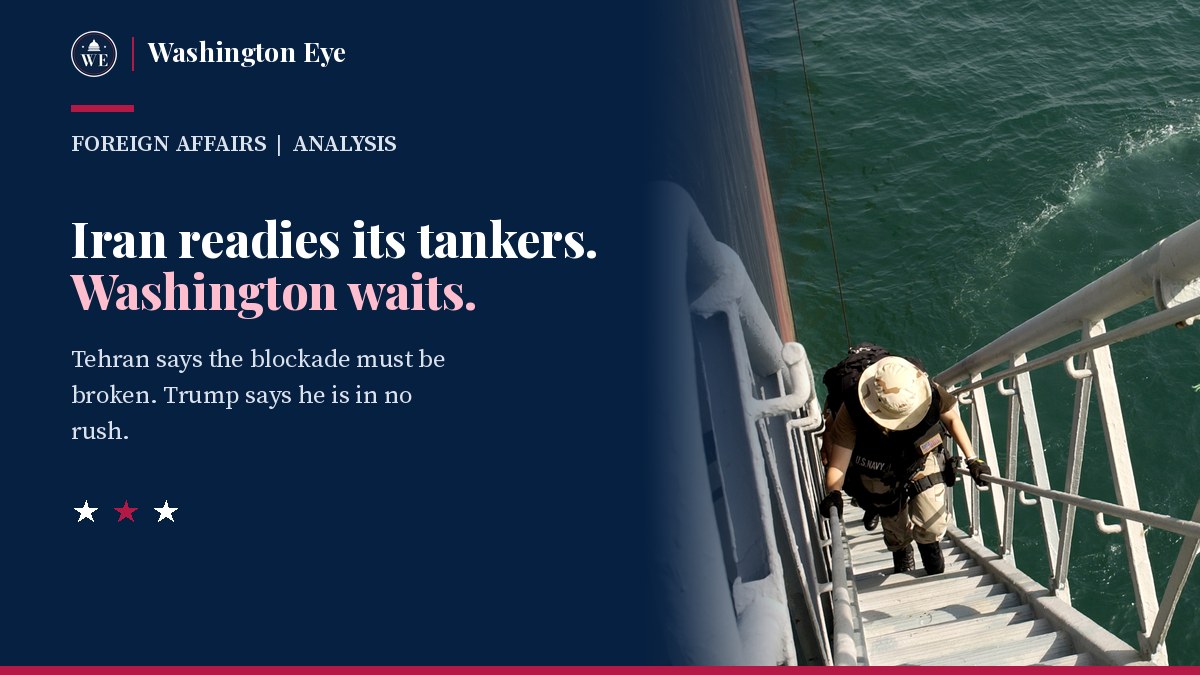
For four months the American blockade of Iran's oil trade has worked mostly in silence. Warships sat across the approaches to the Gulf of Oman, tankers stayed tied up at Iran's main export terminal, and the country's crude sales fell toward zero. This week the silence ended. Satellite imagery and ship-tracking data show more than 14 Iranian tankers gathered at Kharg Island with crews assigned and Iranian flags raised, apparently waiting for an order to sail.
On Friday, Iran's foreign minister, Abbas Araghchi, was asked about the reports by reporters in Tehran. "We are making every possible effort regarding oil exports and negotiations," he said. "The naval blockade must be broken." A day earlier, from Air Force One on the way home from China, President Donald Trump had said the opposite of urgent things about Iran. "I am not rushing into any decision," he said. "We will see what happens after the beginning of the year."
Put those two statements side by side and the shape of the next six weeks comes into focus. Washington is betting that time and an empty treasury will do the work that bombs have not. Tehran is signalling that it will not simply wait to run out of money, and that if it moves, the place it moves will be the sea.
How the blockade got here
The war began on February 28, when the United States and Israel attacked Iran. Tehran answered with strikes on Israel and on Gulf states that host American bases, and it closed the Strait of Hormuz on March 2. Washington imposed a naval blockade on Iranian ports on April 13, lifted it in June after a draft understanding with Tehran, and reimposed it on July 14 when that understanding collapsed.
The numbers since then are stark. Iran loaded about 2 million barrels a day of crude and condensate in March, according to shipping data cited by a wire service. By September, a commodities data firm recorded no loadings at all, the first full month without a single cargo since the 1979 revolution. Production has fallen to about 1.8 million barrels a day, roughly half its prewar level. Iran has managed to sell some liquefied petroleum gas and jet fuel since July, shipping sources say, but crude exports have been close to a standstill for months.
Kharg Island is the heart of the problem for Tehran. The terminal in the northern Gulf handles roughly 85 to 90 percent of Iran's crude exports, can store around 30 million barrels and has water deep enough for supertankers. The alternatives, such as the port of Jask, lack the infrastructure to replace it. A blockade that holds at Kharg holds almost everywhere.
The money clock matters even more than the barrels. Chinese refiners usually pay one to two months after delivery, so payments for Iran's last cargoes could arrive by mid-December, according to the head of crude analysis at the same data firm. After that, he estimated, Tehran stands to lose $3 billion to $6 billion a month.
Washington tightens the net
The American side moved first this week. On Wednesday, US Central Command widened the blockade to cover transfers of oil between ships at sea, a common way to disguise a cargo's origin. "Any ship that receives cargo via a ship-to-ship transfer with a vessel subject to the blockade and carrying cargo loaded at an Iranian port or coastline may be considered to be evading the blockade, even if it has not entered Iranian ports or the Iranian coastline," the advisory said. "Such ships may be stopped, boarded, diverted, captured, or directed to proceed to the Iranian port where the cargo originated." Ships that fail to obey could face "the use of force consistent with applicable law."
The timing was not random. On November 17, according to an advocacy group that tracks Iranian shipping and the data firm, a sanctioned tanker transferred about 200,000 barrels of Iranian crude to a smaller vessel that is not under sanctions, south of Kharg Island. The receiving ship appeared on tracking systems to be near Shinas, off Oman, rather than where it actually was. An independent tanker-tracking service said on Thursday that Iran "appears to be preparing to ship out oil again." If a cargo cleared the blockade, its co-founder said, it would be the first seaborne export of Iranian crude since mid-July.
Central Command says it has redirected 150 merchant vessels and disabled five since June. In September, US forces struck several Iranian tankers near Kharg and Jask after the Revolutionary Guards fired missiles at an American warship. The water itself is already dangerous: a researcher at a Washington think tank who tracks maritime data has counted attacks on at least 19 ships in and around the strait in November alone.
Operation Fereydoun
The Iranian side of the story has unfolded in a pattern that analysts of Tehran's politics know well. On Wednesday, a news agency affiliated with the Revolutionary Guards published a commentary urging the government to send a convoy of tankers through the blockade, announce it officially, and warn that any attack would bring strikes on the region's energy infrastructure. It named the idea "Operation Fereydoun," after the hero of the Persian epic the Shahnameh, and illustrated it with the hero on horseback in the sea, guarding Iranian ships. "We won't wait for America's permission," the agency said late Thursday. "We will open the path and make the cost of closing it high enough for the other side that its reason dictates that it leave the path open."
The threat list was explicit. The same outlet said any disruption to a tanker's voyage would mean explosions at oil facilities in the United Arab Emirates, Saudi Arabia, Qatar, Kuwait, Oman and Bahrain, and its original commentary singled out the UAE's oil and communications networks in Dubai. A Guards-linked channel, in a post it labelled unofficial, said dozens of tankers were preparing to sail for China.
From there the idea travelled upward. On state television on Thursday night, a military analyst, Nima Akbarkhani, put it simply: "A blockade is a military action. A military action also has a military response." He described a scenario in which tankers would sail one by one with their transponders switched on and Iranian flags flying, while Tehran announced in advance which regional facilities it would hit if any ship were attacked. The programme's host suggested putting journalists, ordinary citizens and foreign anti-war activists on board to raise the political cost of any American interdiction.
On Friday a member of the presiding board of a parliamentary committee, Mohammad Bayat, called for the tankers to be readied and for "an ultimatum" to Washington and the region's governments. Friday prayer leaders in several cities took up the theme. Those sermons are coordinated nationally by a council that answers to the supreme leader, which is why the shift matters. Mostafa Najafi, described in Iranian media as an adviser to the secretary of the Supreme National Security Council, wrote that Supreme Leader Mojtaba Khamenei had ordered an end to the state of "neither war nor peace," and that "the military option is also on the agenda."
No Iranian official has confirmed a convoy. That distinction is important. Araghchi's line was carefully paired: oil exports and negotiations in the same breath. Elsewhere on Friday he told a state newspaper that messages were still moving between Tehran and Washington through mediators, and that Iran wanted "an agreement that would ensure there was no further war." He named one red line, keeping Iran's highly enriched uranium inside the country, while saying a "fair solution" on nuclear material was still possible. Qatari and Iranian officials met on Tuesday in talks Doha described as an effort to narrow the gap between proposals.
Trump's patience, and who is asking for it
In Washington, the President has made patience his public posture. "We've got time," he said on Thursday when asked about new strikes. At a long White House news conference on Friday, he described Tehran's position this way: "They want to make a deal, but they don't want to make a deal that's acceptable to me." He has also said he could end the war "immediately," but that Saudi Arabia had asked him "to please just let it be the way it is now for a while," because, in his telling, Iran is disintegrating.
That patience is not shared by everyone in the room. Israel has pressed for a resumption of joint strikes, and the head of the Mossad, Roman Gofman, was in Washington last week to make that case, according to reports in two American outlets. The White House has asked the Pentagon and intelligence analysts how Iran would respond to each strike option, and specifically whether any of them would avoid a retaliation against Gulf oil and gas facilities. The calendar adds its own pressure: a Democratic Congress that has already tested the President's war powers takes over in January.
Three ways this can go
The first possibility is that the convoy is mostly a message. Loud talk of tankers can be leverage in talks, raising the price of Washington's waiting game without firing a shot. If Tehran's real aim is a better offer through Qatar, a fleet that is ready but never sails may serve it better than one that does.
The second is a test that Washington lets partly pass. One Iranian energy analyst, Abdullah Babakhani, has suggested that US forces might allow some tankers through and then pursue and seize them in international waters, as they did with tankers linked to Venezuela last year. That would keep the blockade intact on paper while avoiding a firefight at the mouth of the Gulf. It would also leave China with a choice it has so far avoided making in public: whether to accept the cargo.
The third is the one the region fears. If the tankers sail and American ships fire on them, Tehran has now told the world, through outlets close to its armed forces, exactly what it says it will hit in return. For the UAE, Saudi Arabia, Qatar and their neighbours, that is not abstract. Houthi drones and missiles have already struck Saudi airports, oil facilities and office buildings in recent weeks.
Markets, for now, are betting on the first or second outcome. Brent crude traded a little above $91 a barrel on Friday, heading for a third weekly decline, even with the convoy talk. That calm rests on an assumption that both sides would rather keep this a war of nerves than a war at sea.
Why it matters
For most of the autumn, the Iran war has been fought over calendars: the midterms, the Asia trip, and now the New Year. The tankers at Kharg are a reminder that the other side keeps a calendar too, and that its deadline is set by cash, not elections. If Iran's oil money really does run dry in mid-December, the decision Trump says he will take after January could be forced on him weeks earlier, by a captain on a bridge deck in the Gulf rather than by anyone in the Situation Room.