
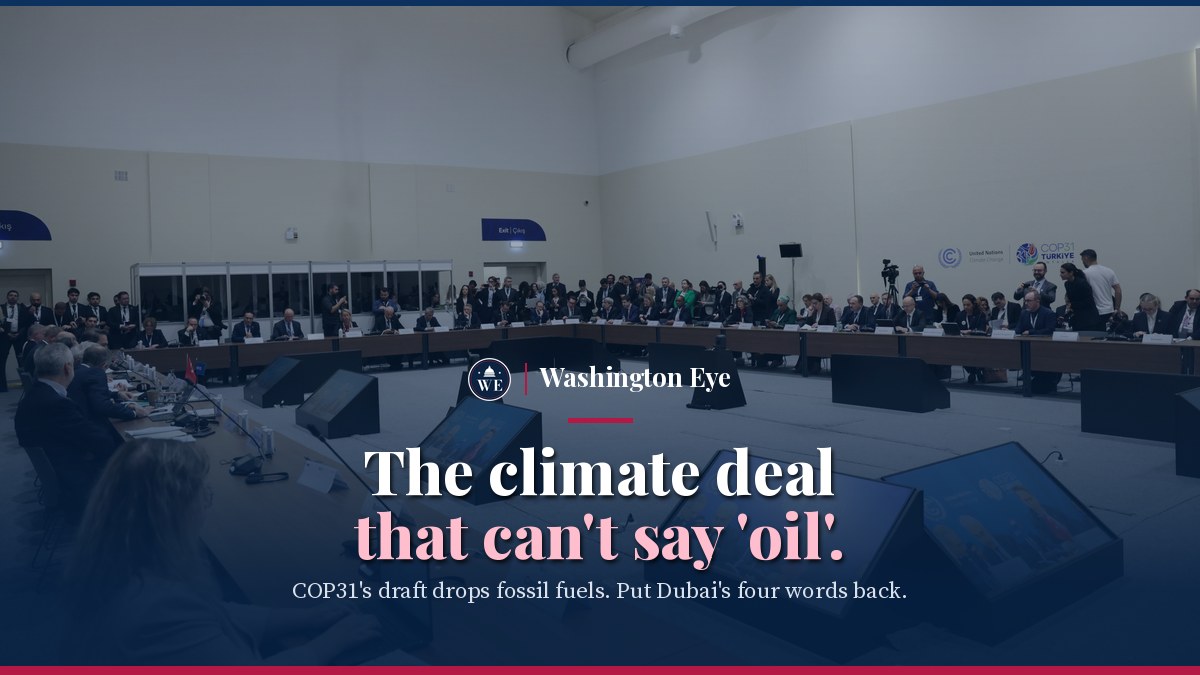
Somewhere in the second draft of the agreement that nearly 200 governments spent two weeks negotiating in Antalya, there is a paragraph about capturing carbon dioxide and burying it underground. There is a target for electricity. There is a reaffirmation of a goal to triple money for adaptation. What there is not, anywhere in the text released on Thursday, is the phrase “fossil fuels.” Not coal, not oil, not gas. The single largest cause of the problem the summit exists to solve has been edited out of its closing document.
The talks, the 31st United Nations climate conference, were supposed to end at six o'clock on Friday evening, Antalya time. They did not. Negotiators were still arguing into the night, a late plenary dealt only with technical items, and a fresh draft was not expected before Saturday. That is not unusual. The last of these summits to finish on time was held in Italy in 2003. What is unusual is how openly the fight has become about a single word, and how much depends on whether it comes back.
Our view is simple, and it will satisfy neither the loudest activists nor the most cautious presidency. The deal should not be blown up. It should be fixed. The fix is to restore the four words the world already agreed by consensus in Dubai three years ago, “transition away from fossil fuels,” keep the electrification target that is the best thing in the text, and strip out the carbon capture figure that is doing the job the missing words used to do.
How a word disappears
The first draft, released earlier in the week, was long and sprawling and included strong calls to accelerate the phase out of coal, oil and gas. The second, shorter version on Thursday dropped every mention of fossil fuels and weakened the electrification goals as well. In their place sits a new formulation: an acknowledgment that “the global transition towards low greenhouse gas emissions and climate-resilient development is irreversible.”
That sentence sounds harmless. It is not. According to detailed readings of the text published by observers in Antalya, it is the phrase that the Arab negotiating group, along with Russia and some developing country allies, wants to substitute for the Dubai commitment. Insiders at the summit have described Saudi Arabia as one of the countries playing an obstructive role and as among those pushing hardest for carbon capture to be written strongly into the final agreement. Swap “transition away from fossil fuels” for “transition towards low emissions,” add a large number for carbon capture, and the fuels themselves never have to be named again.
The carbon capture number is the tell. The draft refers, in brackets that mean it is still being negotiated, to “working towards” 2.5 gigatonnes of carbon dioxide captured and stored every year by 2035. Neil Grant, a mitigation expert at the advisory group Climate Analytics, pointed out that every carbon capture project in the world could capture about 60 million tonnes a year if all of them ran at full capacity, and that in reality they run at about half of that. “To scale to 2.5 gigatonnes would require a 40 fold increase over a decade for incredibly complex technologies,” he said, adding that about 80 percent of large scale projects have been delayed or cancelled. He called the language “a Trojan horse for fossil fuel interests.”
For scale, 60 million tonnes is less than 0.2 percent of the 38.2 billion tonnes of carbon dioxide released by burning fossil fuels this year, according to the Global Carbon Budget. Carbon capture has a real place in heavy industries with no clean alternative. As a headline target in a document that cannot bring itself to mention oil, it is a promise to clean up a mess the text refuses to describe. France's minister for the ecological transition, Monique Barbut, put the contradiction plainly: “So what does it mean? It means we don't recognize what is the problem.”
The best idea in the room
None of this means the draft is worthless, and the people calling Antalya “the worst COP ever” are wrong to treat it that way. The centrepiece of the text, championed by the Turkish hosts and the Australian minister running the negotiations, Chris Bowen, is a goal to raise electricity's share of the world's final energy use to 35 percent by 2035, up from somewhere between a fifth and a quarter today. Around 90 governments back it, including many in the European Union. On Friday China and Australia issued a joint statement welcoming “growing international ambition and cooperation on electrification” toward that figure.
That matters more than it sounds. Every car, furnace and factory that switches from burning fuel to drawing power from a grid is a demand for oil or gas that no longer exists, and power grids are where cheap solar and wind actually land. “Electrification is the key to transitioning away from fossil fuels,” Bowen told reporters. He is right. If the target survives, it will do more practical work than most of the slogans shouted outside the plenary hall.
But the target has two weaknesses, and both are fixable. It is voluntary. And as written it does not say the extra electricity has to come from clean sources, which means a country could hit it by building coal plants. Pairing the 35 percent goal with the Dubai words would close that gap without asking anyone to sign up to anything new.
The coalition that wants it back
A group of countries that rarely negotiate as one has made exactly this demand. Led by France and Panama, ministers from Belgium, Côte d'Ivoire, Finland, Greece, Guatemala, Spain, Sweden and Vanuatu stood together on Friday with six priorities, among them an explicit recognition of “a clear and orderly transition away from fossil fuels,” faster cuts to methane and finance from those most responsible for emissions. European negotiators called the current draft “not acceptable.” The 44 least developed countries have asked for the carbon capture language to be removed and a fossil fuel phase out put back.
Panama's environment minister, Juan Carlos Navarro, has gone furthest. “It is not acceptable to have a COP or a cover document that does not even mention fossil fuels, and we simply will not put up with it,” he said. In a letter to the presidency he warned that Panama would formally object in the closing plenary to any decision that does not meet its demands. Because these agreements are adopted by consensus, a single formal objection can block adoption.
That threat is legitimate leverage, and it is probably the reason the Dubai language is still in play at all. But one of Panama's other demands, that decisions be adopted by voting instead of consensus, is a road to nowhere. Consensus is frustrating precisely because it gives every government a veto. It is also the only reason the biggest producers stay at the table. A majority vote would not force oil states to cut anything. It would give them a reason to leave, as the United States has already done.
The money underneath
The fossil fuel fight is the visible one, but it is tangled up with an older argument about money that explains why so many developing countries are angry. Ministers from Ghana, Zambia, Senegal, Kenya and Sierra Leone held a press conference on Friday morning accusing rich nations of asking Africans to pay for a crisis they did not cause. “We didn't come here to beg,” said Zanetor Agyeman-Rawlings of Ghana, who chairs the African ministers. “We came here to claim what is rightfully ours.” Several African governments have said they will only back the electrification goal if adaptation funding rises with it.
The draft reaffirms a goal of tripling adaptation finance by 2035 but leaves the crucial question of how the increase is calculated for later. Europe insists it already leads: a senior official said the bloc and its members provided 32.3 billion euros from public sources and mobilised 9.3 billion euros in private finance for developing countries in 2025. “We're doing by far the most,” the official said. Both things can be true. Europe gives the most, and the total is still far short of what poorer countries say they need to build grids instead of burning coal.
That is the honest link between the two fights. A country cannot electrify on promises. If rich governments want the fossil fuel words back, the price is a clearer adaptation number. If developing countries want that number, the electrification target is how they show it will be spent on the future rather than the past.
Why Americans should care about an empty chair
For the second year running, the United States sent no official delegation. The administration has begun a formal withdrawal from the UN climate framework, and President Trump has repeatedly dismissed global warming as a hoax. In Washington's place came a delegation of American lawmakers, mayors and governors, among them Minnesota Governor Tim Walz, trying to show that climate action in the United States is still alive.
Their presence is a gesture, not a vote. The world's largest economy has no hand in the text that will shape where trillions of dollars of energy investment flow over the next decade, including the grids, batteries and transmission lines American companies want to sell. Whatever one thinks of the climate policy of this administration, leaving the room means the rules get written by others, and right now the loudest of those others are the producers trying to keep the word oil out of the document.
What a good ending looks like
The draft does make one claim worth defending. It notes that full delivery of national climate plans would put the world on course for around 2.6 degrees Celsius of warming, down from projections of more than four degrees before the Paris Agreement. That is real progress, and it came from exactly the kind of imperfect consensus deals now being dismissed in Antalya. It is also far above the Paris goal of keeping warming well below two degrees.
So here is the deal we would sign. Put “transition away from fossil fuels” back in, word for word, because every government in the room already agreed to it in 2023 and none can credibly call it radical. Keep the 35 percent electrification goal and add the word clean. Delete the bracketed 2.5 gigatonne carbon capture figure or tie it to industries that have no alternative. Put a number on adaptation finance. Then gavel it through.
“No one has said to me, let's give up and go home,” Bowen said on Friday afternoon. Good. The summit's host, Turkey's environment minister Murat Kurum, told the late night plenary that the world “waits for good news from this room.” The best news would not be a perfect agreement. It would be a document that can at least name what is burning.