
Four days after a midterm defeat that Florida Governor Ron DeSantis called an "extinction-level event" for his party, the White House's chief trade adviser went on a conservative streaming show and announced the lesson he had drawn from it. "We are quadrupling down on tariffs," Peter Navarro said. In a separate statement he insisted that the duties "have played no role in the inflation and affordability issue" and promised they would keep rising "as long as the world cheats us."
Conservatives who believe in limited government, low taxes and the constitutional powers of Congress should take the opposite lesson. The tariff wall is not a conservative policy. It is a tax, imposed without a vote, that voters have now rejected at the ballot box. And the place to start taking it down is the most indefensible piece of it: the 50 percent duty on goods from Canada. When the new Democratic Congress brings a Canada repeal bill to the floor next year, Republicans should not merely tolerate it. They should help write it, and then vote for it.
Start with the voters. On 3 November Democrats flipped seven Senate seats and picked up 27 House seats on election night alone, with races still being counted. Republican operatives have offered many explanations, from the war with Iran to the quality of some candidates. Vice President JD Vance put it bluntly: "The reason we lost is the war." The president told a television interviewer that it was really the price of gasoline. Both may be partly right. But a television network's exit poll found that 66 percent of voters thought the tariffs had hurt the economy and only 21 percent thought they had helped. A separate poll by a business news network found 64 percent saying tariffs had hurt their local economy, against 14 percent who said they had helped.
Those numbers were not lost on the campaigns. According to an analysis of ad-tracking data reported by a major financial newspaper, Republican candidates spent nothing this cycle on advertising about tariffs, for or against. Democrats spent $58.3 million attacking them. When a party will not spend a dollar defending its signature economic policy in the final weeks of a campaign, it has already conceded the argument.
Some Republicans are saying so out loud. Senator Ted Cruz of Texas, hardly a squish, said after the results that "tariffs have made everything too expensive." One House Republican, listing the reasons for the rout to a cable news website, included tariffs and a "departure from traditional conservatism in favor of populism." Michael Strain, an economist at the American Enterprise Institute, predicted that many in the party will now conclude it "took a wrong turn with protectionism." Stephen Moore, an outside adviser to the president, said that after checking in with friends in the White House he had heard it might be willing to walk back the tariff agenda, and that "the free traders have a louder voice now." Navarro's response was to call Moore a "hired corporate gun" and to suggest that Republicans oppose tariffs in proportion to the money they receive from multinational corporations.
That is not an argument. It is a way of avoiding one. The evidence on who pays is now hard to wave away. In a new study, researchers at the Federal Reserve Bank of New York published a study of 67 categories of consumer goods. They found that as of February, tariffs had pushed prices in those categories 2.9 percentage points higher, and that without the levies prices would have fallen by almost 1 percent. For every percentage point added to the average tariff, consumer prices were roughly a quarter of a percent higher a year later. "Tariffs have a larger and more drawn-out impact on consumer prices than the direct effect alone would suggest," the authors, Mary Amiti, Sebastian Heise and David Weinstein, wrote. They expect elevated prices to linger into 2027.
The White House answer, from spokeswoman Taylor Rogers, was that the administration "has consistently maintained that the cost of tariffs will ultimately be borne by foreign exporters." Conservatives used to be the people who explained to the left that companies do not pay taxes, customers and workers do. The same logic applies at the border. A duty collected by Customs and Border Protection from an American importer is a tax on Americans. By one estimate it has lifted the average import duty from 1.5 percent to 11.8 percent, the biggest protectionist turn since the 1930s.
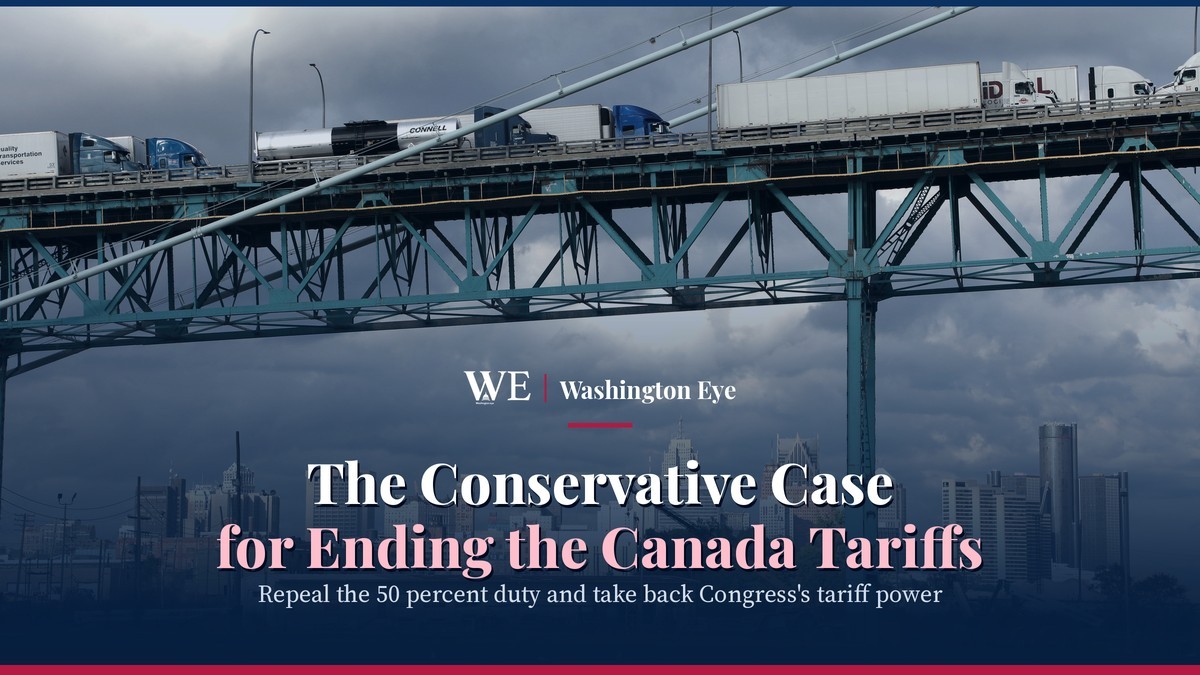
Why Canada first? Because it is the clearest case of policy without purpose. The 50 percent duty rests on Section 338 of the Tariff Act of 1930, the Smoot Hawley law, a provision never used in its 96 year history until this summer. A proclamation in July found that Canada's motor vehicle tariffs discriminated against American commerce. After a brief suspension, the duty took effect on 22 August. Since then the list of covered goods has been rewritten twice by proclamation. The latest version, effective 30 October, removed 22 product lines and added 100 more, most of them outside the car industry: shampoo, paint, vinyl flooring, carpets, chest freezers, hand tools, canoes and archery equipment. The president has also said that 50 percent duties on Canadian cars, trucks, auto parts and steel will begin on 1 January, two days before the new Congress is sworn in.
Whatever one thinks of the dispute over Canadian vehicle rules, it is hard to see the national interest in taxing American families' carpets and freezers to win it, or in making the list longer every few weeks by executive pen. This is exactly the kind of open ended, unaccountable power that conservatives warn against when a Democratic president uses it. Ottawa, meanwhile, is not capitulating. Its new budget, titled "Masters of our Destiny," says the two countries "will not return to our old relationship" and promises to reduce reliance on the American market. The tariff has not changed Canada's behaviour. It has changed its strategy, away from the United States.
There is a constitutional point as well. Article I gives Congress, not the president, the power to lay duties. Over decades Congress handed much of that power away through statutes like Section 338, Section 232 and Section 301, on terms it wrote itself. In February the Supreme Court ruled 6 to 3 that the emergency powers law the administration first relied on did not authorise tariffs at all, which triggered more than $100 billion in authorised refunds. The administration's response was to rebuild the same wall from other statutes. If conservatives believe in the separation of powers, the answer is not to wait for the next court case. It is for Congress to take back what it gave away.
Republicans do not need to embrace the Democratic agenda to do that. Senator Ron Wyden, the incoming Finance Committee chairman, says "there is overwhelming support for repealing the tariffs on products from Canada," and that is the narrow bill Republicans should insist on, rather than a sweeping measure loaded with unrelated priorities. A better long term model already has a senior Republican name on it. The Trade Review Act, introduced by Senators Chuck Grassley of Iowa and Maria Cantwell of Washington, would require a president to notify Congress within 48 hours of a new tariff and would end it after 60 days unless Congress approved it. That is not anti Trump. It is how a self governing republic is supposed to set taxes, and it would bind the next Democratic president just as tightly.
The best case on the other side deserves a fair hearing. Tariff supporters point to real gains. The October jobs report showed 165,000 new jobs, including 19,000 in manufacturing, which the White House called the strongest monthly factory gain since 2023. The president argues that foreign companies are building more than 3,000 plants in the United States, and that "if we remove tariffs now, all factory construction will stop." Some sectors, including autos and metal products, appear to have benefited, and some unions and industry groups now benefit from the protection. Charles Benoit, formerly counsel at a pro tariff trade group, argues that affordability was driven by housing and fuel, not tariffs. That is a serious point about the war's role in prices.
But none of it rescues the Canada duty. A narrow repeal would leave in place the Section 232 national security tariffs on steel, aluminium, copper, autos and other goods, which now carry the largest share of the program. And the claim that factories would simply stop rests on the assumption that companies build here only because they are threatened, which is a poor advertisement for the American economy and a worse one for conservative faith in markets.
The politics are also not what the White House thinks. The president has promised to veto what he calls "insane" Democratic bills. Overriding a veto would take two thirds of both chambers, which on one estimate means roughly 30 to 35 House Republicans and 11 to 13 Republican senators. That is a high bar, but not an impossible one. Four Republican senators, Mitch McConnell, Rand Paul, Susan Collins and Lisa Murkowski, already voted in October 2025 to end the Canada tariffs, and the House passed a disapproval measure in February. Jessica Riedl, a Brookings Institution economist and former Republican Senate aide, expects more to follow once the president is a lame duck. As for blaming the war alone, she said, "That's total cope."
Even if an override falls short, the vote matters. Republican leaders have largely avoided public votes on tariffs. A party that wants to win back the voters it just lost cannot keep hiding from the issue those voters named. Douglas Holtz-Eakin, the former Congressional Budget Office director, predicted that whoever comes next will not use tariffs with this president's "scale and depth and capricious handling," while warning that "I don't think they'll all go away easily." Conservatives can either shape what replaces this era or let Democrats define it.
The choice in January is not between loyalty and betrayal. It is between the conservatism of lower taxes, a Congress that writes the laws and confidence in free exchange, and a policy that taxes American households, has failed to move Canada and helped hand the opposition both chambers. Quadrupling down is a strategy for losing again. Repealing the Canada tariff, and restoring Congress's say over the rest, is a strategy for remembering what the party used to believe.