
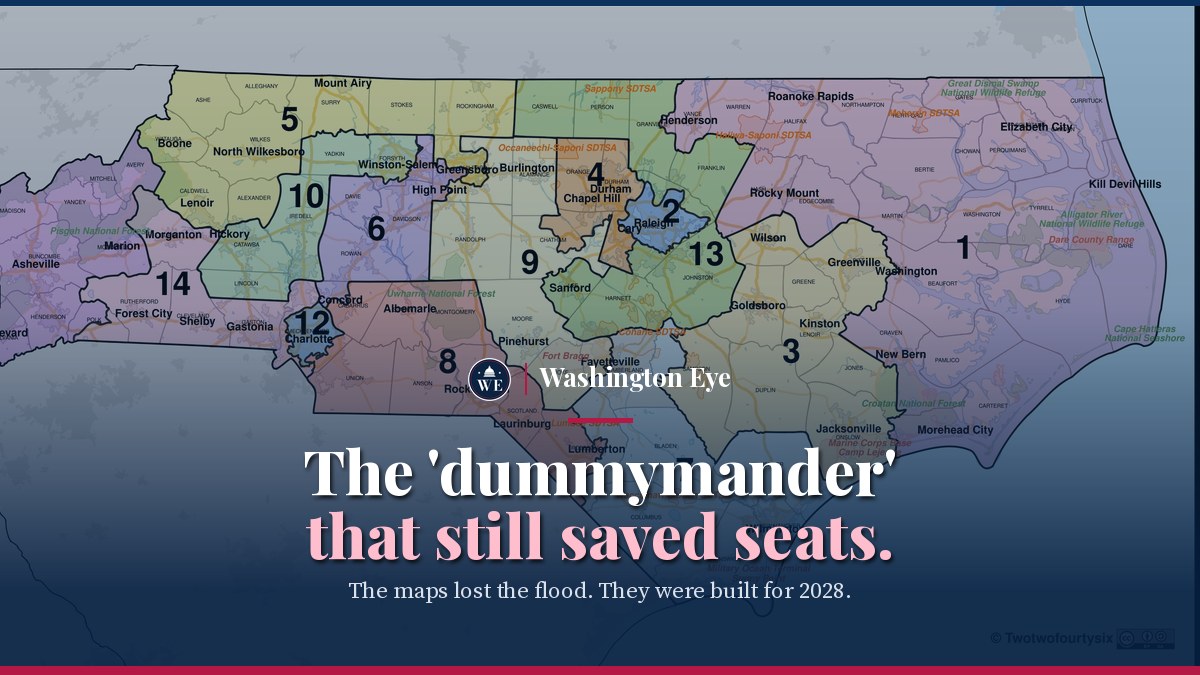
Democrats have a new favourite word, and it is a good one. A “dummymander” is what political scientists call a gerrymander that blows up in the face of the party that drew it. Two scholars, Bernard Grofman and Thomas Brunell, coined the term in 2005. After November 3, it is everywhere, usually attached to a picture of North Carolina and followed by a laugh.
We understand the laughter. We do not share the conclusion. The story Democrats are telling about the 2026 maps, that Republican redistricting was a self-inflicted wound, is satisfying, quotable and mostly wrong. The maps did not save the House. Nothing could have saved the House this year. But the evidence now coming in says the maps saved seats, and they are built to save a great many more in 2028 and 2030. Republicans should learn the right lesson from this election, and the right lesson is not to apologise for drawing lines.
A flood, not a failure
Start with the scale of what happened. Democrats won at least 257 House seats, their highest total since 2008, and carried the national House popular vote by about 14 points, according to an analysis published on Thursday by a nonprofit elections news site. A wire service tally counted 46 Democratic flips in the House against just three Republican ones, plus nine Democratic gains in the Senate. Polling of voters pointed to frustration with the economy and with the war with Iran. The President’s approval rating hovered around 35 percent.
No map in American history is designed to survive that. A gerrymander is a wall. Walls are built for ordinary weather. “It probably was an effective gerrymander in most years. This was not most years,” said Chris Cooper, director of the Haire Institute for Public Policy at Western Carolina University. He compared North Carolina’s map to a wall that would hold “in most environments,” but not in what he called the electoral equivalent of a thousand year flood.
Judging a map by a flood year is like judging a levee by the one storm that topped it, while ignoring the neighbourhoods it kept dry.
Counting the seats the maps kept
Here is the inconvenient arithmetic for the victory lap. Nine states enacted new congressional maps for 2026, a modern record for a year that does not follow a census. Six were Republican gerrymanders, one, California, was a Democratic gerrymander, and two, Ohio and Utah, were drawn by a bipartisan commission and a court after legal requirements forced new lines.
If you simply count flipped seats in those states, Democrats cleaned up: at least 14 Republican held seats, and possibly as many as 19 once the last races are settled. But that count tells you about the wave, not the maps. The elections analysis tried to separate the two. It took each redrawn district, measured how much redder or bluer it became under its new lines using the 2024 presidential vote, and subtracted that shift from the 2026 result. By that measure, Democrats gained no seats from redistricting at all. Republicans gained somewhere between four and seven.
The method is not exact, and its author says so. House races are not presidential races. But it is a far more honest yardstick than pointing at a map and counting losses in a year when Republicans lost everywhere, including in states where nobody touched the lines.
Look at the details. In Florida, Republicans failed to take a single Democratic seat, which is the part Democrats like to mention. The part they skip is that the new map shored up Representatives Anna Paulina Luna and Laurel Lee, who may well have lost on the old lines. In Texas, redistricting was plainly the reason Republicans flipped the 32nd District, which had been safely Democratic. The two seats Democrats took in Texas, the 15th and the 23rd, were barely redrawn at all, so the maps had nothing to do with those losses. In the 15th, Bobby Pulido, a Tejano music star making his first run for office, won by nearly 25 points in a district that is close to three quarters Latino. That is a story about voters moving, not about lines.
In Tennessee, Republicans flipped the 9th District in Memphis after redrawing it, and a quieter change to the 5th District may be the only reason that seat stayed red. Even California’s Democratic gerrymander, sold as a five seat counterpunch, looks far less potent on inspection. Four of the Republican seats it targeted might have fallen anyway under the old map. Only the 1st District is clearly a redistricting win. In a twist, the Democratic map made Representative Jay Obernolte’s 23rd District about three points redder, which may have saved him.
And then there is Utah, where Republicans did not want new lines. A court ordered a map with one safely Democratic seat and three safely Republican ones. In a year like this, the old map of four moderately red seats might have handed Democrats three of them. The court did Republicans a favour nobody asked for.
North Carolina, the exhibit for the prosecution
North Carolina is the case Democrats lead with, and it deserves a straight answer. The state’s map, first passed in 2023 and tweaked last year, was drawn to elect 11 Republicans and three Democrats. “The end result is a map that should perform to elect 11 Republicans,” State Senator Ralph Hise told a legislative committee when he presented it in October 2025. It appears to have elected 11 Democrats and three Republicans, with recounts under way in the 5th and 10th Districts.
The tweak was a genuine blunder. To make the Democratic held 1st District redder, mapmakers made the neighbouring 3rd District bluer. Representative Don Davis held the 1st by nearly three and a half points. Representative Greg Murphy lost the 3rd to Raymond Smith by 293 votes after provisional ballots were counted. A Democratic campaign committee spokesperson, Madison Andrus, declared that “this dummymander will haunt North Carolina Republicans for years to come.”
Maybe. But the same analysis that crowned North Carolina a textbook case also ran the obvious test. Knock five points off every Democratic margin in the state, which would still leave Democrats winning the national vote by about nine points, a landslide by any normal standard, and Republicans win 10 of the 14 seats. The 2028 and 2030 elections will be held on this map. Unless Democrats can reproduce a 14 point national environment twice more, the map that embarrassed its authors this month is likely to reward them later.
Professor Cooper put it in a single sentence that every Republican legislator should pin above the desk: “What looks like a dummymander in 2026 may look like a well-drawn gerrymander in 2028.”
The national map moved, and it stays moved
Step back from individual states and the long game is clearer still. All the redistricting of the past two years shifted the median House district from one that Donald Trump carried by three points in 2024 to one he would have carried by almost five. That shift barely registered in a 14 point year. It will matter enormously in a close one. It is easy to picture a future election in which Democrats narrowly win the national House vote and still fall short of a majority, because the light red seats that decide control have been pushed just out of reach.
The maps also imposed costs that do not show up in the seat count. Representative Shomari Figures in Alabama and Representative Darren Soto in Florida survived Republican efforts to unseat them, but only after expensive fights that soaked up money Democrats could have spent elsewhere. In Texas, long serving Democrats Al Green and Lloyd Doggett will leave Congress in January because the new lines left them nowhere to run.
None of this is to say Republican mapmakers were brilliant. In Tennessee they spread their own voters so thin that the once safe 4th District may now fall to a Democrat. In Ohio, where a bipartisan commission redrew five districts to include more Trump voters, Democrats won all five and picked up four seats in total. The pattern is consistent: Republicans assumed the voters who backed Mr Trump in 2024 would turn out and vote the same way in a midterm without him on the ballot. Many did not.
The right lesson for Republicans
That is where conservatives should focus, because it is the real warning in the numbers. The North Carolina problem was not that Republicans drew lines. It was that they drew them too efficiently, packing 11 seats into a narrow band of Trump margins between 10 and 19 points. When the national tide reached that band, eight of those seats went under at once. A map that leaves every seat at R plus 12 is a bet on a normal year. A sturdier map, with fewer targets and wider margins, is insurance against an abnormal one. Mapmakers should buy insurance next time.
The deeper lesson is that maps are not a substitute for winning arguments. The wave of 2026 was driven by prices and by a war that voters soured on, not by district lines, and no amount of cartography fixes a 35 percent approval rating. Republicans who treat redistricting as a way to avoid the hard work of persuading Latino voters in South Texas or suburban voters in Ohio will keep learning that lesson the expensive way.
Democrats, meanwhile, are not swearing off the tactic they now mock. Maryland voters this year approved a ballot measure that allows the state to pursue a new congressional map favouring Democrats, and the new Democratic trifecta in Wisconsin may consider redrawing before the presidential election. The arms race that began last year is not ending. It is changing hands.
What to watch next
The next test is Mississippi, where the Supreme Court’s April ruling in Louisiana v. Callais, which narrowed when the Voting Rights Act can require race conscious districts, has left lawmakers facing a redraw. Governor Tate Reeves said this week, “I have every intention of there being a special session for redistricting,” though he has not set a date. State Senator Jeremy England, a Republican on the redistricting committee, warned that if lawmakers are not called back by about the first week of December, the state may have to push back qualifying deadlines for next year’s elections. Candidate qualifying begins in January.
Mississippi Republicans would do well to study 2026 carefully before they reach for the pen. The lesson is not that gerrymanders always fail. It is that greedy ones are brittle. Draw for durability, not for the maximum on paper.
So by all means, enjoy the word. Dummymander is a fine piece of political slang. But the scoreboard says Republicans walked out of a historic wave with somewhere between four and seven more seats than the old maps would have given them, and with lines that will be waiting for the next, calmer election. That is not a joke at Republicans’ expense. It is a down payment.