
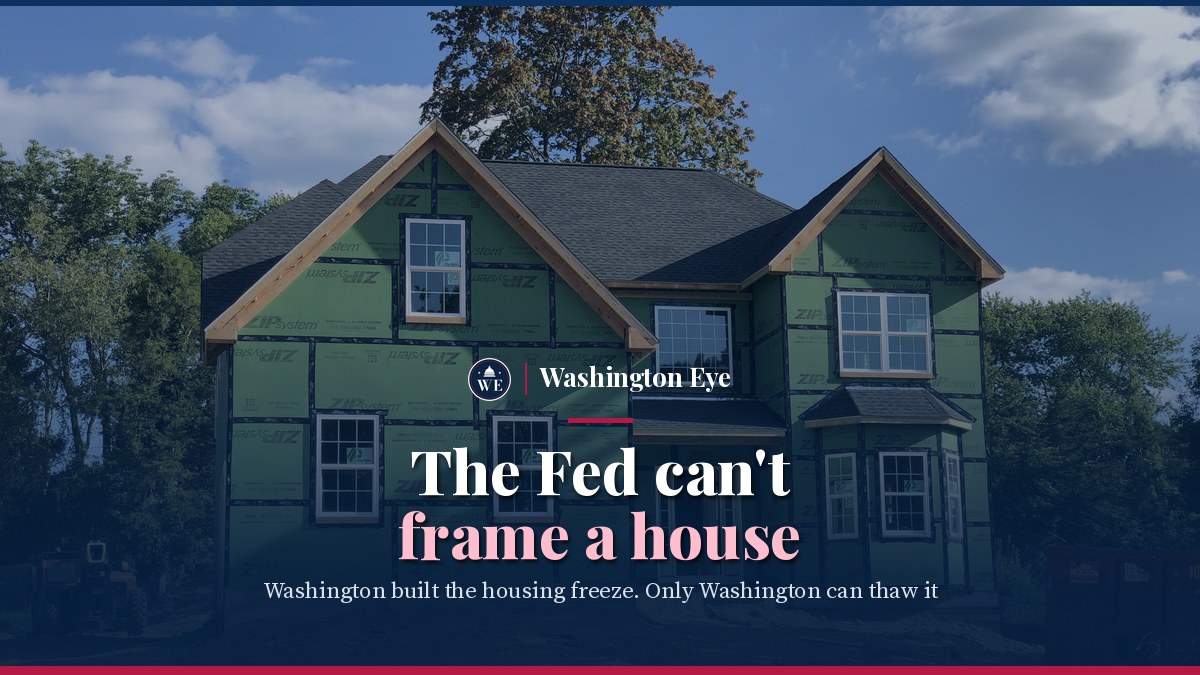
Drive through almost any new subdivision in America this month and you will find the same scene: a house wrapped in green sheathing, windows in, roof on, and nobody signing a contract to buy it. The numbers behind that picture have turned grim. Builder confidence in the market for new single family homes fell four points to 25 in November, the lowest reading since April 2012. Pending sales of existing homes fell 4.7% in October to the lowest level in the index's history, and they were down 16.7% from a year earlier. Nearly half of all builders, 46%, cut prices this month, the highest share since the pandemic.
In two weeks the Federal Reserve is widely expected to make borrowing more expensive again. Markets are pricing a quarter point increase at the December 8 and 9 meeting, from a target range of 3.75% to 4%. One governor, Christopher Waller, has said he favours half a point, or a clear signal of faster increases next year. The central bank's minutes from October show almost every policymaker expected to raise rates in the months that followed.
It is tempting to ask the Fed to hold off for the sake of housing. We think that would be aiming at the wrong building. The Fed is doing its job, however painful. The housing freeze of late 2026 is in large part a problem Washington made with its own hands, and it is Washington, not the central bank, that can start to unmake it. With a new Congress arriving in January, the moment to do that is close.
Begin with what the Fed is actually facing. Inflation measured by the price index it targets is running at about 3.5%, according to New York Fed President John Williams, against a goal of 2%. September's figures were bad by any standard: prices rose 0.5% in a single month and 3.7% over the year. Core inflation, which strips out food and energy, rose 3.1%. Core consumer prices for October came in hotter than forecasters expected, and the October figures for the Fed's preferred gauge are due on Wednesday. Meanwhile the labour market looks sturdy. Employers added 165,000 jobs in October, unemployment fell to 4.1%, and weekly jobless claims are near 200,000. A survey published on Tuesday found consumer confidence at its highest level in nearly two years.
No honest central banker looks at that mix and cuts rates to rescue home sales. Mr Williams said as much in a speech in the Bronx on Monday. "Inflation is simply too high," he said, and he would not rule out moving at consecutive meetings. Then he offered the line that should be pinned above every desk on Capitol Hill: "Monetary policy cannot move ships or reopen pipelines and refineries." It can only make sure that supply shocks do not turn into permanent inflation. The same logic applies to houses. The Fed cannot frame one.
So who can? Listen to the people who build them. When the builders' survey came out last week, the chairman of the National Association of Home Builders, Bill Owens, did not lead with interest rates. "Stepped-up immigration enforcement is keeping legal workers off job sites, deepening labor shortages and driving up costs," he said. "Higher fuel prices are prompting subcontractors to raise their rates sharply, and with fewer buyers in the market, more builders are scaling back construction." The group's chief economist, Robert Dietz, listed building material costs "pushed higher by tariffs," the shortage of construction workers and "excessive regulations" before he got to mortgage rates above 7%.
Each of those is a policy choice made in Washington, not a law of nature.
Take materials first. Since October 2025, softwood lumber and timber imports have carried a 10% national security tariff, on top of antidumping and countervailing duties on most Canadian lumber that the Commerce Department more than doubled in 2025 to about 35%. Canada supplies roughly 85% of the softwood lumber America imports and close to a quarter of the total supply, according to the builders' association, which notes that American sawmill output has been essentially flat for two years. Kitchen cabinets and vanities carry a 25% tariff, scheduled to double to 50% on January 1, 2027. A homebuilding supply chain consultancy recently modelled the total tariff burden on a typical new American home at $12,919. That is a model, not a receipt, and it should be read as one. But it points in the same direction as every builder survey of the past year.
Now labour. Construction has always leaned heavily on immigrant workers, and the builders say the crackdown is emptying job sites, including of people who are working legally. One can support tougher border enforcement and still see the cost of raids that frighten away crews who have every right to be there. The economic data hint at the same thing from another angle: part of the fall in unemployment over the past year, by one widely reported reckoning, reflects a smaller labour force, as retirements and the immigration crackdown thin the ranks of people looking for work. A tighter labour market sounds like good news until you need someone to hang drywall.
Then energy. Fuel and commodity prices have been pushed up by conflict in the Middle East, and Mr Williams named those costs as one of three forces keeping inflation high. Builders feel it in every delivery of concrete and every subcontractor's quote.
Put those together and you get something worse than a cyclical dip. Mortgage rates averaged 7.33% in October and stood at 7.28% in mid November. A property listings company estimates that the monthly payment on a typical home reached $2,004 in October, up 12.8% in a year, and that a median income household would now spend 41.5% of its income on the full cost of owning that home. Home values, by the same estimate, are barely up at all. Buyers are not being priced out by soaring house prices. They are being priced out by the cost of money and the cost of building.
Lawrence Yun, the chief economist of the National Association of Realtors, put the puzzle starkly. Annual existing home sales, he said, could be the lowest since the mid 1990s, even though the population has grown by roughly 75 million since then. "Either sizable housing demand is building in the background, or the dream of homeownership is increasingly out of reach for many Americans," he said. Both are probably true, and neither is something a quarter point decision in December will settle.
Here is the uncomfortable part for those who want the Fed to blink. If the central bank held rates steady to help housing while inflation is running near 3.5%, the bond market would likely push long term borrowing costs up anyway, because investors would demand more protection against future inflation. Mortgage rates track those long term yields far more than the overnight rate the Fed controls. A Fed that looked soft on inflation could leave buyers worse off, not better. The quickest route to cheaper mortgages runs through lower inflation, and that means letting the Fed finish the job.
That leaves the work to the people who wrote the policies. We would start with three steps, none of them exotic.
First, lift or suspend the national security tariff on softwood lumber and cancel the scheduled jump in cabinet tariffs to 50%. The administration has already delayed tariff increases on wood products once, in a December 2025 announcement that cited ongoing negotiations with trading partners. It can do so again, and a Congress that wants to show voters it heard them on the cost of living can push hard for it. The national security case for taxing two by fours from Canada was always thin. The cost to young families is not.
Second, separate immigration enforcement from the construction labour market as far as the law allows. That means focusing enforcement on people with criminal records rather than on job sites full of authorised workers, and it means expanding legal pathways for construction labour, which have long been too narrow for an industry that cannot import its work from abroad. A house in Ohio has to be built in Ohio.
Third, use the federal government's considerable leverage over local zoning, through transport and housing grants, to reward places that make it easier to build. Mr Dietz is right that regulation adds to costs, and this is one of the rare housing reforms that draws support from both left and right.
None of this would produce a boom by spring. Builders are sitting on unsold inventory, and Mr Yun suggested October may prove to be the low point for contract signings now that rates appear to have topped out. But a Congress that spends the next year blaming the Fed for a housing crisis built in Washington would be doing voters a disservice. The central bank's job is to bring inflation down. Lawmakers' job is to stop adding to the cost of every house before the first nail goes in.
The houses are already standing in those empty subdivisions. What is missing is a government willing to stop making them dearer to build and harder to buy.