
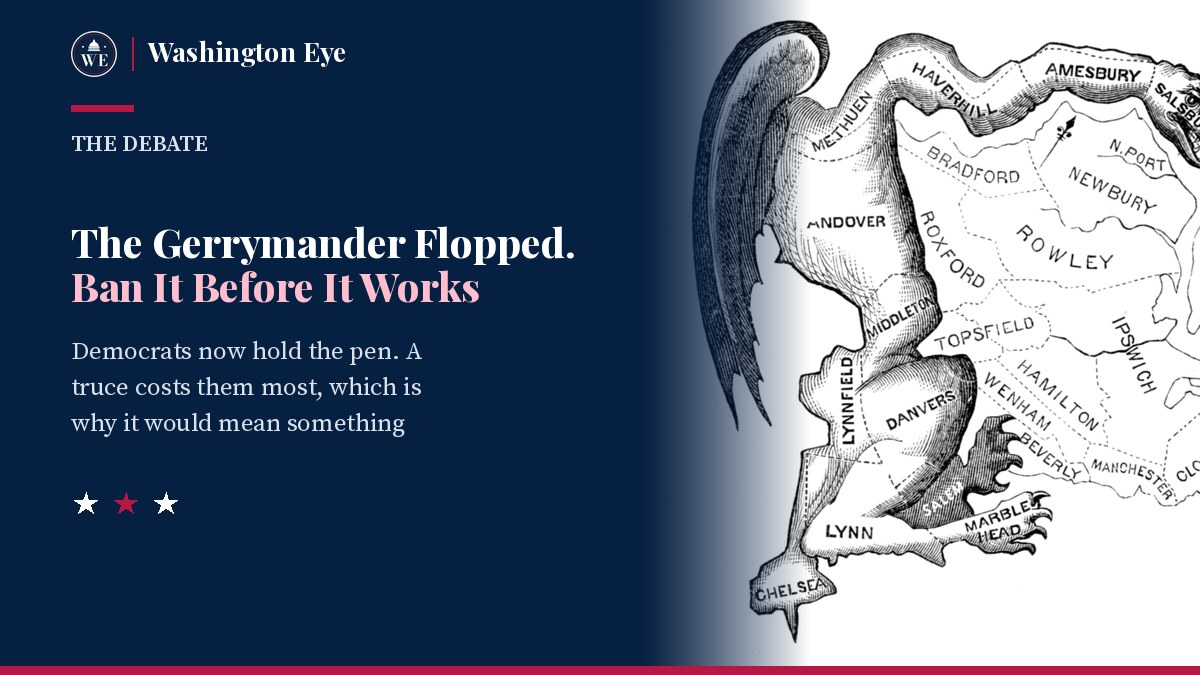
For a year and a half, the party that controlled the White House treated the congressional map as something to be engineered rather than respected. At the president's urging, Republican legislatures in Texas, Ohio, North Carolina, Florida, Missouri and the Deep South redrew House districts in the middle of a decade, a practice that used to be rare, in the hope of building a wall around a slim majority. On November 3 the voters went straight through the wall.
The numbers are now close to final, and they are brutal for the architects. Texas Republicans redrew five Democratic seats into districts the president had carried by at least ten points and aimed for a 30 to 8 delegation. They will arrive in January holding 24 seats to the Democrats' 14, losing four of the five seats they set out to take and two of their own. In Ohio, a map built to add two Republican seats instead produced a delegation of eight Democrats and seven Republicans, reversing the ten to five Republican edge it replaced. North Carolina was the most spectacular reversal of all: a map meant to unseat one Democrat leaves Republicans with three of the state's fourteen seats. Florida's redraw, designed to net up to four seats, netted nothing, as Democrats won every district that had been targeted. In Missouri, courts kept the new lines from ever being used, and Democrats gained a seat anyway.
Political scientists have a word for this: a dummymander, a gerrymander that spreads a party's voters so thin that a strong wave on the other side sweeps them all away. Democrats now hold around 259 House seats, their largest majority since 1992, and the maps meant to stop them helped them get there.
So here is our argument, and we suspect it will please almost nobody in either party. The gerrymander flopped. Democrats should ban it now, before it works again.
The truce talk, and the fine print
Democrats say they want peace. Senator Alex Padilla of California has said he hopes Republicans will now accept a ceasefire and back a federal ban on mid-decade redistricting. He and Representative Zoe Lofgren already have a bill. The Redistricting Reform Act, introduced in September 2025, would bar states from redrawing congressional maps between censuses unless a court orders it, and would require every state to hand mapmaking to a 15 member independent commission split evenly between the majority party, the minority party and unaffiliated voters. The Senate version has sat in the Judiciary Committee since the day it was introduced.
Listen past the talk of a truce, though, and the same party is quietly loading new weapons. In Maryland, voters approved Question 3 with 60 percent of the vote, stripping the state constitution's requirement that congressional districts be compact and contiguous. Governor Wes Moore has made clear what he wants next: a new map, after the General Assembly convenes in January, that could give Democrats all eight of the state's House seats in 2028 by carving up the Eastern Shore district held by Representative Andy Harris, the state's lone Republican in Congress. "Donald Trump is not done," Mr Moore told reporters the day after the election.
In Wisconsin, where Democrats won the governorship and the legislature, the likely next Assembly speaker, Greta Neubauer, said plainly that "we are going to consider congressional redistricting." Governor-elect David Crowley has said he would sign a new map if it reached his desk. New York lawmakers intend to pass, for a second time, a constitutional amendment that would let them redraw mid-decade. Virginia's Senate majority leader has hinted at another attempt after the state's highest court threw out a voter-approved Democratic map. A progressive group that spent more than $33 million on state legislative races says it expects new maps in Pennsylvania, Wisconsin and Arizona. "Democrats can draw new maps there," its chief executive said. "We expect that to happen."
Hakeem Jeffries, who pledged in May that his party would be ready to redraw maps in seven states, was asked about it after the election. His answer: Republicans "messed around and now they're going to find out."
Why the winners should disarm
We understand the instinct. Democrats did not start this fight. Republicans in Texas fired first, at the president's direction, and Democratic states mostly answered. California's Proposition 50, which voters approved last year, suspended the state's independent commission and handed Democrats five seats in return. It was an explicitly partisan answer to an explicitly partisan provocation, and it worked. Many Democrats now feel that the lesson of 2026 is that deterrence pays.
But that reading gets the election backwards. Republicans did not lose because California retaliated. They lost because voters were unhappy with the economy, the war with Iran and the president himself, and because a gerrymander only holds when the wave is small. Democrats did not need Maryland's eighth seat to take the House. They will not need it in 2028 either, unless the wave recedes. And if it recedes, the party that spent 2027 slicing up the Eastern Shore and Milwaukee's suburbs will discover, as Texas Republicans just did, that districts drawn to the last inch are the first to break.
There is a deeper reason, too. Every serious attempt to end partisan mapmaking has failed for the same reason: the party with the pen never wants to put it down, and the party without it has no leverage to make it. Ms Lofgren likes to recall that when the House passed a version of her bill in 2021, "we did not receive a single vote from the Republicans." Republicans had no reason to vote for it. They were winning the map game.
That is no longer true. Republicans have just watched their mapmaking backfire in state after state, and many of their own voters dislike the practice as much as anyone. In a national poll in April, 71 percent of adults said states should not be allowed to redraw districts to favor one party, including 69 percent of Republicans and 74 percent of Democrats. Georgia's Republican governor, Brian Kemp, declined to call a special session to redraw his state's map after Democrats swept statewide offices, saying, "The voters of our state have spoken." Representative Kevin Kiley of California, now an independent, and Representative Mike Lawler, a New York Republican, have already offered legislation to rein in partisan mapmaking, though it never advanced. The man who drew California's Proposition 50 map, the Democratic consultant Paul Mitchell, has now urged Congress in a newspaper column to "kill partisan gerrymandering for good."
For the first time in years, the incentives line up. Republicans have stopped believing that mid-decade maps save them. Democrats have stopped needing them. That is exactly the moment when a ban is possible, and exactly the moment that will not last.
What a real truce would cost
A ban that Democrats can support only when it costs them nothing is not a truce. It is a press release. If the new majority wants credibility, it should accept three things that will sting.
First, the ban has to bite immediately, not after the 2030 census. The Padilla and Lofgren bill already reaches maps drawn under the 2020 count, which is the right design. That means Maryland, Wisconsin and New York put down their pens too. Democrats would be giving up seats they could plausibly take in 2028. That is the point. A ceasefire that only freezes the other side's guns is a demand for surrender, and Republicans will treat it as one.
Second, Democrats should say openly that the lines drawn in the 2025 and 2026 war, including California's, stay frozen as they are until the next census and no further, and that independent commissions take over everywhere after that. That leaves Texas and Florida with maps Republicans drew for themselves, and California with a map Democrats drew for themselves. Neither side will love it. Both sides already know those maps can lose.
Third, Democrats should move the bill early in the new Congress, while the memory of the dummymander is fresh and before their own state parties have sunk money and pride into new maps. In the Senate, any such measure would still need Republican votes to clear a filibuster unless the rules change, and the president would have to sign it. The best way to win those votes is to make the bill visibly costly to Democrats. Republicans will believe a truce when they see what the other side is giving up.
The objection we take seriously
The strongest case against us is simple. Republicans in Mississippi, Alabama, Tennessee and South Carolina have talked openly about new maps, and the head of the National Democratic Redistricting Committee says Democrats are watching them closely. Mississippi's governor, Tate Reeves, said in May that redrawing his state's map was "not a question of if, it's a question of when." Disarming first, the argument goes, is naive.
But that is precisely why the answer is a federal law rather than unilateral restraint. A national ban stops Mississippi as surely as it stops Maryland. Without it, both parties will keep pointing at each other forever, and Maryland's own House majority leader seems to know it. Asked whether his state would redraw, David Moon said: "Hopefully, Congress does its job and is able to ban mid-decade redistricting and partisan gerrymandering with these new majorities."
He is right. The House that takes office in January has more Democrats than any since 1992, many of them sent by districts that were drawn to keep them out. They are living proof that voters can beat a gerrymander in a wave year. Waves end. The next time the tide runs the other way, the maps will matter again, and whoever drew them will be glad they did.
Democrats can spend the next two years proving they can play the game as ruthlessly as Texas. Or they can use the one moment in a generation when they hold every card to end the game for both sides. The first choice wins a few seats. The second might just win back some of the trust that both parties have spent a decade carving away, one district line at a time.