
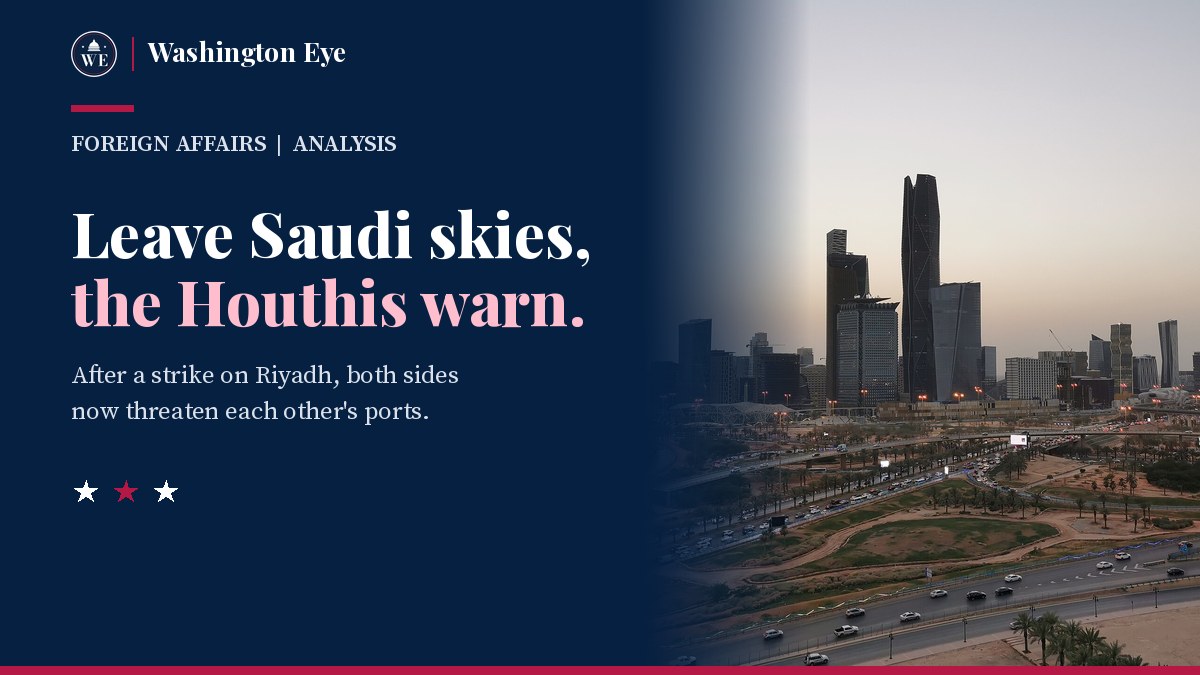
On Friday afternoon, the military spokesman for Yemen's Houthi movement, Yahya Saree, posted a warning that read less like a threat than a flight notice. Saudi airspace, he said, would be "the scene of our operations in the coming hours," and airlines should stay out of it. He made one exception: the skies over Mecca and Medina, the two holy cities.
Within hours the group had added more targets to the list. Saree told workers and residents near the Shuqaiq power station in Saudi Arabia's southwestern Jazan region to evacuate. He declared Riyadh's financial centre a military target and urged people there to leave. He warned that Jeddah and "all Saudi ports along the Red Sea coast" would be hit if the Saudi-led coalition went ahead with its threatened strikes on Hodeidah, the Houthi-held port that serves as Yemen's main gateway for food and fuel. He urged shipping companies to move their vessels out.
The coalition did go ahead. Its spokesman, Major General Turki al-Malki, said its forces "targeted operational capabilities at Hodeidah port that were used in smuggling operations and the transport of weapons and ballistic missiles," and that operations were continuing in Sanaa, Saada and Taiz. By the evening, the coalition said Saudi air defences had shot down five drones and three ballistic missiles over the course of the day, including two missiles fired at Jazan whose debris fell in the Shuqaiq area, the very place the Houthis had named.
Taken one by one, none of these events is new. The Houthis have fired at Saudi Arabia before, and the coalition has bombed Yemen for more than a decade. What changed this week is the scale, the targets and the openness of the escalation. A war that the world had largely filed away as frozen is now being fought, in public announcements, over airports, ports, power plants and the skyline of the Saudi capital.
A tower in Riyadh
The immediate trigger came on Thursday. A Houthi attack struck the Public Investment Fund Tower, the 80-storey, 385-metre skyscraper that dominates Riyadh's King Abdullah Financial District and houses the headquarters of the kingdom's sovereign wealth fund. Saudi Arabia's civil defence authority said several floors of the tower and nearby buildings suffered material damage, and that no one was hurt. Witnesses described a facade damaged across several floors, with windows blown out. Three sources familiar with the matter told a wire service the building had been hit by an incoming missile.
The coalition's first statement said only that it had "dealt with a missile threat" aimed at Riyadh and that debris had fallen. The kingdom's foreign ministry said it reserved the right to take "all necessary measures" to defend its sovereignty and protect its citizens and national assets. The civil defence authority called the attack a "flagrant violation of international humanitarian law."
The symbolism is hard to miss. The fund, chaired by Crown Prince Mohammed bin Salman, manages more than $900 billion and is the main engine of the kingdom's plan to diversify away from oil. The financial district around it is meant to be the showroom for that plan, home to the stock exchange and the regional offices of global banks. It was the second time in less than two weeks that a Houthi strike had damaged a landmark there: the building of the state oil company, Aramco, was hit on November 8. The district was closed to visitors after Thursday's attack.
It also fits a wider pattern. In October, a Houthi attack on Riyadh's King Khalid International Airport killed 14 people, injured hundreds and halted flights for two weeks. The group has struck airports, energy sites and military bases in recent weeks, and the coalition reports intercepting missiles and drones almost daily.
How the truce collapsed
For most of the past four years, Yemen was the quiet front of the Middle East. A truce brokered by the United Nations in 2022 largely halted major attacks between the Houthis and the Saudi-led coalition, which backs Yemen's internationally recognised government. Cross-border strikes on Saudi cities, a routine feature of the war's early years, stopped.
That truce is now gone. Fighting reignited over the summer, and in September the Houthis launched an offensive that swept down Yemen's Red Sea coast and seized ground along the Bab el-Mandeb Strait, the narrow passage between Yemen and the Horn of Africa through which ships travel between the Red Sea and the Indian Ocean. By early October they had cut the main road from the city of Taiz, Yemen's third largest, south to Aden, encircling Taiz and displacing more than 100,000 people.
By November 2, four military sources said the Houthis were within 80 kilometres of Aden, the government's temporary capital, closer than at any point since 2015, when they briefly entered the city before being driven out. Houthi fire has also hit Aden itself, including its airport and, in October, the presidential palace. In mid-November, after government-aligned forces pulled back from parts of the southern coast, Saudi Arabia replaced the commander of its military effort in Yemen.
The Houthi campaign is not happening in isolation. Military sources have described the offensive as a new front in the wider US-Israeli war with Iran, the Houthis' principal backer. The group has stepped up attacks on Saudi Arabia as that war has dragged on, and the coalition has answered with heavier strikes. On Tuesday, coalition strikes on Hodeidah killed at least 14 people, according to the Houthis. Friday's coalition evacuation warning for the port, and the Houthi counter-warning for Jeddah, turned a tit-for-tat into a declared contest over each side's most important harbour.
Why the ports matter
Hodeidah is the lifeline for millions of Yemenis living under Houthi rule. Most of the food, fuel and medicine that reaches the north of the country passes through it, which is why aid agencies have long treated any attack on the port as a humanitarian alarm, not just a military event. A sustained campaign against it would put new pressure on a population that has already lived through one of the world's worst humanitarian crises.
Jeddah and the other Saudi Red Sea ports matter for a different reason. The Red Sea coast is the kingdom's alternative outlet to the world, the route that lets it move goods and crude without relying on the Strait of Hormuz, where Iran has been attacking tankers. A credible threat to those ports, combined with Houthi positions along the Bab el-Mandeb, puts pressure on both ends of the Red Sea at once.
So far, the oil market has shrugged. Brent crude rose early on Friday to about $92.57 a barrel on the Houthi attacks on Riyadh and reports of tanker disruptions in the Strait of Hormuz, then slipped to about $91.31 by mid-afternoon in London, on course for a third straight weekly decline because crude shipments through Hormuz have returned to roughly pre-war levels. Iran's Revolutionary Guards said on Thursday that two tankers had hit naval mines in the strait and were burning, and analysts at one bank counted roughly one tanker incident a day in November.
Not everyone believes the calm will last. "The prices are correct if you believe that this geopolitical risk doesn't come back," said Aldo Spanjer, a commodity strategist at a French bank. "I'm not in that camp who thinks this is done." OPEC+ ministers meet on November 29 to set output policy for 2027, and a successful strike on a Saudi port or power plant would land squarely on that agenda.
What it means for Washington
For the United States, the Yemen front is no longer a side story. The Houthis are an Iranian ally, and every missile that reaches Riyadh is also a reminder that the war with Iran has not ended, whatever the diplomacy. A Pentagon official said this week that the cost of that war has topped $48 billion, a figure that excludes damage to American bases and the care of injured troops.
The timing is awkward for the White House. President Trump returned this week from a summit in China with Xi Jinping and Vladimir Putin whose joint statement promised to increase the world supply of refined petroleum products but made no mention of the wars in Iran or Ukraine. Mr Trump has said all three leaders want the Iran war to end. In the meantime, the Senate on Thursday rejected, by 51 votes to 48, a resolution that would have required congressional approval before new American strikes on Iran, and Congress faces a government funding deadline on December 11 in which money for the war is a live dispute.
Saudi Arabia is one of Washington's closest security partners in the region and a major buyer of American air defence systems. Interceptor stocks, airspace warnings and threats to commercial shipping on the Red Sea all have direct American stakes, from the US Navy's presence in the region to the price Americans pay at the pump if the market's calm breaks.
What to watch
The next hours will show whether Friday's warnings were mainly signalling or the prelude to a new phase. Three things matter most. First, whether the Houthis follow through on Jeddah or another Red Sea port, a step they have so far only threatened. Second, whether airlines treat the warning as credible enough to reroute more widely; an existing European advisory already tells carriers to avoid western and southern Saudi airspace near the Yemen border. Third, whether the coalition's campaign against Hodeidah becomes sustained, which would deepen the humanitarian crisis in the north and harden the Houthi case for striking back.
For now, both sides are doing something unusual in modern war: announcing their targets in advance and telling civilians to leave. That may limit casualties. It also leaves very little room for either side to back down without being seen to blink.