
Every year a team of researchers in Sydney tries to answer a question that diplomats usually dodge: who actually holds power in Asia, and by how much? The answer they published on Sunday should worry anyone in Washington who still thinks of the Pacific as America's lake. In the 2026 edition of the Lowy Institute's Asia Power Index, the United States remains first with 78.9 points out of 100. China is second with 73.6. The gap between them, 5.3 points, is the smallest since the index began in 2018.
The headline number is striking enough. The detail underneath it is more striking still. China's score barely moved, slipping by just 0.1 of a point. America's fell by 1.5. In the authors' own words, the narrowing "owes more to Washington's missteps than to any major advances on Beijing's part." Put simply, China did not sprint. The United States stumbled, and much of that stumble traces back to a war being fought thousands of miles from the Pacific.
How the scoreboard works
The index ranks 27 countries and territories, from Pakistan in the west to Russia in the north and out across the ocean to Australia, New Zealand and the United States. It weighs 131 indicators grouped into eight measures. Four of them describe what a country has: economic capability, military capability, resilience and future resources. The other four describe what it does with them: economic relationships, defence networks, diplomatic influence and cultural influence. More than half the data points come from the institute's own research, including a survey of regional experts, and the rest from public national and international sources.
That design matters for reading this year's result. A country can keep its factories, fleets and money and still lose ground if its neighbours stop believing it will show up. That is broadly what happened to the United States in 2026.
The record fall nobody in Washington is talking about
The sharpest drop came in diplomatic influence. America's score on that measure fell by 6 points to 76.7, its fourth straight annual decline and the largest single year loss on that measure since the index began. The United States now ranks only third in Asia for diplomatic influence. China, by contrast, hit a record high of 98.4 and holds first place, helped by the fact that it takes part in more regional summits and organisations than any other country in the index.
The report lists the causes plainly: punitive tariffs on trading partners, the repudiation of bodies such as the United Nations and the International Criminal Court, and what it calls "a costly and unpopular war in the Middle East against Iran." It also points to two remarks by President Trump that unsettled allies. He described a $14 billion arms sale to Taiwan as a "good negotiating chip" in managing relations with Beijing, and he called for the United States to "substantially reduce" military exercises with South Korea, a treaty ally.
The numbers behind the mood are telling. US voting alignment at the United Nations with the other countries in the index fell sharply, by 36.6 points, reflecting Washington's growing habit of voting alone. In 2026 the United States withdrew from the UN Economic and Social Commission for Asia and the Pacific, a year after leaving the UN Human Rights Council. Experts surveyed for the index judged that Mr Trump's strategic ambition fell further than that of every other leader in the survey except Taiwan's President Lai Ching-te.
Missiles spent in the Gulf are missiles missing in the Pacific
The military picture is where the Iran war shows up most directly. Since the coordinated US and Israeli strikes on Iran in February, the report says, the administration has moved military resources from the 7th Fleet in the Pacific to the Persian Gulf. Strikes on Iran have depleted American stocks of long range missiles. The United States has also held fewer joint exercises and defence dialogues with its main allies in the region, including Australia, Japan and South Korea.
The result is that America's lead over China in military capability is now the narrowest on record. The United States scores 87.4 on that measure and China 72.1. Washington still spends nearly three times as much on defence as Beijing, and it keeps clear advantages in air power, land firepower, ballistic missile submarines, aircraft carriers, amphibious ships and the ability to move forces around the world. But the report adds an uncomfortable caveat: in the Pacific itself, China's military posture and its ability to deploy force quickly and at scale now outmatch those of the United States. China also keeps a sizeable lead in ground based missiles and ground forces, and it is increasingly willing to use its maritime strength to press smaller neighbours such as the Philippines, an American ally.
America's defence networks score fell 4.2 points to 77.3, the lowest since the index began. The authors date the slide to late 2023, when events in the Middle East first began pulling Washington's attention away from Asia. In other words, this is not one bad year. It is a trend that the Iran war has accelerated.
Detente with Beijing, anxiety among friends
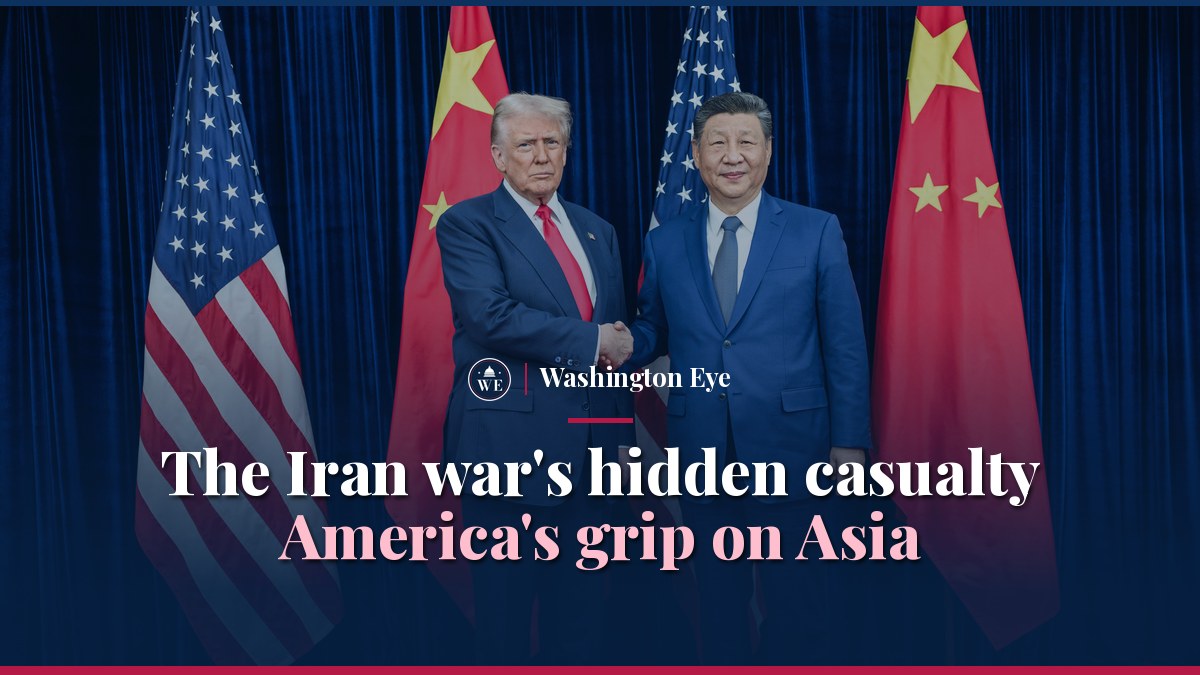
There is a twist in the story. Washington has not been confronting China harder; it has been easing off. After their summit in Beijing in May, Mr Trump and Xi Jinping agreed to pursue what they called "constructive strategic stability." The report says the region broadly welcomes that thaw. Yet the same allies who welcome calmer relations between the superpowers are, in the authors' words, "increasingly anxious about a potential US military withdrawal from the Pacific." They are struggling to adapt to a more transactional foreign policy in which, as the report puts it, treaty alliances and institutions "no longer guarantee their security."
Meanwhile the economic contest has not cooled. Washington has shown no sign of giving up unilateral tariffs, and the two powers are now almost level in economic capability, with the United States on 86.7 and China on 86.1. America still leads on corporate giants and the reach of the dollar, but China's economy keeps outgrowing America's when measured at purchasing power parity, its official reserves are nearly three times larger, and global purchases of dollars fell over 2025 and 2026. The authors stress that any real move away from the dollar "remains a long way off." China's research and development workforce is more than triple that of the United States, and the report says Chinese artificial intelligence models now rival American ones in quality.
The allies are building their own net
If there is good news for Washington in the report, it is that its friends are not waiting around. As American attention drifted, US treaty allies deepened their defence ties with one another. The Philippines signed visiting forces agreements with several countries and a reciprocal access agreement with Japan. Australia agreed to buy Mogami class frigates from Japan, which the report calls Japan's largest defence export since the Second World War. In 2022 Australia held 5 military exercises with Japan and 4 with the Philippines without the United States taking part. By 2025 those figures had grown to 13 and 11. Early in 2026, Japan deployed combat capable ground forces to the Philippines for the first time since the Second World War, as part of the annual Balikatan exercise.
India is gaining too. Its overall score rose to 40.5 points, and the gap between India and China is the narrowest on record, although China's power is still 80 per cent greater. Experts now rank Prime Minister Narendra Modi as the second most effective regional leader, behind Mr Xi.
On the other side of the ledger, the report finds deepening cooperation among China, Russia and North Korea. Trade between China and Russia reached almost $250 billion in 2025, more than a third of Russia's total trade and nearly double its 2022 level. An estimated 11,000 North Korean soldiers are fighting for Russia in Ukraine. The authors find no three way engagement among the trio yet, but warn that if one develops it could threaten the region's existing security architecture.
Why this matters beyond Asia
It would be easy to wave away an index as an academic exercise. Rankings rest on choices about weighting, and a survey of experts measures perception as much as reality. The United States still ranks first on six of the eight measures, still has the strongest military in the world and still anchors the region's alliance system. The report itself says the regional balance "remains markedly bipolar" and that no coherent bloc is emerging to displace America.
But perception is a form of power in Asia. Governments in Manila, Seoul, Hanoi and Jakarta make long term bets on trade, bases and weapons purchases based on who they think will still be around in ten years. The report warns that if Washington keeps leaning on tariffs and pressure, Southeast Asian states are likely to hedge by spreading their trade and security partnerships. Its conclusion is the line that should land hardest in the White House: the administration "can still reverse this trend, but if it remains entangled in the Middle East, US influence in Asia may decline further."
That framing turns a Pacific scoreboard into a verdict on the Iran war. Every month the conflict runs on, and every long range missile spent on it, carries a cost that never appears in a battle damage report. It shows up instead in a ranking compiled in Sydney, in fewer drills with allies, and in the quiet calculations of capitals deciding whether America is still the partner it promised to be. The authors sum it up in a single sentence: 2026 "showed how quickly a superpower can erode its credibility." The question for Washington now is whether 2027 shows how quickly one can rebuild it.