
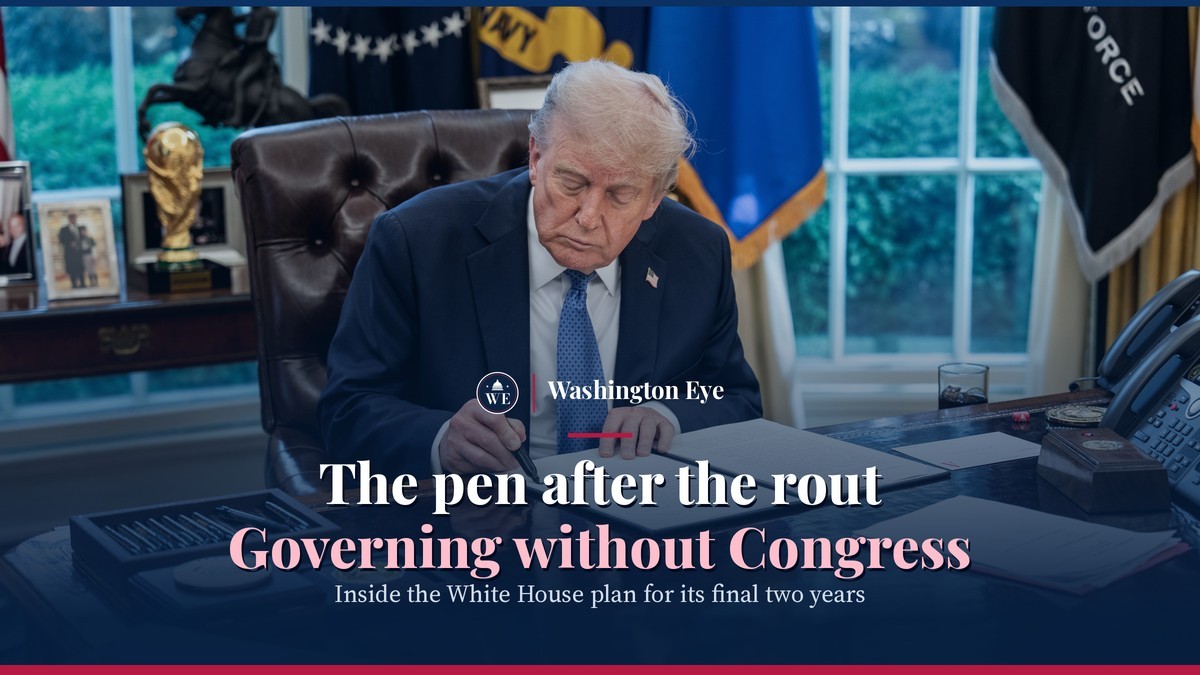
A week after voters handed both chambers of Congress to Democrats, the White House is not preparing to bargain. It is preparing to go around them. The new chief of staff, Stephen Miller, took over from Susie Wiles on Monday. The budget office, the White House counsel and the Justice Department have spent months building a legal and political toolkit for a presidency that no longer needs Capitol Hill to pass anything. Read together, the public record of that planning tells a clear story: the administration intends to treat the midterm result as a change in the weather, not a change in the rules.
That should worry anyone who believes elections are supposed to have consequences. The planning is not secret. Much of it has been described by officials, some on the record and some anonymously, reported by a wire service and a political newsletter, or written into federal notices and legal opinions. What follows is an attempt to put the pieces together.
The blueprint dates to April. According to a wire service report published two days before the election, Miller and budget director Russell Vought have worked since then with the White House Counsel's Office to identify actions on immigration, tariffs, housing costs and federal spending that President Trump could take without a vote in Congress. A White House official described the counsel's assignment as working out "what Trump can legally do on his own, where he could push the limits of his authority and how to defend those decisions in court." Federal agencies have submitted their own proposals and legal reviews. Trump has been briefed and has joined the discussions. Asked how comfortable the president would be governing by executive authority under a Democratic Congress, one person familiar with the plans answered: "very comfortable."
A political newsletter on Tuesday described the same strategy in starker terms, reporting that Trump intends to govern even more forcefully in his final two years, stretching executive power, pardoning allies and daring the courts and Congress to stop him. It noted the historical contrast. Bill Clinton and Barack Obama moved toward the centre after losing midterms. Trump's instinct, the newsletter reported, runs the other way. One adviser put the mood simply: "Trump and his team are at our best when our backs are against the wall."
The first front is trade, and here the paper trail is already in the federal record. The specific measures under review, according to the April planning, include new tariffs on critical minerals and wind turbines. Those are not new ideas. A Congressional Research Service fact sheet dated 8 October shows a national security tariff investigation into wind turbines and their parts that has been open since August 2025, and a separate presidential directive on processed critical minerals issued in January. Both sit under trade laws that let the president act after an executive branch investigation, with no vote required.
The courts have already shown both the reach and the limits of this approach. On 20 February the Supreme Court ruled that the emergency economic powers law the administration had relied on did not authorise tariffs at all. The White House simply changed statutes. It imposed a temporary 10 percent global tariff under a different trade law, which expired on 24 July, and then placed tariffs of 10 or 12.5 percent on 60 economies through a separate investigation. The lesson the administration drew from losing in court was not restraint. It was to find another legal door.
The second front is money, and it is where Congress's core constitutional power is most directly at stake. Vought is studying which priorities can be funded with money Congress has already appropriated, and he wants to rewrite federal grant rules to give political appointees more say over which programmes are funded, according to the pre-election report. That would move spending decisions from the legislature to the West Wing without changing a single law.
The administration has already tested the most aggressive version of this idea. On 25 September, five days before the fiscal year ended, the president told Congress he would not spend $810 million that lawmakers had appropriated for health, education, refugee aid and other programmes. The largest item was $567 million for a refugee assistance programme at the Department of Health and Human Services. Because the request arrived too late for Congress to act, the money simply expired. It was the second such "pocket rescission" in two years, after $4.9 billion in foreign aid was cancelled the same way in 2025. Before that, no president had used the manoeuvre since 1977.
The Government Accountability Office, Congress's own auditor, called the move illegal. "The President may not force the expiration of budget authority Congress has already enacted and did not rescind," it wrote. Vought dismissed the finding online, calling the agency "hyper partisan" and saying it bases its legal views "on whether Democrats are in the White House." The Supreme Court allowed the 2025 cancellation to stand on procedural grounds, while saying its order was not a final ruling on the merits. Senator Susan Collins of Maine, the Republican chair of the Appropriations Committee, has also opposed the tactic.
The third front is personnel, and the Supreme Court has given the president a new weapon. In June the justices ruled 6 to 3 in Trump v. Slaughter that the president may fire members of the Federal Trade Commission at will, overruling a 1935 precedent that had protected independent regulators. Chief Justice John Roberts wrote for the majority. The case arose after Trump fired the commission's two Democratic members in 2025. "The Slaughter case gives the president tremendous powers," Trump said in a telephone interview on Election Day.
The effect is already visible. On Monday the White House sent the Senate 22 nominations, including Christopher Mufarrige to fill the commission seat once held by Alvaro Bedoya, one of the two fired Democrats, along with a Fifth Circuit judge, four district judges and a new director of the federal cybersecurity agency. The timing matters. Republicans keep control of the Senate until January, and the lame duck session is the last chance to confirm lifetime judges before Democrats take over. After that, a public policy professor told the wire service, Democrats will be "very reluctant to approve any of the president's appointments."
The fourth front is the most troubling: the response to oversight itself. Democrats have promised sweeping investigations. Representative Robert Garcia of California, expected to chair the House Oversight Committee, told administration officials to "lawyer up." On Saturday the president answered on a social media platform, calling the Democratic plans "extortion," writing that "the imprisonment should be against these EXTORTIONISTS," and declaring that he was "ordering the Department of Justice to look into this criminal act, immediately!"
On Sunday, Attorney General Todd Blanche refused to rule out prosecuting lawmakers. In a television interview he acknowledged Congress's constitutional oversight role but did not name any criminal statute or confirm that an investigation had begun. "I would be very worried if I was a member on that committee," he said. Garcia replied: "They can come after us however they want. We're not going to be intimidated." A longtime Trump ally, Roger Stone, went further, telling the political newsletter that "many Democrat lawmakers are going to find themselves under indictment." It is worth remembering that in February a federal grand jury refused to indict Senator Elissa Slotkin and five other Democratic lawmakers over a video urging troops to refuse unlawful orders.
Behind the public threats sits quieter legal work. White House lawyers have briefed political appointees on handling subpoenas and document requests and advised them to be careful about what they put in writing, according to the wire service. In August the Justice Department's Office of Legal Counsel issued an opinion concluding that executive privilege can cover the president's communications with advisers who do not work for the government. A former official of that office told a cable news network the question had never been directly tested in court. In practice, the opinion gives the White House a ready answer when investigators ask about outside advisers.
Then there are pardons. In a television interview broadcast on Sunday, Trump said he intends "to issue tremendous numbers of pardons," possibly covering people who "got within a thousand miles of the Oval Office." He called a pardon for himself "not unreasonable," though he said he did not expect to issue one. Preemptive clemency would blunt one of the few tools Democrats have that does not depend on the president's cooperation: the ability to expose wrongdoing and refer it for prosecution.
The White House frames all of this differently. A spokeswoman said before the election that the administration and "commonsense Republicans" would keep securing the border and "putting more money back into the pockets of hard-working Americans." Trump himself has predicted a period of confrontation followed by compromise. "I guess I'll become Mr. Veto," he said before the election, adding that "at some point, we'll probably make deals." There are hints of that, too: the newsletter reported the president may soften some immigration enforcement tactics and could sign a bill reversing Medicaid cuts in his own 2025 tax law.
But the weight of the evidence points in one direction. Every piece of the plan is designed to make Congress optional: tariffs through investigations rather than legislation, spending through grant rules and expiring funds, regulators who serve at the president's pleasure, oversight met with threats of prosecution, and clemency held in reserve for anyone caught. Taken one at a time, each step has a legal argument behind it. Taken together, they amount to a claim that the branch voters just changed does not much matter.
That claim deserves a firm answer, and Democrats have the tools to give one. They can write a ban on pocket rescissions into the next spending bill and refuse to fund programmes the White House has already shown it will not spend as directed. They can use the Senate's confirmation power to insist on qualified, independent nominees. They can run disciplined, evidence-based investigations that give the Justice Department no pretext. And they can keep taking overreach to court, where the tariff ruling showed that even this Supreme Court will draw lines.
None of that will be quick, and the president's veto means little will become law without Republican votes. Still, the midterm verdict was about more than prices or a war. It was a request for a government that answers to someone. A White House that plans its final two years around avoiding that answer is not governing through divided government. It is governing in spite of it.