
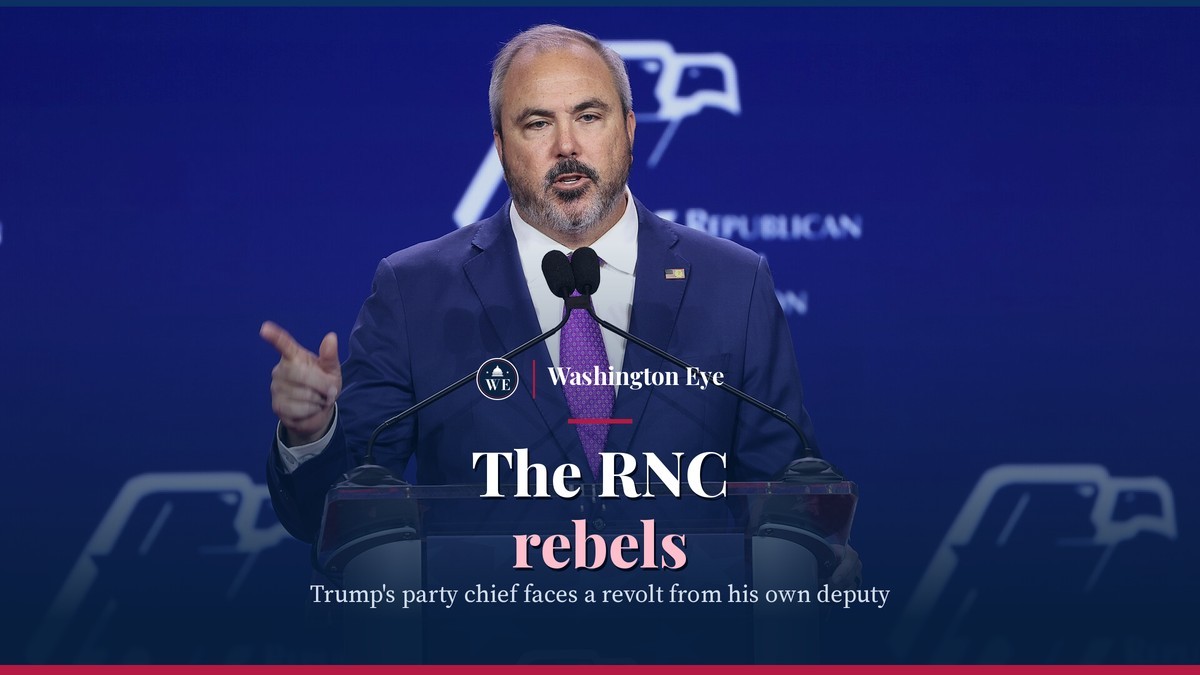
Inside the Republican Party, the fight over what went wrong on 3 November has finally found an address: the chairman's office at the Republican National Committee.
A small but growing faction of the committee's 168 members is trying to remove Joe Gruters, the chairman Donald Trump installed in August 2025 and wants to keep. Their candidate is KC Crosbie, the committee's co-chair and its second most senior official. The rebels are demanding a forensic audit of how the party spent its money in a cycle it lost badly despite a large fundraising advantage. Among the spending now being picked over is a line almost designed to go viral: the committee paid for hair and make-up services for senior White House officials, including the president himself.
The White House has answered with a threat. An administration official warned that if Crosbie wins, fundraising events featuring Trump, Vice President JD Vance and members of the Cabinet would stop, and the committee would lose the right to use the president's name, likeness and signature in its appeals. For an organisation that raises money largely on the strength of one man's brand, that is close to a death sentence.
The vote is not until January, at the committee's winter meeting in Scottsdale, Arizona. But the contest is already the clearest internal test of Trump's authority since Republicans lost control of both the House and the Senate.
What makes the revolt unusual is who is leading it. Crosbie is not a Trump critic. She is a long-time supporter of the president and his Make America Great Again agenda, a Kentucky Republican who has served as the state's national committeewoman since 2012, was previously the committee's treasurer and became co-chair in January 2025. Trump backed her for that job, just as he backed Gruters for his.
She launched her bid on 5 November, two days after the election, in a letter to every committee member. "Tuesday's results were a serious setback," she wrote. "We owe ourselves an honest account of why." Her diagnosis was blunt by the standards of a party that rarely criticises its own machinery in writing. "Voters were focused on the cost of living, and the direction of the country," she wrote. "Our improvements in field operations, voter contact, and election integrity infrastructure were valuable, but they did not address those concerns or deliver the results we needed."
She also questioned whether the party had backed its candidates properly and whether it had nominated people capable of winning competitive races, and she complained that rank-and-file members had been shut out. "RNC members should have a meaningful voice in the decisions that shape our party," she wrote. "I believe the RNC has fallen short of that responsibility, and I hope to see that change." Crosbie has declined interview requests since.
The letter landed badly at the White House, where officials said they were blindsided. "People are infuriated that she did not give anybody a courtesy call," an administration official told a US news site. "The only reason she is currently the Co-Chair is because of President Trump."
Trump moved within a day. In a lengthy post on his social media platform he called Gruters a "MAGA Warrior", gave him his "Complete and Total Endorsement" and credited him with turning the committee into an "efficient, focused, and powerful machine". "Joe Gruters should return as Chairman of the RNC to continue to build our Party," he wrote.
Eleven days later, the argument has moved from strategy to spending, and it has turned ugly. Feuding members are leaking emails and opposition research on rival factions. Gruters' critics say a committee that out-raised its rivals should have far more to show for it.
"There's clearly a groundswell of support for a forensic audit," said Oscar Brock, a committee member from Tennessee who is backing Crosbie. He framed the dispute as a question of purpose rather than loyalty. "Our job is to elect Republicans broadly, not to support one man all the time," he said, adding that "there's so much frustration that Chairman Gruters didn't pull his weight in this election."
Gruters has tried to get ahead of the charges. In a letter sent to members on Thursday night and later reported by a wire service, he took on three of the most talked-about items one by one.
The first was a $22,500 hospitality space at the Presidents Cup golf tournament. Gruters said the space was offered to major donors and "resulted in $2.5 million in renewed contributions to the RNC."
The second was a contract with Caroline Wiles, a veteran Republican consultant and the daughter of Susie Wiles, Trump's former chief of staff. Gruters said she had been hired by his predecessor, Michael Whatley. "While I have no reason to doubt Caroline Wiles' value to the RNC or Chairman Whatley's reasons for bringing her on, this was a brief six-month engagement that ended when I was elected Chairman," he wrote.
The third was the make-up. Gruters confirmed that the committee paid for "hair and make-up services" for senior White House figures, including Trump, Vance and Karoline Leavitt, the former press secretary. "This was a request made of us so that the expense did not fall to taxpayers," he wrote, arguing that the officials "generously gave so much of their limited time and energies to help the RNC this cycle" and "did not ask for much of us in return, so we felt this was a request we could accommodate."
None of these sums is large by the standards of a national party. That is partly the point for his critics. The items are small enough to explain, but they make an easy symbol for a deeper complaint: that the committee became an extension of the White House rather than a machine for electing Republicans up and down the ballot.
Gruters is not without defenders, and their argument is practical. A leadership change now, his allies say, would leave the committee starting from scratch just as the 2028 presidential cycle begins, with a new team needing months to learn the job. Open friction between the president and the party's leadership would also hurt its ability to organise and raise money, which is exactly what the White House threat makes explicit.
They also reject Crosbie's central demand. A formal post-election review, they argue, would consume six months rehashing the past and put every grievance on paper, handing Democrats a ready-made document about Republican failure.
Lauren LePage, a committee member from Maine, offered the most personal defence. She credited Gruters with helping her father, Paul LePage, flip a congressional seat, one of the few bright spots for Republicans this year. "From my perspective, as chairman, he did his job," she said, adding that Trump's endorsement is "something that the committee should take very seriously."
Gruters himself has spent the past week on private calls with members. Those who took part said he listened to their grievances but said little about what he would do differently.
The arithmetic in January starts small. To be formally nominated, a candidate needs the backing of at least two members from each of ten states, twenty in all. Sue Cienki, a committee member from Rhode Island, predicts that Crosbie will clear that bar. Getting from twenty to a majority of 168 is a much harder climb.
History is not on the challenger's side. Sitting presidents have traditionally chosen their party's chair, and the committee has almost always gone along, turning the leadership vote into a formality. Even without a Republican president in office, the last serious insurgency failed: in January 2023, after a disappointing midterm, Harmeet Dhillon challenged Ronna McDaniel, and McDaniel won a fourth term by a wide margin.
This time there is an extra source of pressure. Some members who sympathise with Crosbie privately admit that they fear retaliation from the White House, especially now that Stephen Miller, one of the president's most combative aides, has become chief of staff. Others simply believe in the tradition that a president picks his own party chief, whatever the election results.
Crosbie's backers say that tradition is exactly the problem. They point to Republican losses even in strongholds such as Texas, South Carolina and Mississippi, and argue that the party must send a visible signal that something will change. Patti Lyman, a committee member from Virginia, said it would be "catastrophic" and "insulting" to the party's base "to keep the same leadership and pretend that we don't need to do anything different, that we don't need new players and a new plan."
On paper, January's contest is about who runs a party committee, a job most voters could not describe. In practice, it is a referendum on a question Republicans have mostly avoided since election night: whether the president's control of the party should survive what a wire service called the party's worst midterm performance in a generation.
So far, the answer from Republican leaders in Washington has been yes. They have stood behind Trump and most of his least popular policies, and few have suggested the party move on. The committee is different. Its members are elected by state parties, many of them activists and donors who answer to voters back home rather than to the White House, and the chairman they choose will run the machinery of the 2028 nominating contest, in which Trump is expected to play a central role.
If Gruters wins comfortably, the White House will have shown that even a historic defeat has not loosened its hold on the party's apparatus. If Crosbie gets close, or wins, it will be the first concrete evidence that the people who run the Republican Party at the state level are ready to tell the president no. Either way, the audit fight has already done one thing Gruters' allies wanted to avoid. It has put the party's post-election grievances on paper, one invoice at a time.