
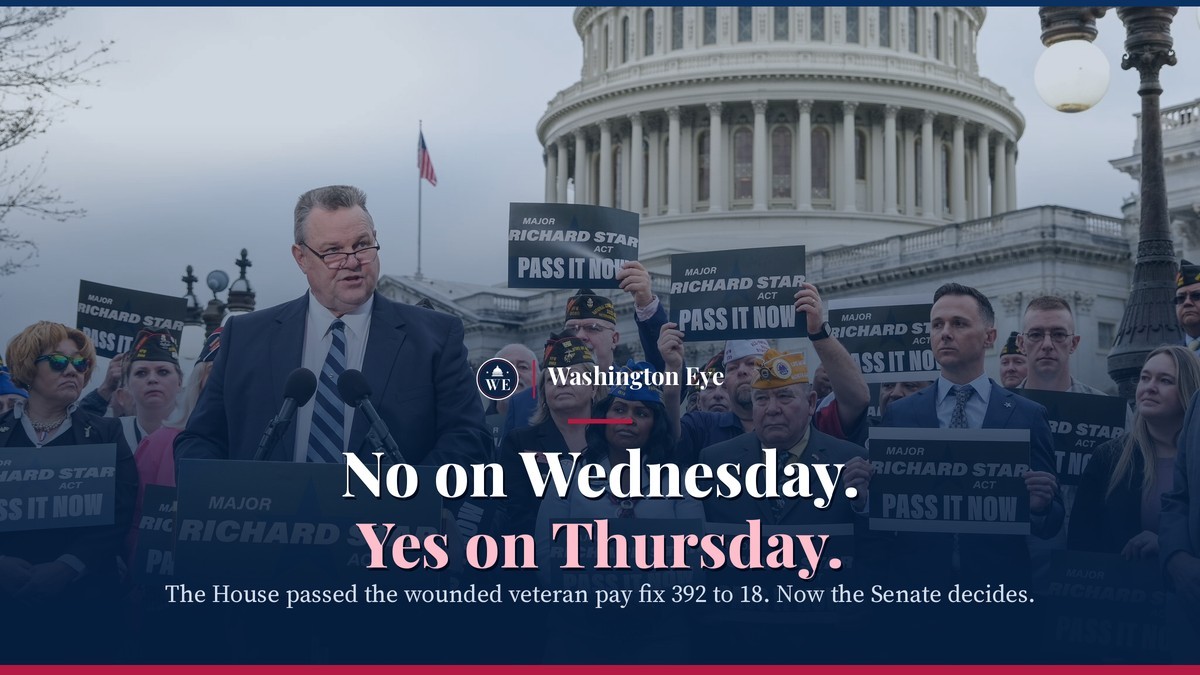
On Wednesday, Veterans Day, Speaker Mike Johnson voted against letting the House take up the Major Richard Star Act on its own. On Thursday morning he voted for it. So did Majority Leader Steve Scalise and Mike Bost of Illinois, the Republican chairman of the Veterans' Affairs Committee. All three had been on the losing side of a 245 to 175 vote the day before, when a bipartisan coalition took the bill out of their hands. By the time it reached final passage, only 18 members of the House were willing to vote no.
The final tally, 392 to 18, makes the bill look like the easiest call in Washington. It is not. Behind the lopsided number sits a six-year fight over a narrow but emotional question: whether veterans forced out of the military by combat injuries should lose part of their retirement pay because they also receive disability compensation. The House has now said yes twice, in two different bills that pay for the change in two very different ways. The Senate, which has repeatedly refused to move the idea, now has about seven weeks to pick one, or neither.
Here is what passed, how it got to the floor, and why its future is far less certain than the vote suggests.
Under current law, a service member who is medically retired with fewer than 20 years of service has military retirement pay reduced, dollar for dollar, by the amount of disability compensation received from the Department of Veterans Affairs. Advocates call it the "wounded veteran tax." Retirees who complete a full 20-year career and carry a disability rating of 50 percent or higher have been able to collect both payments since 2004. Those whose careers were cut short by their wounds were left out.
The Star Act would end the offset for medically retired veterans with fewer than 20 years of service whose disabilities are combat-related. It does not raise disability ratings and does not apply to every disabled veteran. The Congressional Budget Office estimated in late October that about 58,000 veterans would qualify and that their combined pay would rise by an average of about $1,450 a month, roughly $17,400 a year. The average offset they face today is about $2,275 a month. Over ten years the bill is projected to cost $12.75 billion, and the House version contains no offsetting cuts.
The change would take effect on the first day of the month after the bill is signed. A law enacted in December would show up in January payments.
The bill carries the name of Richard Star, an Army combat engineer who was medically retired after developing terminal cancer linked to burn pit exposure during deployment to the Middle East. He pressed Congress to change the rule and died on February 13, 2021, at age 51. "Six years ago, Major Star asked Congress to fix this. He died before we could," said Representative Mark Takano of California, the top Democrat on the Veterans' Affairs Committee, after Thursday's vote.
The puzzle is why a bill with this much support needed a procedural rebellion to get a vote at all. Versions have been introduced since 2020. In 2023 it passed 290 House cosponsors and was placed on the chamber's Consensus Calendar, yet still did not reach the floor. The current version, H.R. 2102, was introduced in March 2025 and drew more than 330 House cosponsors. Its Senate companion, led by Senator Richard Blumenthal of Connecticut, has about 80. Defense Secretary Pete Hegseth endorsed it earlier this year, according to a Capitol Hill newspaper.
The obstacle has always been money. In 2021 the House Rules Committee blocked the bill as an amendment to the annual defense authorisation because it lacked an offset, according to Takano's committee office. Republican senators have objected to attempts to pass it quickly in 2025 and again this year, citing cost.
Takano filed a discharge petition on May 21, 2026. The tool lets a majority of members force a bill to the floor over the objection of the leadership, once 218 lawmakers sign. On September 15, Representative Nancy Mace, a South Carolina Republican, supplied the 218th signature. In the end 213 Democrats and five Republicans signed, a military newspaper reported.
Republican leaders had their own plan. On June 10 they introduced the Take Care of America's Veterans Act, a package that folds dozens of veterans bills into one. It includes a version of the Star Act, but a smaller one: a formula caps the restored pay, so some eligible veterans would receive less than under the standalone bill. To cover the cost, the package changes how the department rates two of the most common disability claims, tinnitus and sleep apnea, for future claims. Republicans say this follows a ratings update the department proposed in 2022 to reflect advances in treatment, such as breathing machines for sleep apnea. The House version bars cuts to compensation already being paid.
That package came first. At about 2:45 p.m. on Veterans Day the House approved it by voice vote, with no recorded roll call. Democrats had been told by their whip to vote no, but nobody on their side asked for a recorded vote. They accused Republicans of drawing Takano away from his microphone to discuss changes at the moment the bill was called. A Republican aide told a Capitol Hill newspaper that Democrats had simply failed to have a member ready to demand a roll call.
Takano was furious. "They did it by voice vote, in seconds, with no roll call and no names," he said. The Veterans of Foreign Wars called the package "the largest net benefit cut since the Great Depression." Bost, its lead sponsor, called it a "historic" expansion of veterans' health care and benefits and said he wants it on President Donald Trump's desk before the end of the year. His message to veterans, he said, was that House Republicans "have got your back."
Later that same afternoon the House voted on the motion to discharge. It passed 245 to 175. According to the official roll call, every Democrat who voted and one independent backed it, joined by 34 Republicans. All 175 no votes came from Republicans, among them Johnson, Scalise, Bost and Majority Whip Tom Emmer.
On Thursday the rule setting terms for debate passed 271 to 135, with 135 Republicans opposed. Then came final passage. The official roll call shows 210 Democrats, 181 Republicans and one independent voting yes. Eighteen Republicans voted no, including Chip Roy of Texas, Andy Biggs of Arizona and Ralph Norman of South Carolina. Nineteen Republicans and four Democrats did not vote. One of them was Dan Crenshaw of Texas, a medically retired Navy SEAL, who abstained and called current compensation for tinnitus and sleep apnea "absurdly high," according to a major American newspaper.
The two votes measured different things. The 245 to 175 vote was about control: whether leadership or a cross-party majority would decide which bill reached the floor. The 392 to 18 vote was about the policy itself. Once leaders lost the procedural fight, there was little reason for them to vote against a benefit for combat-wounded veterans, and nearly all of them voted yes.
"Today, against the will of the House Republican leadership, we passed a bill to help tens of thousands of my fellow veterans," said Representative Chris Deluzio of Pennsylvania, a Navy veteran.
Both bills now sit in the Senate, and the chamber has no equivalent of the discharge petition. Most legislation there needs 60 votes to overcome a filibuster, or unanimous consent to pass quickly. Either route requires leaders to give it floor time, and floor time is scarce. Senate Republicans have said that confirming as many as two dozen judicial nominees before they lose their majority is a top priority. Government funding runs out on December 11.
The two sides are dug in on how to pay. Blumenthal has said the Republican package "will be defeated in the Senate." He wants to pay for the standalone bill with unspent Pentagon money from last year's tax and spending law, arguing that "more than $75 billion" of those defence funds "remain unspent and unobligated." Senator Jerry Moran of Kansas, the Republican chairman of the Senate Veterans' Affairs Committee, objected to that approach in July, saying the Congressional Budget Office had confirmed it would not be a viable offset and would break budget rules. "None of the opponents of this legislation have identified a viable alternative or solution," Moran said then. After the House vote on the package, he said he would work with colleagues to "see it become law."
Fiscal conservatives in the Senate have a separate objection: the standalone bill adds roughly $13 billion over a decade with nothing to pay for it. That argument sits awkwardly beside the 181 House Republicans who just voted for it, but the Senate has never been bound by the House's arithmetic.
The clock is the last variable. The 119th Congress ends on January 3, 2027. Any bill that has not cleared both chambers by then dies and must start again. Democrats will hold majorities in both chambers in the new Congress, and the Star Act would almost certainly return early. But a Democratic Senate would still need Republican votes to reach 60, and the funding question would not disappear with the change of power.
For the roughly 58,000 veterans who would qualify, the practical stakes are simple. If the Senate acts in December, the extra money could arrive in January. If it does not, the whole process begins again, with a new bill number, a new cost estimate and another round of the same argument about who pays.
The House has now shown it can produce a near-unanimous vote for the policy. What it has not settled, and what the Senate must decide, is whether the money comes from new borrowing, unspent defence funds or future ratings for other veterans. That question, not the 392 votes, will decide whether Major Star's bill becomes law.