
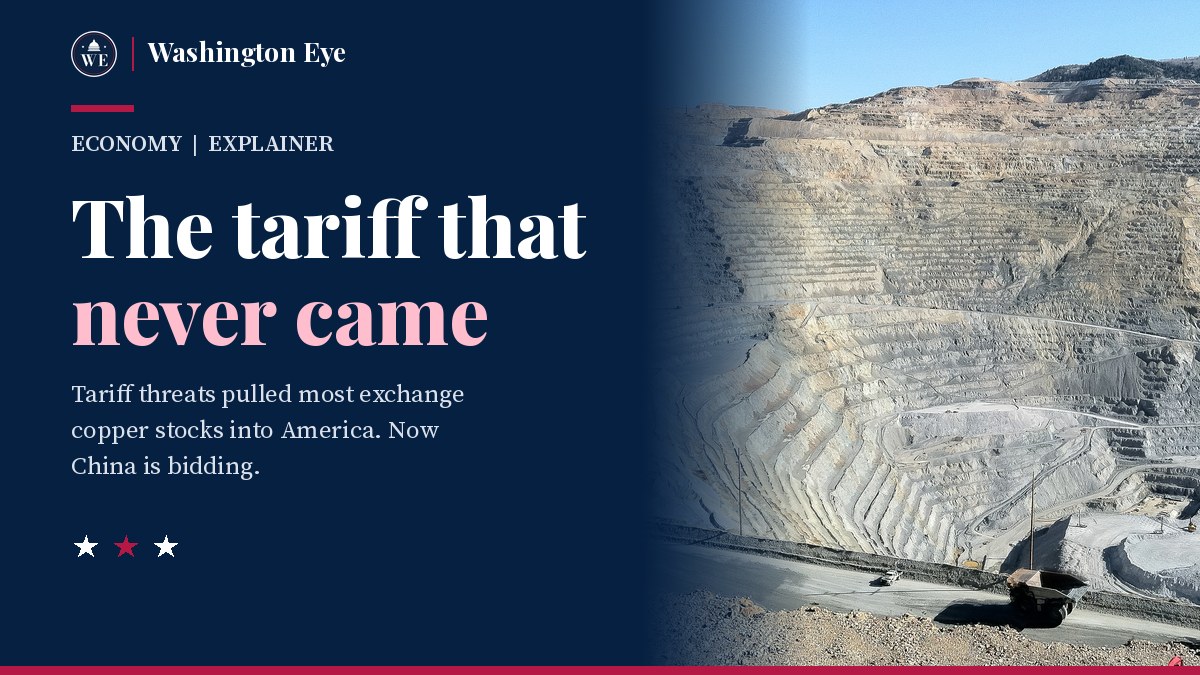
For most of the past two years, the most important copper tariff in the world has been one that does not exist. Washington never put a duty on refined copper, the pure cathode sheets that wire makers and pipe mills turn into almost everything electrical. It only said it might. That possibility was enough to pull a mountain of metal into American warehouses, drain stocks elsewhere and set up one of the strangest commodity markets in years.
Now the mountain is starting to shift. After this month's midterm elections, which handed Democrats control of both chambers of Congress from January, traders have begun to bet that the threatened duty will be delayed, softened or quietly dropped. Chinese buyers, short of metal, are paying record premiums to get it. And some copper that crossed the Pacific to beat a tariff is now being booked to cross it again in the other direction.
Here is how a policy that was never enacted reshaped a global market, and why it matters well beyond the trading floors.
What Washington actually did
The story begins on July 30, 2025, when President Trump signed a national security proclamation on copper under Section 232 of the Trade Expansion Act of 1962. It imposed a 50% tariff, from August 1 of that year, on semi finished copper products such as pipes, wires, rods, sheets and tubes, and on copper intensive goods such as cables and connectors. In April 2026 the White House widened that, applying the 50% rate to the full value of semi finished products and 25% to the full value of copper heavy derivatives, with a lower 10% rate where nearly all the metal is American.
What the proclamation did not do was tax copper in its raw and refined forms. Ores, concentrates, cathodes, anodes and scrap were left out. Instead, the President relayed a recommendation from his Commerce Secretary, Howard Lutnick: a phased universal tariff on refined copper of 15% starting in 2027 and 30% starting in 2028. Commerce was told to report back on the domestic market by June 30, 2026, after which the President could decide whether to go ahead.
That report was delivered, according to a White House official. A decision was not. In September, people familiar with the discussions said the plan had stalled as officials weighed the benefits of encouraging domestic mining against the risk that pricier copper would raise costs for American manufacturers. The official said only that the administration "continues to evaluate all options to reshore copper and other critical manufacturing back to the United States." As of this weekend, no decision has been announced, and January 1, 2027, the date the first 15% would bite, is less than six weeks away.
How a threat built a stockpile
Markets do not wait for decisions. If a trader believes copper held inside the United States may soon be worth 15% or 30% more than copper held anywhere else, the rational move is to ship it in early and sit on it. Miners and merchants did exactly that, prioritising shipments to American ports for two years.
The result is visible in the warehouse data. Depots monitored by the main New York futures exchange held 732,943 tonnes of copper in early November, more than double the level a year earlier. Across all the major exchanges, monitored inventories stood near 1.09 million tonnes in mid November, and roughly 85% of that metal sat in American warehouses, according to an analysis by Ole Hansen, head of commodity strategy at Saxo Bank.
Meanwhile, the world's largest consumer ran short. Stocks in warehouses watched by the Shanghai Futures Exchange fell to 27,642 tonnes, the lowest since December 2023 and less than a single day of Chinese consumption. Earlier this month the expiring November contract in Shanghai briefly traded more than $2,100 a tonne above December delivery, a squeeze so severe that the exchange encouraged traders to settle in cash rather than hunt for physical metal.
Why the midterms flipped the trade
The election changed the arithmetic. With Republicans heavily defeated, traders and analysts began to price a lower chance that the refined copper tariff would arrive on schedule. One bank's strategists said copper faced a further slide because the result had weakened expectations for import tariffs. China based market participants told a pricing agency they increasingly expected a delay or a milder version of the 2027 duty.
You can see the shift in the gap between New York and London prices. A month before the vote, copper in New York traded about $89 a tonne above the London benchmark, the premium that made it worth shipping metal to America. By November 4 that had flipped to a discount of about $85. The incentive to send copper to the United States had largely disappeared.
At the same time, the pull from China grew fierce. The Yangshan premium, which measures what Chinese buyers will pay for imported copper on top of the London price, was below $100 a tonne in September. It hit a record $230 on November 9, climbed to $360, and then jumped almost 40% in a single day to a record $500 on Thursday, November 19. The premium for spot copper inside China over Shanghai futures reached an all time high of 7,250 yuan, about $1,088, a tonne.
Is the copper really going back?
Some of it, yes. People with knowledge of the trade said this week that tens of thousands of tonnes of refined copper that had piled up on the American West Coast, metal never registered in exchange warehouses, is set to arrive in China in January. A Chinese trading company, Xiamen Xindeco, and the global trading house Mercuria were named among those shipping it. Neither responded to requests for comment. Traders were offering around 1,000 tonnes from the United States to Chinese customers at a premium of $300 a tonne. A European newspaper went further on Saturday, reporting that hundreds of thousands of tonnes could cross the ocean by February.
Plenty of seasoned voices are not convinced the flow will be that large. The metal sitting in America is still a bet on a tariff, and that bet has not been called off. "For it to happen I think you'd need tariffs to be definitively ruled out," said Amy Gower, a metals strategist at Morgan Stanley. "Our base case is that the US material will be quite sticky and will only get drawn down through under importing." Natalie Scott-Gray, a senior metals analyst at StoneX, doubted the Chinese premium would last. "It would need to go higher and stay there in order to really pull that material out," she said.
In other words, the stockpile is a hostage to a single decision in the White House. Confirm a phased tariff for 2027 and the metal stays put, or more of it arrives. Rule it out and a large share of the world's visible copper could start moving at once.
Prices are falling while metal is scarce
The oddest part of this market is that prices and physical supply are pointing in opposite directions. December copper futures in New York fell to around $5.80 a pound in mid November, a seven month low and about 16% below the record near $7 set in September. Large speculators cut their bets on higher prices from more than 80,000 contracts to about 35,000 in six weeks, close to a 14 month low.
Part of that is the tariff unwinding. Part is doubt about the artificial intelligence boom, which had become a pillar of the bullish case for copper because data centres are full of it. American construction spending on data centres reached a record annualised $96.5 billion in September, according to an industry newsletter, but analysts warn that local resistance over power bills and land use, emboldened by the election, could slow that building. China's weak property sector adds to the gloom.
Supply, meanwhile, remains tight for reasons that have nothing to do with Washington. Chinese smelters are struggling to find ore concentrate and scrap. A crackdown on illegal mining in the Democratic Republic of Congo, China's biggest source of refined copper, saw the government seize more than 500 trucks. Older mines in Chile, the largest producer, are working ever lower grades of ore. "The current correction is challenging expectations about how quickly copper demand will grow, rather than removing the need for substantial investment in future supply," Mr Hansen wrote.
Why it matters beyond the trading floor
Copper is not an exotic commodity. It is in household wiring, plumbing, air conditioners, electric cars, wind turbines and the transmission lines that every grid upgrade requires. When metal is pulled into one country by policy rather than by demand, it leaves less for everyone else, raises costs where supply is thin and creates a risk of a sudden glut where it is thick. Manufacturers on both sides of the Pacific have spent two years planning around a rule that was never written.
For the United States, the episode is also a test of what the tariff strategy was meant to achieve. The stated goal was more American mining and refining. There are signs of that: Freeport-McMoRan's board has approved a $4.5 billion expansion of the Bagdad mine in Arizona that would more than double its output to over 400 million pounds a year from mid 2030, and Rio Tinto is putting $144 million into the Resolution Copper project in Arizona after a court victory over a land swap. But mines take years. A stockpile built in months can leave in months.
For China, the episode shows how exposed even the world's dominant copper processor is when traders reroute metal toward another market. For everyone else, it is a reminder that in modern trade an announcement can move as much as a law.
What to watch
Three things will decide where this goes. First, the White House decision on the 2027 refined copper tariff, which could come at any moment or simply be left to lapse. Second, the January arrivals in China, which will show whether the reverse flow is a trickle or a wave. Third, whether the Yangshan premium holds near its records; if it falls back, the economics of shipping copper out of America weaken again.
Until Washington says yes or no, the world's biggest pile of copper will keep sitting in American warehouses, waiting on a tariff that may never come.