
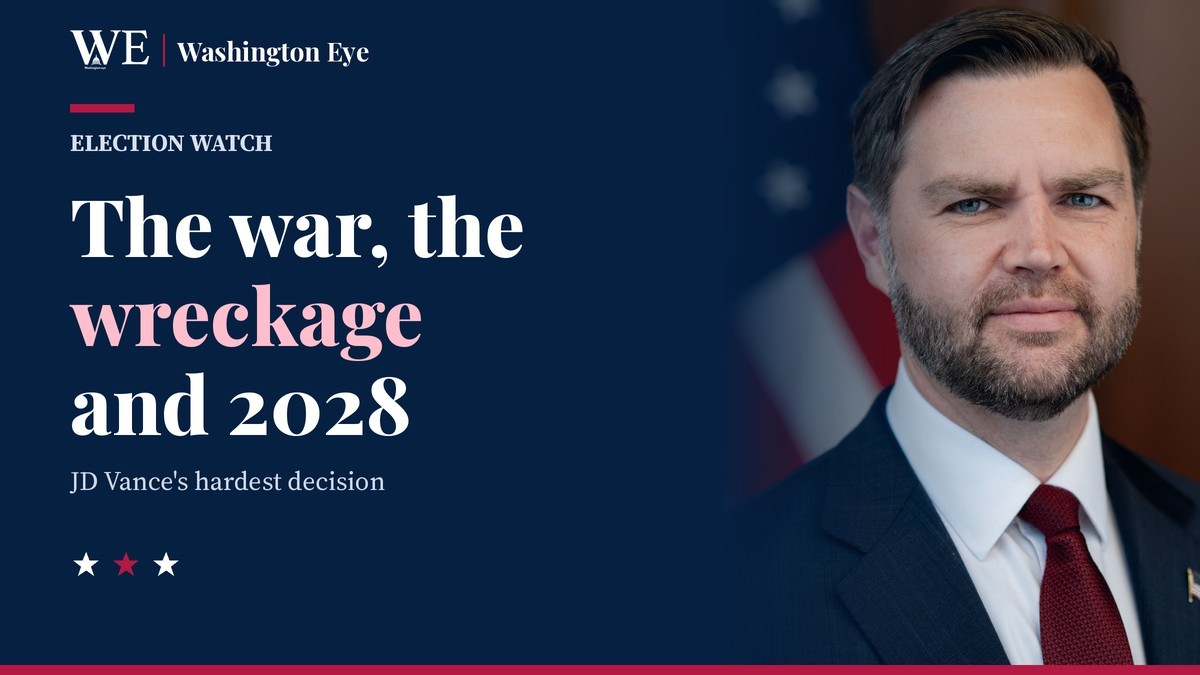
A week ago JD Vance was the closest thing the Republican Party had to an heir apparent. He led early primary polling, he chaired fundraising for the national party, and he had spent the autumn crossing the country as the administration's chief midterm surrogate. Then came Tuesday. Democrats took both chambers of Congress, flipped seven Republican Senate seats, including the Ohio seat Vance himself held until 2025, and won governorships in Georgia and Texas. The vice president's audition for 2028 ended in the worst Republican night in a generation.
Now the question in conservative Washington is no longer simply whether Vance will be the nominee. It is whether he will run at all, and if he does, what kind of Republican he intends to be once Donald Trump's name is no longer on any ballot.
Vance answered part of that question within a day. In a long statement posted online on Wednesday, he offered the bluntest postmortem any senior figure in the administration has given. "The real reason we lost is obvious to almost everyone," he wrote. "The reason we lost is the war. The president himself said so last night." He then dared his own side to disagree in public. "If you'd like to argue it was worth it, that losing the Senate for the next 6 years was worth it, then do so. Argue it was a worthwhile cost to pay. Agree or disagree, that's at least honest."
The statement leaned on the work of a pollster Vance did not name, who he said had asked Trump voters who defected to Democrats what would bring them back. According to Vance, nearly all of the answers fell into four categories: end the war, focus on the cost of living and inflation, put America first, and change the relationship with Israel. His argument was not that Republican voters stayed home. It was the opposite. "Our voters showed up," he wrote. "The main problem is that many people who voted for Trump/Vance in 2024 voted for Democrats in 2026."
For conservatives, that is a striking claim, and one that cuts against the instinct of a defeated party to blame turnout, money or the media. It locates the problem in policy. It also quietly separates the vice president from the president who chose that policy.
Trump has offered a very different reading. Asked about the losses on Wednesday, he said the result reflected his absence from the ballot. "If I were on the ballot, we would have won," he said, describing packed rallies and adding that "you couldn't transfer that love" to other candidates. On the war itself he has been unrepentant. "I did the right thing," he said on election night, according to a major American newspaper. "I would have done it again."
That gap between the two men is now the central fact of Republican politics. Vance has spent years as the most articulate advocate of the populist programme that carried Trump back to power: economic nationalism, restraint abroad and a hard line on crime and borders. A review by a wire service of half a dozen of his speeches since the party's September convention found that in the closing weeks of the campaign he talked less about the president and more about those themes, while largely avoiding the Iran war and mass deportations as polls showed Trump's popularity sinking. Two people familiar with the strategy told the wire service the shift was deliberate.
Wednesday's statement took that approach into the open. Republicans in Washington widely read it as the first step in distancing himself from the most unpopular parts of the administration's record. It was endorsed online by Donald Trump Jr., a signal that the break is not, at least yet, a break with the Trump family. Michael Ricci, a Republican strategist who once advised House Speakers John Boehner and Paul Ryan, said the post had forced conservatives to argue about the merits of the war and, more broadly, about what a Republican presidential candidate should stand for in 2028.
There is history behind Vance's position. According to text messages described by a major American newspaper, he privately urged the president in January not to give up on diplomacy as Trump weighed a major military operation, and he gathered polling on the risks of all-out war. That polling found the public split 44 percent to 43 percent on going to war, but 62 percent said fewer than 100 American combat deaths would be acceptable, and 65 percent said the president should seek approval from Congress first. Those numbers now read less like a warning than a forecast.
Yet the same reporting shows how fragile Vance's position has become. People close to him say he and his allies are privately debating whether he should run in 2028 at all. Some have told him they no longer believe any Republican can win the White House in two years. On Election Day a longtime confidant texted him to consider sitting out the race. Two people close to him suggested he return to Ohio to run for his old Senate seat or for governor instead. He rejected both ideas, and has told associates he has not made up his mind. Within a day of the vote, a veteran New York fundraiser was hearing from major donors who said they could not support Vance and who floated Florida Governor Ron DeSantis instead.
Vance's own words before the election left the door open. At a town hall in October he acknowledged that "there's a chance" he never runs. In a television interview the same month he said the midterm results would feed into his decision. "Regardless of what happens over the next 35 days, there will be new information, new things you have to make a decision over," he said. The new information has arrived, and it is grim.
Nowhere is it grimmer than on the electoral map. Kansas, South Carolina, Texas, Ohio and Iowa, all states Trump carried easily two years ago, elected Democrats to the Senate. In Texas, Democrats won their first Senate race in 38 years, defeated three-term Governor Greg Abbott and took control of the state House. Ohio, which Vance represented and which Trump turned into safe Republican ground, sent a Democrat back to the Senate by about five points. Bill Stepien, who managed Trump's 2020 campaign, put the consequence plainly. "Last night undoubtedly made the mechanics of winning in 2028 harder for Republicans," he said.
Texas is the nightmare scenario. With 40 electoral votes, only California offers more, and a Republican nominee who cannot count on it has almost no path to 270. David Polyansky, a Republican strategist in the state, warned that a serious Democratic push there would cost the party countless millions of dollars and untold manpower to defend. Senator Ted Cruz, a possible 2028 contender himself, said on his podcast that "Texas is blue," calling it "a hard sentence to utter," and noting that he is now the only Republican elected statewide in Texas. He described the result as "a Watergate-level repudiation" of his party.
Cruz's diagnosis differs from Vance's in emphasis. "The top issue, cost of living, is very real. Too many in politics dismissed it," he said, adding that Republicans had pointed to soaring stock markets and record median income while voters felt something else. A voter survey conducted for one national television network supports him: it found House voters nationally more focused on the cost of living than on the Iran war. DeSantis, who leaves office in early 2027, called Tuesday "the political equivalent of a meteor strike" and "close to an extinction-level event for Republicans in many parts of the country," while presenting Florida, where his party held its ground, as the model for rebuilding.
There are reasons for Republicans not to despair entirely. Democratic strategists themselves caution that most of Tuesday's gains flowed from Trump's deep unpopularity and anger over prices, forces that may look different in two years. Alan Abramowitz, a political scientist at Emory University, called the result "some type of a breakthrough" but said the country remains "very polarized," and he does not expect the shift to last. Jim Messina, who ran Barack Obama's 2012 re-election campaign, called a full Democratic effort in Texas "a hundreds-of-millions-of-dollars decision" that campaign managers will delay as long as they can. Kristin Davison, a Republican strategist, has urged her party not to panic.
For Vance, though, the problem is personal as well as structural. Republicans lost in states where he campaigned hard. He was criticised for attacks on Democrats who went on to win, including calling Michigan Senate candidate Abdul El-Sayed "a little weasel who should shut his mouth." He also endorsed tactics that may have backfired, among them an Ohio campaign advertisement for Vivek Ramaswamy that cast doubt on the abuse suffered by the winning Democratic candidate for governor, Amy Acton. Tony Perkins, a leading social conservative, called the midterms a "clear repudiation" of the administration's tactics.
Then there is the president. Trump has declined to endorse any successor, and on Wednesday he seemed to shrug at the vice president's prospects. "Maybe he won't run," he said. "I don't know who's going to run." Secretary of State Marco Rubio said in September he had no plans to run, but did not rule it out, and some of his allies read that as a sign he was reassessing his options. Each potential rival faces the same dilemma Vance does: how to inherit Trump's coalition without inheriting the war, the tariffs and the prices that drove so many of those voters away.
Vance's bet is that the coalition is recoverable once the conflict ends. People close to him argue that Tuesday was a rejection of the war rather than of Trump, and that the voters who left can be won back on affordability and restraint. He has even signalled flexibility on immigration enforcement, saying he is open to shifting the focus towards businesses that hire illegal labour, while warning that "anyone pushing amnesty is lying to you."
That is a coherent conservative argument, and it may be the most honest one on offer. But it carries a cost. To make it credible, Vance has to keep saying, in effect, that the administration he serves made the decision that lost his party the Senate. To stay loyal, he has to soften that message. He cannot do both for two more years. The choice he makes in the coming months, between waiting, breaking or walking away, will tell Republicans whether their next nominee intends to run on Trump's record or against its biggest mistake.