
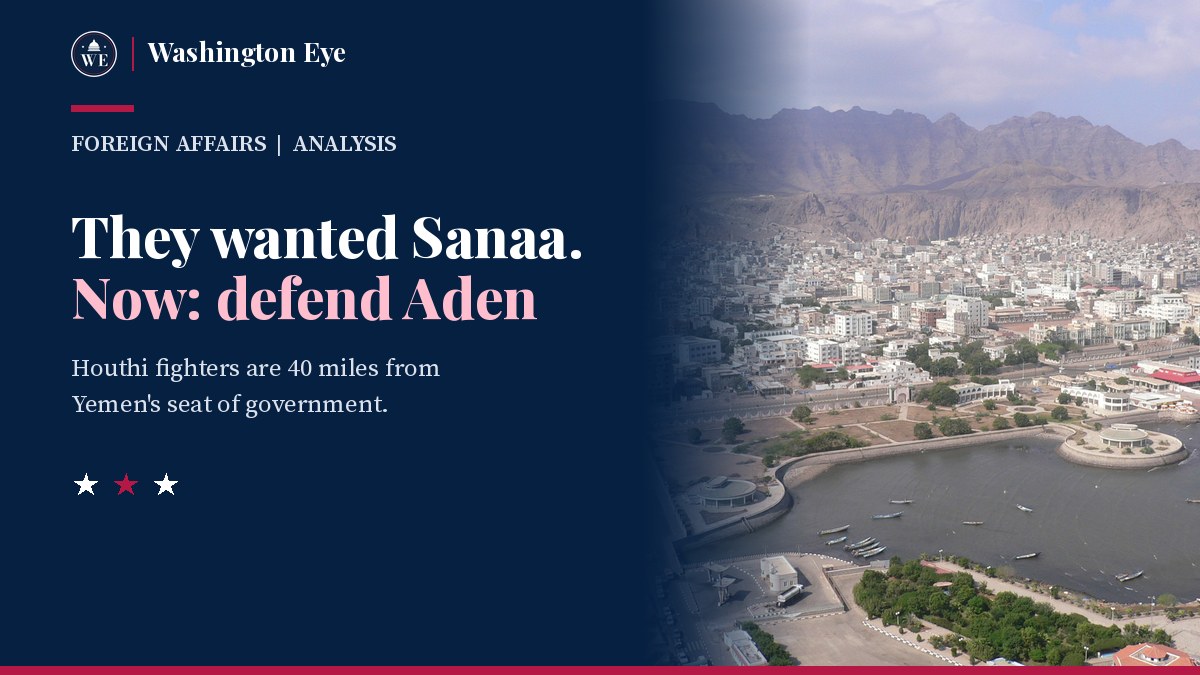
Yemen's internationally recognised government spent the autumn talking about Sanaa. After a counter-attack in October pushed Houthi fighters back from key positions near the Bab el-Mandeb Strait, officials and their backers spoke openly about one day returning to the capital they lost in 2014. On Tuesday, the conversation was about something much closer to home.
"Yes, Houthi forces are about 60 kilometres from the city. We take that seriously, and we are ready for it," Colonel Majid al-Nuzaili, the Yemeni army's spokesman, told a briefing in Aden. "They are now ready to attack. We have made our preparations to defend Aden."
Sixty kilometres is roughly 40 miles, about the distance from Washington to Baltimore. It is the closest the Iran-aligned movement has come to the seat of Yemen's government since the street battles of 2015, when a Houthi push into the south was turned back and the war widened into a regional conflict. One Yemeni analyst summed up the reversal in a single line last week: "The government was aiming to recapture Sanaa, but now they are defending Aden."
How the front collapsed southward
Yemen's civil war had been largely frozen since a truce in 2022. It reignited this summer as a spillover of the wider conflict between the United States and Iran. In July the truce between the Houthis and the government unravelled, and the Houthis moved fast. They seized long stretches of the Red Sea coast and the shores of the Bab el-Mandeb, the narrow strait at the southern mouth of the Red Sea through which a large share of trade between Europe and Asia normally passes. They also tightened a siege on Taiz, Yemen's third largest city, in the mountains above the approach to Aden.
Government forces struck back in October and retook key ground around the strait, including the town of Dhubab. It did not last. On 15 November the government announced it was withdrawing from areas near the Bab el-Mandeb to reinforce troops "where current circumstances require", making the defence of Aden and the neighbouring province of Lahj the priority. Yemeni military sources said the Houthis then took the Al-Maqatirah and Al-Madaribah districts and reached the coastal area of Khor Omairah, about 100 kilometres west of Aden.
The setback was serious enough to shake the coalition's leadership. A day after the withdrawal, a royal decree in Riyadh moved the commander of the coalition fighting the Houthis, Lieutenant General Fahd bin Hamad Al-Salman, into an advisory role and handed command of the joint forces to the Saudi chief of the general staff, General Fayyad Al-Ruwaili. Two Western diplomats linked the change directly to the battlefield.
Tuesday's briefing confirmed the result: Houthi units now sit within striking distance of Aden on more than one axis. Other estimates last week put the front about 80 kilometres north of the city in the highlands and about 110 kilometres to the west, along a desert road with few natural obstacles.
A city digging in
Aden is built around an extinct volcano that juts into the Indian Ocean, and for the past week its defenders have been turning that geography into a fortress. Residents and military sources describe new checkpoints, identity checks, reinforcements, trenches and earth barricades on the roads leading to the front. The army says it has built a fortified line north and west of the city.
The city is already under fire. Houthi missiles and drones have struck Aden repeatedly in recent weeks, including an attack on 15 October that targeted the presidential palace and killed four people, according to government military sources. "Rockets are being fired into this city in a frightening way. People are in a state of constant anxiety," Tariq Abdul Rahman, a former soldier who lives in Aden with his family of nine, said last week. "I don't know if I should stay in the city, or try to return to the countryside."
Officials insist the worst case will not come. "The situation is not where we want it to be. But it's not as dire as reported," Colonel al-Nuzaili said. "Taking Aden is a hypothetical situation. It will not happen." Rashad al-Alimi, who heads Yemen's Presidential Leadership Council, struck the same note on a social media platform on Tuesday: "We trust in the ability of the Yemeni people and their armed forces to end the Houthi threat, no matter how the front lines shift."
The weakness behind the front line
The bigger danger for Aden may be the coalition defending it. The anti-Houthi camp is a patchwork of units with different patrons and different end goals, and many fighters in Aden display the flag of the former South Yemen, the state that unified with the north in 1990. Southern movements want that union reversed. Last winter, rival southern factions fought each other for weeks, a split that ended with the United Arab Emirates leaving the coalition and the leadership of the Southern Transitional Council quitting the government.
"These forces may share a common enemy in the Houthis, but they do not share the same political objectives, territorial priorities, or willingness to fight," said Mohammed al-Basha, a Yemen analyst at the Royal United Services Institute in London. The Southern Transitional Council has not joined the latest fighting, though it says it will defend Aden and the south if needed. "What we won't do is send our soldiers into an offensive with no strategy and no route to a political settlement," its spokesman, Anwar al-Tamimi, said.
The government rejects the picture of division. Emad Bamatraf, deputy head of the Yemeni mission in Washington, said the Giants Brigades, the Homeland Shield Forces, the Emergency Forces and units from three military regions "coordinate their efforts" under "a unified strategic command." Analysts are not convinced. Mohammed Al-Qadhi, a conflict analyst, said the Houthis are benefiting from "an accumulation of years of disagreements and infighting" on the other side.
Is Aden really the target?
Not everyone thinks an assault is imminent. Some Yemeni analysts argue that the Houthis' real prize is the Bab el-Mandeb itself, and that pushing into Lahj province is meant to threaten the supply roads to government positions near the strait and force further withdrawals. Aden, they note, is a different city from 2015: it has organised forces and a population with little sympathy for the movement, and a fight street by street would be costly.
That reading offers Aden little comfort. A Houthi movement that holds both shores of the Yemeni side of the strait and can shell the government's capital at will does not need to take the city to win the war's political argument. It can wait, squeeze and bargain.
Why Washington should care
For the United States, Yemen is no longer a sideshow. Houthi gains and attacks on Red Sea shipping and Saudi airports and oil facilities have strengthened Iran's hand in the wider conflict at exactly the moment Washington is trying to force Tehran back to the table. On Tuesday Iran repeated that it would not hold talks with the United States unless several conditions were met, and said three oil tankers had struck naval mines in the Strait of Hormuz. Vice President JD Vance and Secretary of State Marco Rubio met Qatar's prime minister separately at the White House on Monday, as mediators tried to revive stalled negotiations.
Put the two chokepoints together and the stakes become clear. With the Strait of Hormuz contested and the Bab el-Mandeb increasingly in Houthi hands, the two maritime gates that frame the Arabian Peninsula are both under pressure from Iran and its allies. Any shipping company weighing a route through the Red Sea, and any insurer pricing it, will read Tuesday's briefing closely.
There is also a question of accountability. Houthi officials said this week that Saudi warplanes killed 41 civilians in a single day in strikes carried out with US-made bombs, a claim that has not been independently verified. As a newly Democratic Congress prepares to take office in January, arms sales to the Gulf and the conduct of the air war are likely to come under fresh scrutiny on Capitol Hill.
The human cost
Behind the maps is a country that was already the poorest on the Arabian Peninsula before the war resumed. Since the truce collapsed in July, the fighting has killed more than 1,600 people and displaced more than 300,000, according to the latest United Nations toll. Many of the displaced now live on thin aid rations in tarpaulin camps in the hills around besieged Taiz. In Aden, state salaries barely cover the cost of living, and families like Abdul Rahman's are buying food on credit.
"We want security and stability and Yemen to go back to being a state, the way we used to live before," said Khaled Abdo, a construction labourer in Aden with ten children who has not found work in more than a week.
What to watch
Three signals will show which way this goes. First, whether the Houthis press into Lahj or settle for consolidating the strait. Second, whether the Southern Transitional Council's forces, which have stayed out of the fight so far, join the defence of the city if the front moves closer. Third, whether the stalled talks between Washington and Tehran produce anything that reaches Yemen, since the war here restarted as an echo of that larger conflict and is unlikely to end without it.
For now, the government that dreamed of Sanaa is counting kilometres to its own front door. Its spokesman says Aden will not fall. The fact that he has to say it at all is the story.