
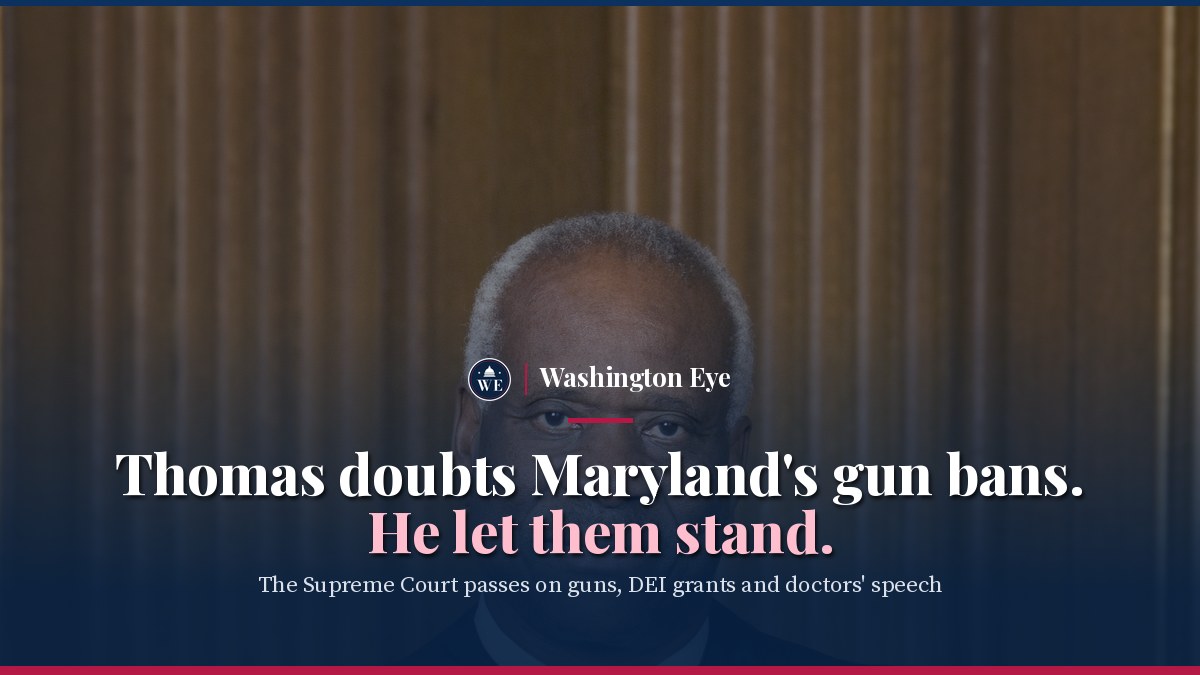
Justice Clarence Thomas made no secret of what he thinks of Maryland's gun laws. In a written statement released on Monday, he said he was "skeptical" that the state's long list of places where carrying a firearm is banned fits "this Nation's historical tradition of firearm regulation." Then he agreed with the rest of the Supreme Court that the case should not be heard.
The order in Novotny v. Moore leaves in place a ruling by the federal appeals court for the Fourth Circuit that upheld nearly all of Maryland's so-called sensitive places restrictions. The court as a whole gave no reasons, and no justice noted a dissent. It was one of several closely watched cases the justices turned away on the same morning, including a Trump administration appeal over research grants cut from University of California scholars for links to diversity programs, and a California doctor's challenge to rules on what continuing medical education courses must teach.
Taken together, the orders show a court that is choosing its fights carefully. On guns, the real test is two weeks away. On diversity, equity and inclusion, the administration lost a round without a word of explanation. And on professional speech, three conservative justices signalled they are ready for a fight the majority is not yet willing to join.
Here is what happened, and why each decision matters.
Maryland bars licensed gun owners from carrying firearms in a wide range of public settings. According to Justice Thomas's summary, the list covers public demonstrations, mass transit, places of amusement, healthcare facilities, locations that sell alcohol for drinking on site, and tens of thousands of acres of state park and forest land.
The challengers, led by Katherine Novotny, argued that these rules go far beyond anything the Supreme Court allowed in its 2022 decision in New York State Rifle and Pistol Association v. Bruen. That ruling said Americans have a right to carry a gun in public for self defence, and that any limit must be consistent with the country's historical tradition of firearm regulation. Bruen accepted that some "sensitive places" could be off limits, pointing to legislative assemblies, polling places and courthouses, but it also warned that the category could not be stretched to every place where the public gathers.
In their petition, the challengers called the constitutionality of these bans "among the most critical questions facing the judiciary" since Bruen. Maryland answered that there was no need for the justices to step in, because lower courts share "vast areas of shared consensus" on where guns may be restricted, and because the state's rules rest on a "rich" historical tradition of laws that limited carrying weapons in particular locations.
The Fourth Circuit had sided with Maryland on all but one of the restrictions, in a ruling known as Kipke v. Moore.
Justice Thomas, the author of Bruen, did not hide his frustration. "I harbor serious doubts that our Nation's historical tradition of firearm regulation supports many of these sweeping restrictions," he wrote.
He placed Maryland in a wider pattern. New Jersey, he noted, bans firearms in at least 25 locations, including zoos, public libraries, casinos and state owned beaches. New York has designated 20 locations as sensitive. California lists 29 gun free spaces, including athletic facilities, banks and any government permitted public gathering. A footnote added Illinois and Hawaii. The cumulative effect, he argued, is to prohibit firearms "wherever people gather for eating, drinking, recreation, amusement, and free speech."
He also accused lower courts of having "largely blessed these ahistorical ventures," citing rulings that upheld bans in New York, California and Hawaii, and a New Jersey decision that has since been vacated for rehearing by the full Third Circuit.
So why did he not vote to hear the case? His answer was about strategy, not substance. Because each Maryland statute "implicates a distinct historical tradition of firearm regulation," he wrote, "the breadth of petitioners' challenge would complicate our review." A single case asking the court to rule at once on parks, bars, buses, hospitals and protests would force the justices to dig through a different historical record for every category. "In an appropriate and more narrowly focused case, however, we should consider the scope of States' authority to ban firearms in 'sensitive places,'" he added.
That is close to an open invitation. Gun rights lawyers now have a roadmap from the court's most senior justice: bring one location at a time, and build a clean record on its history.
For supporters of the laws, the order is a practical win. Maryland's restrictions stay in force, and the court has again declined to police the lower courts' application of Bruen in detail. For gun rights groups, it is a delay rather than a defeat, and the language of the statement suggests at least one justice is eager to return to the question.
The bigger moment arrives on December 2. That morning the justices will hear argument in two consolidated cases, Viramontes v. Cook County and Grant v. Higgins, on whether the Second and Fourteenth Amendments protect the right to own AR-15 style rifles and similar semiautomatic weapons. The cases challenge an assault weapons ban in Cook County, Illinois, and Connecticut's assault weapons law. The federal government has filed a brief supporting the challengers and has been granted time to argue. A ruling is expected by the end of the term next summer.
Seen in that light, Monday's order looks less like a retreat than a choice of terrain. The court has one major gun case on its calendar. It did not need a second one that would have forced it to rule on a dozen kinds of public places at once.
The second notable denial came in Trump v. Thakur, a fight over research grants that federal agencies cut after the president's executive orders targeting diversity, equity and inclusion programmes.
A group of University of California researchers sued on behalf of a class of colleagues who had lost funding. A federal district court in California ordered grants restored in June 2025. The Ninth Circuit later narrowed that order, applying a separate Supreme Court ruling involving the National Institutes of Health that limited lower courts' power to force payment of terminated grants. But it upheld the part of the injunction covering researchers whose grants were ended over diversity concerns, finding they were likely to win on their First Amendment claim. The appeals court reasoned that once the government sets up a subsidy programme, it may not discriminate between speakers within that programme to suppress viewpoints it dislikes.
The administration asked the justices to reverse that holding. Solicitor General D. John Sauer argued that the First Amendment "does not require taxpayers to continue funding projects that the government concludes no longer serve the public interest," and warned that the ruling would "hamstring every future administration." The researchers replied that the government could point to no case where any court had allowed agencies to end competitively awarded grants because of the perceived viewpoint of the research.
The court denied the petition without comment and without any noted dissent. That does not mean the justices endorsed the Ninth Circuit's reasoning, and the case continues in the lower courts. But for now the injunction protecting that group of researchers stands, and the administration has lost a chance to win a nationwide precedent on one of its signature policy fights.
The third case, Khatibi v. Yip, drew the sharpest reaction from inside the court. Dr. Azadeh Khatibi, a California ophthalmologist who teaches continuing medical education classes, challenged a state Medical Board requirement that such courses include material on "the understanding of implicit bias." A federal judge dismissed the case, ruling that the courses count as government speech, and the Ninth Circuit agreed.
The doctors warned that letting that ruling stand "would license states to conscript private professionals" into promoting contested ideas whenever their teaching is tied to a licence. The Medical Board said the dispute was narrow: instructors simply had to follow the state's rules if they wanted their courses to earn state approved credit.
The court turned the case away, but not quietly. Justice Neil Gorsuch said he would have granted review. Justice Thomas, joined by Justice Samuel Alito, wrote a dissent arguing that the Ninth Circuit "fundamentally misunderstands" the court's precedents. "First Amendment protections do not give way simply because a State heavily regulates speech," he wrote.
Three votes is one short of the four needed to take a case. That arithmetic is worth watching. Questions about how far states can shape what licensed professionals say, from doctors to teachers to lawyers, are multiplying, and a better vehicle may not be far off.
The same order list turned away dozens of other appeals. Among them were a former federal public defender's challenge to how the judiciary handles its own employees' harassment complaints, a group's challenge to the Colorado legislature's rules on how transgender people are addressed in committee hearings, and a Wyoming crypto bank's attempt to force the Federal Reserve to give it a master account. The justices also asked the solicitor general for the government's views in three cases brought by victims of terrorism who are trying to reach Afghan central bank funds held in New York.
A denial of review is not a ruling on the merits, and none of Monday's orders settles the constitutional questions for good. What they do reveal is a court that is managing its docket with an eye on the cases it most wants to decide.
On guns, the message from Justice Thomas is plain: the sensitive places question is coming back, just not in this form. On diversity programmes and professional speech, the administration and its allies on the bench will have to wait for another day. And on December 2, the court will take up the most consequential Second Amendment question it has faced since Bruen, whether the country's most popular rifle is protected by the Constitution.