
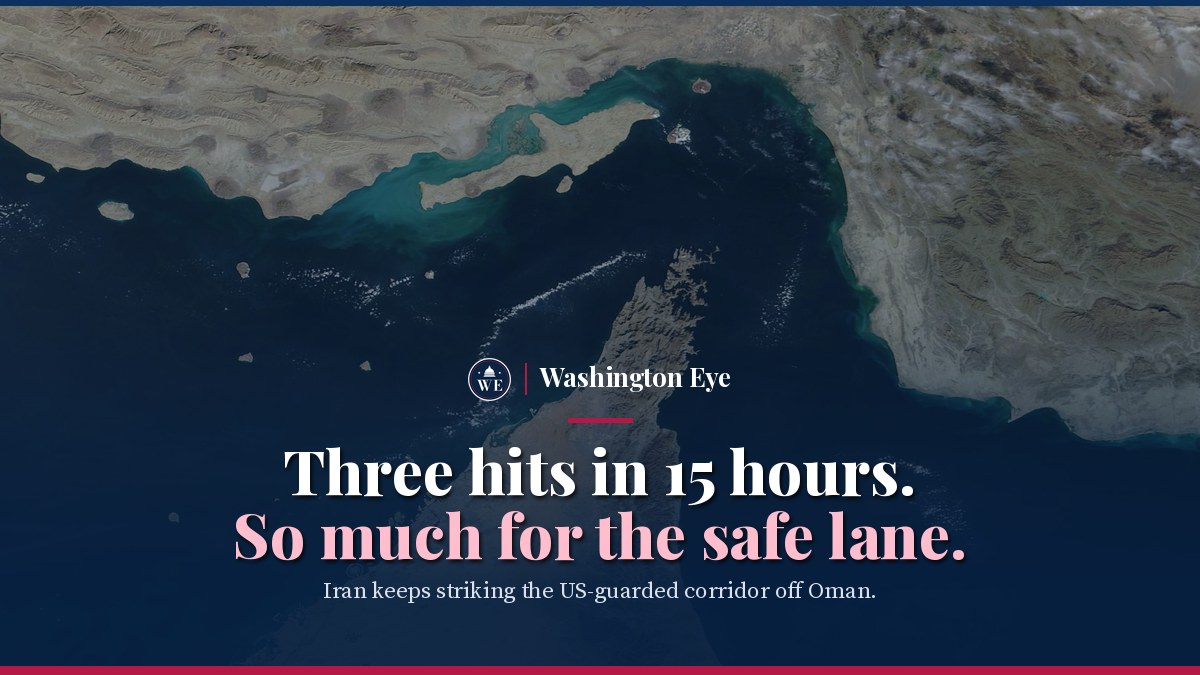
For most of this autumn, the narrow lane that hugs the Omani coast at the mouth of the Gulf has been Washington's quiet answer to Iran's grip on the Strait of Hormuz. Ships heading out of the Gulf keep close to the Musandam Peninsula, the American Navy watches the corridor, and a trickle of oil keeps moving to the world. Over roughly 15 hours on Friday and Saturday, that lane was hit three times.
The first strike came on Friday afternoon. Britain's maritime trade monitoring centre, which tracks incidents in the region, reported that an outbound tanker had been struck on the port bow by an unknown projectile about eight nautical miles north of Khasab, the main town on Oman's Musandam tip. The ship's security officer reported a fire on board. Early on Saturday the same centre logged a second outbound tanker hit on its stern about 11 nautical miles north of Khasab, and then a report of a tanker hit in its engine room 17 nautical miles east of the town. It was not immediately clear whether the two Saturday reports described the same vessel. No casualties were reported, and the environmental damage was unknown.
Iran's account was different in its details and identical in its message. The navy of the Islamic Revolutionary Guard Corps said on Friday that a tanker had exploded and caught fire after striking naval mines while trying to cross the strait through an "unauthorized route with support from the US military". On Saturday Iran's navy said another tanker had caught fire after hitting a mine in a restricted area east of the strait. Neither claim could be independently verified, and it was not established whether they referred to the incidents the British centre had logged.
Hours later, Iranian state television broadcast footage from an underground missile base, where the Guards unveiled a launcher that they said can carry and fire two liquid-fuelled missiles at once. The display, during the first visit by the Guards' commander, Major General Ahmad Vahidi, to one of the force's so-called missile cities, was plainly aimed at a foreign audience. Washington has said the United States destroyed Iran's missile programme. Tehran wanted the world to see launchers instead.
Taken together, Saturday looked less like a spasm than a message: the American workaround is still in range.
A strait that is open on paper
The background matters. The war began on February 28, when the United States and Israel struck Iran. Tehran answered with strikes on Israel and on Gulf states hosting American bases, and it declared the Strait of Hormuz closed to ships that do not coordinate with its forces. On April 13 the United States imposed a naval blockade of Iranian ports, lifted it in June after a draft understanding with Tehran and reimposed it in mid-July after talks stalled, largely over who controls navigation through the strait.
Since then the waterway, which carried close to a fifth of the world's crude oil before the war, has split into two systems. Iran demands that ships use a designated route and coordinate with its armed forces. The United States facilitates neutral traffic along a southern corridor near the Omani shore, which Iran calls unauthorized or prohibited. American officials have been explicit that the blockade targets Iran alone. "The blockade will not impede neutral transit passage through the Strait of Hormuz to or from non-Iranian destinations," the Navy's Central Command component said on November 18.
The corridor has kept oil moving, but not much of it. Joint maritime advisories in early November described commercial movements as "substantially reduced" compared with 2025, when the strait averaged about 138 transits a day. US-facilitated passages have run at roughly 28 to 30 a day this month, according to figures compiled by maritime trade publications, while hundreds of ships sit at anchorages east of the strait. Analysts say part of the workaround relies on ship-to-ship transfers, in which smaller tankers cross with their tracking systems switched off and hand their cargo to larger ships once they are clear.
The busiest weeks of the war at sea
Friday and Saturday were not isolated. Britain's maritime monitoring centre reported 31 attacks in and around the strait in October and about 19 more in November as of November 18, compared with 53 incidents in total between March and September. The International Maritime Organization, the United Nations shipping agency, uses more conservative counts but still records 34 confirmed attacks in and around the strait in October and November so far, and 138 attacks on vessels across the Middle East since the war began. A Washington research institute counted 37 ships attacked in October alone, the highest monthly total of the conflict.
The human toll is real and rising. On October 13 a container ship owned by a UAE-based feeder line was hit, caught fire and sank, though all 21 crew were evacuated. On November 16 and 17 a liquefied petroleum gas carrier was struck twice and abandoned by its 25 crew, one Indian seafarer missing. On the evening of November 17, a vessel managed by ADNOC Logistics and Services, the Abu Dhabi energy shipping company, was attacked while transiting the strait. "One crew member remains unaccounted for," the company said, adding that eleven others were injured. The company said it "reiterates the importance of protecting seafarers and safeguarding freedom of navigation and maritime security."
Attribution remains contested. Iran routinely says ships on the southern route struck mines. American commanders reject that. On October 28 Central Command called the Iranian mine claims "FALSE" and said US forces had cleared the primary transit routes. Most of the vessels hit this autumn, according to the British centre's data, were in the southern part of the strait close to the Omani coast, exactly where the American corridor runs.
What Iran is trying to prove
Analysts who follow the conflict describe a deliberate strategy. "Iran's objective remains to keep the Omani route, which is described as a U.S.-facilitated route, a very high-risk passage and to keep the energy recovery inconsistent," Noam Raydan, a senior fellow at a Washington research institute, told a US television network this week.
Hamidreza Azizi, senior Iran analyst at the International Crisis Group, put it more bluntly. "Washington and its regional partners have found ways to keep oil flowing through the Strait of Hormuz," he said. "Tehran now seems determined to make these arrangements more costly and less reliable." In his reading the goal goes further than oil: "Iran is trying to demonstrate that the United States cannot guarantee maritime security in the Persian Gulf despite its overwhelming naval superiority."
Sina Toossi of the Center for International Policy described "a cycle of adaptation and counter-adaptation", with Tehran escalating to make the ship-to-ship system "more dangerous, costly, and ultimately unviable". The broader aim, he argued, is to show that normal oil exports cannot continue while the American blockade stays in place, and to build enough economic pressure to force Washington to negotiate.
That reading fits the timing. Earlier this week Iran gathered more than 14 of its own tankers at Kharg Island, crewed and flagged, and its foreign minister, Abbas Araghchi, declared that "the naval blockade must be broken". President Donald Trump, speaking on his way home from Asia, said he was "not rushing into any decision" and would "see what happens after the beginning of the year". On November 18 the American command widened the blockade, warning that ships receiving cargo by transfer from blockaded vessels may be "stopped, boarded, diverted, captured". Saturday's strikes arrived three days later.
Why it matters beyond the Gulf
For the Gulf states, the stakes are immediate. The UAE, Oman and their neighbours depend on the strait for exports and imports alike, and Emirati-owned or Emirati-managed ships have featured repeatedly in this autumn's casualty lists. Oman, a longtime intermediary between Washington and Tehran, has seen its own waters become the front line; Iranian state media said Iran struck what it called "enemy navigation aid systems" on the Omani island of Didamar on November 8.
For everyone else, the cost arrives through insurance and prices. Brokers cited by a British financial newspaper last month put additional war-risk premiums for Gulf tankers at 6 to 10 percent of hull value, up to $20 million for a single supertanker voyage, against roughly 0.25 percent before the war. Every attack on the corridor feeds that number, and every premium increase is eventually paid at the pump and in the price of goods that move by sea.
For Washington, the problem is strategic. The blockade is meant to squeeze Iran until it negotiates on American terms. The corridor is meant to show that the squeeze does not have to cost the world its oil. Iran's campaign is aimed at the second half of that bargain. If the safe lane stops being safe, the pressure to choose between escalation and a deal grows, and it grows on Washington as well as on Tehran.
What to watch
Three things will tell us whether this weekend was a spike or a new baseline. The first is whether the American command publicly attributes the latest strikes and whether it responds against launch sites, which would risk a wider exchange. The second is the daily count of US-facilitated transits: a sharp drop would mean owners have concluded the corridor is not worth the risk. The third is diplomacy. Talks that began with a memorandum of understanding in June have stalled over the very question these strikes keep forcing, which is who decides what moves through the strait.
For now the answer at sea is the same one it has been since October. The American Navy can open a lane. Iran is showing, three hits at a time, that it can still make sailing it a gamble.