
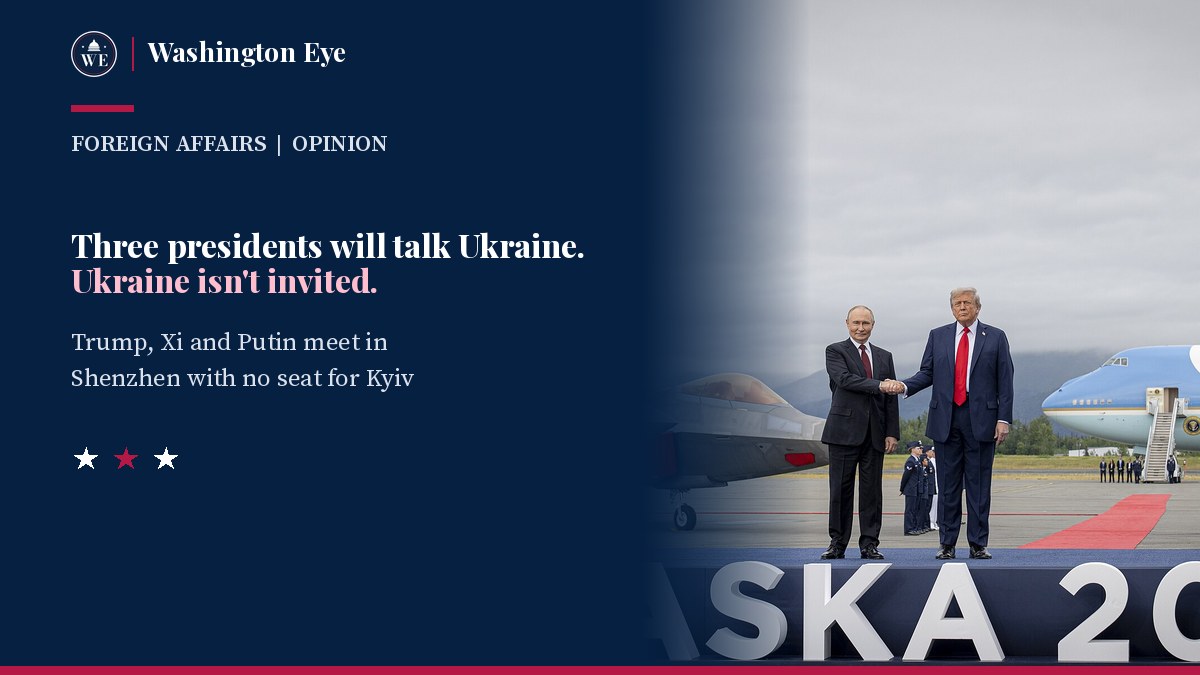
On Thursday in Shenzhen, three men who command most of the world's nuclear weapons will sit down together for the first time. President Donald Trump, Chinese President Xi Jinping and Russian President Vladimir Putin will meet on the sidelines of the Asia-Pacific Economic Cooperation summit, a format Beijing's foreign ministry has already described as being of "groundbreaking significance." There will be no Ukrainian at the table. Until Monday, that seemed tolerable, because the White House said Ukraine would not be on the menu. Then the president changed the menu.
"We'll talk about my favorite subject, Ukraine," Mr. Trump told reporters at the White House on Monday before leaving for Asia, adding that "Russia is losing 25,000 soldiers in the month." He also suggested that Mr. Putin was "backing down a little bit." Three days earlier, a senior administration official had briefed reporters that the president would focus on nuclear arms reduction and the war with Iran, and had explained why Ukraine did not belong in this room: "China is not really a part of that track, so it doesn't seem appropriate to have the Ukraine discussion there."
The official was right. The president should listen to his own staff. A conversation about Ukraine's future between Washington, Moscow and Beijing, with Kyiv and Europe kept outside the door, is not a peace process. It is a gift to the one leader in Shenzhen who started the war, and it risks undoing the slow, unglamorous progress American negotiators have made in the opposite direction.
Whose idea this was
Start with who wanted this meeting. Mr. Putin first floated a three-way summit in a phone call with Mr. Trump in October, and a major American newspaper reported that he hoped to use it to secure a Ukraine settlement on terms favorable to Moscow. The Kremlin has never hidden that goal. On November 12, Kremlin aide Yuri Ushakov told Russian state media that when Mr. Putin and Mr. Trump meet in Shenzhen, "we will continue to discuss the full range of issues related to the settlement."
Beijing, notably, does not seem eager to play along. German President Frank-Walter Steinmeier, who met Mr. Xi in late October, told a German broadcaster that the Chinese leader showed irritation when the idea of discussing Ukraine in a trilateral came up, and explicitly called it a European conflict in which Europeans must be at the table. China's foreign ministry has framed Thursday's agenda as "safeguarding world peace" and "strategic stability in major-country relations," which is diplomatic language for nuclear arsenals, not front lines.
So the one participant who wants Ukraine on the agenda is the aggressor, the host would rather avoid the subject, and the American team had a sensible reason to leave it out. The only person who has reopened the door is Mr. Trump himself.
Why the format matters
It is tempting to dismiss the objection as a matter of protocol. Leaders talk about other countries all the time. But formats send messages, and this one sends exactly the message Moscow has worked for years to send: that the fate of Ukraine is a question for great powers to settle among themselves.
Ukrainian President Volodymyr Zelensky has put the fear in historical terms. "We really don't want this to turn into 'Yalta 2, 3, 4,' with a redistribution of influence," he said, referring to the 1945 conference where Franklin Roosevelt, Winston Churchill and Joseph Stalin shaped postwar Europe with little regard for the countries whose borders they drew. He has also been measured about it: "If Ukraine is on the agenda, we would like Ukraine to be consulted." That is hardly an extreme demand from a country fighting for its survival.
Ukraine's foreign minister, Andrii Sybiha, has been blunter. A meeting of the Russian, Chinese and American leaders, he warned last month, would "encourage Putin to continue this war," and inviting him would "feed his appetite for self-aggrandizement and give him a stature he does not deserve." He pointed out that Russia's economy is, by his count, about 13 times smaller than America's and eight times smaller than China's. Ukraine's embassy in Washington repeated the point on Monday: "Any discussions about the war or decisions concerning Ukraine that take place without Ukraine cannot provide a sustainable path to peace."
Europe's capitals agree. Poland's foreign minister, Radoslaw Sikorski, called the format "an unnecessary elevation of Russia to the position of a global superpower, which Russia hasn't been for a long time," and added a line that ought to hang in the Situation Room: "The focus should be on the aggressor, not the victim of aggression." German Chancellor Friedrich Merz put his request to Washington in four words before the trip: "Please, no surprises."
The Kremlin's answer to the Yalta comparison is revealing in its own way. Spokesman Dmitry Peskov has said that any agreements reached in Shenzhen cannot be imposed on others. That is true as a matter of law. It is less true as a matter of leverage. If the American president walks out of a room with Mr. Putin and Mr. Xi saying he has heard a reasonable plan, Kyiv and its European backers will spend weeks fighting a framing they had no chance to shape.
The progress at risk
The frustrating part is that the administration's own diplomats have been doing something closer to the right thing. On Monday, Mr. Zelensky said Ukrainian, American and European negotiating teams had held talks in which Europe took part with its full group for the first time, including France, Germany, Britain, Italy, Poland, the European Commission, the European Council and NATO. "The discussion was difficult, but there is a result," he said in his evening address. "We need a dignified end to the war and guaranteed security for Ukraine."
Jared Kushner, one of the president's envoys, set out the American goal in a post online the same day: a "sovereign, secure, and prosperous" Ukraine, with credible security guarantees, a path to European Union membership and a reconstruction plan. "NATO will remain a critical pillar of European security," he wrote, and he said any final agreement must be accepted by both Ukraine and Russia.
That is a serious framework, and it was built with Kyiv and Europe in the room. Russia is resisting it. Mr. Ushakov has said Moscow has not agreed to European participation in the next round of talks. Seen from the Kremlin, Shenzhen is the obvious workaround: a table with no Europeans and no Ukrainians, where Mr. Putin can talk to the American president as an equal, with China's leader beside them.
On Thursday, the two tracks will run at the same time. While Mr. Trump sits in Shenzhen with Secretary of State Marco Rubio and Treasury Secretary Scott Bessent, Mr. Merz will host a Coalition of the Willing summit in Berlin with French President Emmanuel Macron and British Prime Minister Andy Burnham, expected to draw more than 20 heads of state and government. The president's envoys Steve Witkoff and Jared Kushner are expected to join the Berlin meeting, and an American official has described the parallel gatherings as a "coordinated diplomatic effort."
If that is the plan, it can work only if Berlin, not Shenzhen, is where Ukraine's future is discussed. The moment Mr. Trump starts negotiating the war's terms with Mr. Putin in front of Mr. Xi, the coordination collapses into competition, and the Kremlin gets to choose which table it prefers.
What the president should do instead
None of this means Mr. Trump should skip Shenzhen. A first meeting of the three nuclear powers is worth having. The last arms control treaty between Washington and Moscow, New START, expired in February, and China's arsenal is growing with no limits at all. Even modest steps, such as agreeing to keep talking about arsenals or about keeping artificial intelligence away from nuclear launch decisions, would be worth the flight. That is the meeting his own officials described, and it is a meeting progressives should welcome.
The president can also use the room to say something useful about Ukraine without negotiating over its head. He can tell Mr. Putin, with Mr. Xi listening, that the war ends through the track that includes Kyiv and Europe, and that a ceasefire is the price of a seat at any table. Mr. Sybiha suggested exactly that: Mr. Putin could earn his place, the minister said, by agreeing to a ceasefire before such a meeting. Mr. Trump could make that point for him.
What the president should not do is treat Ukraine as one item on a great-power agenda, to be traded against Iran, oil or trade. He said on Monday that Ukraine was his favorite subject. If he means it, the kindest thing he can do for Ukraine in Shenzhen is to talk about it as little as possible, and to tell the man who invaded it that the real conversation is happening somewhere else.
Americans who remember the last time a president left a summit with Mr. Putin, in Anchorage in August 2025, will recall how much effort it took in the following weeks to reassure Kyiv and Europe that nothing had been given away. Mr. Merz remembers too, which is why he asked for no surprises. Thursday is a chance to show that the lesson was learned. Three presidents can talk about the bomb. Only one country can decide what peace in Ukraine looks like, and its president will not be in the room.