
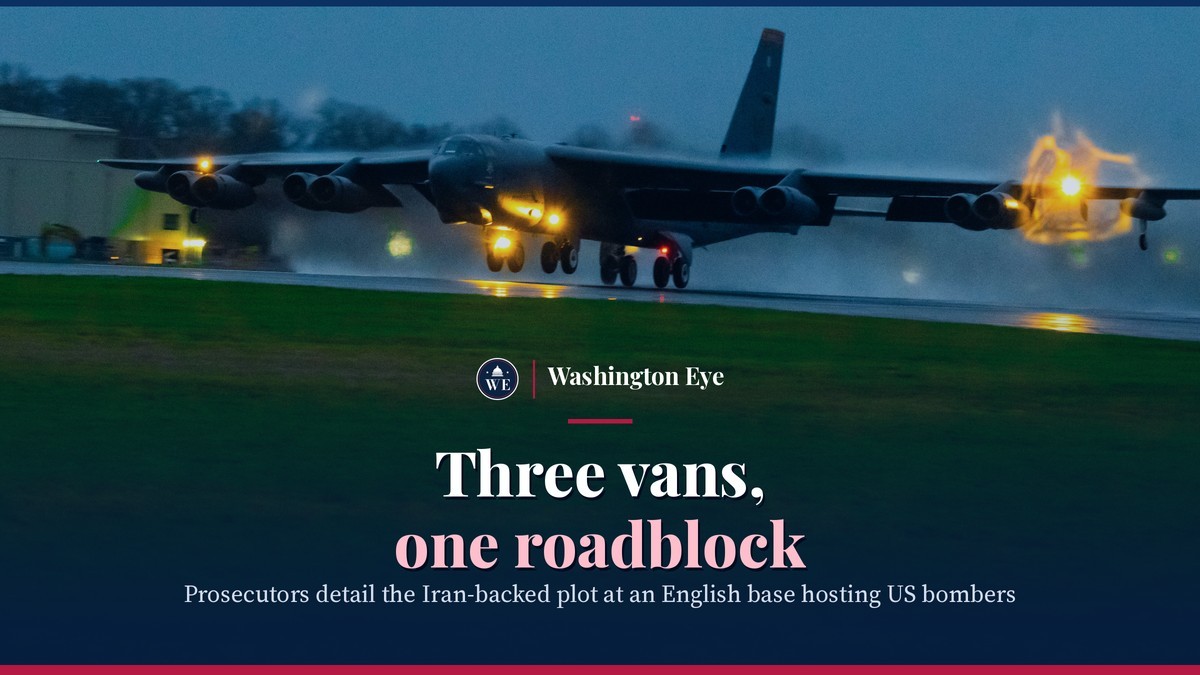
The vans were dressed up to look ordinary. According to federal prosecutors in New York, one carried decals for a fuel delivery business and another for a swimming pool supply company. On the night of September 26, three of them were driven towards the perimeter of RAF Fairford, a Royal Air Force base in the Cotswolds that at the time housed American military aircraft and personnel. At least two were turned back at a security roadblock. In the early hours of the next morning, British police recovered all three and arrested the men inside.
For six weeks that episode was a local mystery with a national security edge: a major incident declared near a quiet English airfield, a farmer's late-night call to police, and, days later, the departure of American bombers. On Tuesday the US Justice Department gave its own account of what it says happened. An eight-count superseding indictment unsealed in the Southern District of New York charges three men with terrorism offences on behalf of Iran's Islamic Revolutionary Guard Corps and the Iraqi militia Kata'ib Hizballah, both designated by the United States as foreign terrorist organisations.
The defendants are Mohammad Baqer Saad Dawood al-Saadi, 32, a dual Iranian and Iraqi citizen; Mohsen Mohajeri, 48, an Iranian national whom prosecutors describe as an operative of the Revolutionary Guard; and Mohammad Ali al-Hassani, 35, an Iraqi citizen. Prosecutors link them to nearly 20 attacks and attempted attacks in Europe and the United States, and say al-Hassani orchestrated the Fairford plot from Iran. As with any indictment, these are allegations. All three men are presumed innocent unless proven guilty in court.
The case grows out of a wave of violence in the spring of 2026. Prosecutors say 18 attacks in Europe were claimed by a group calling itself Harakat Ashab al-Yamin al-Islamiya, or HAYI, which the Justice Department describes as a front for Kata'ib Hizballah and other designated groups. Seven of those attacks took place in the United Kingdom, more than in any other European country. They involved arson, explosives and, in one case, the near-fatal stabbing of two Jewish men in London, one of them a dual American and British citizen.
The most vivid passages of the government's account concern how the attacks were allegedly run. On or about April 6, prosecutors say, Mohajeri and al-Hassani met in a room in Iraq with a map of London on a computer screen. In a video of that meeting, according to the Justice Department, al-Hassani said: "We need to get focused on London." HAYI then claimed six attacks in and around the British capital beginning about a week later.
On or about April 17, the three defendants allegedly watched an attack in Europe unfold in real time on a live video call projected onto a large screen against the HAYI logo. Prosecutors say al-Hassani coached the person on the other end, telling them to "light it," and to "throw the fourth one," while al-Saadi filmed the attack and Mohajeri filmed the two of them directing it. The next day, according to the indictment, al-Hassani guided an attack on a London synagogue by video call, telling the attacker to "light it up like a Christmas tree." The attacker then lit an improvised explosive device and threw it at a building.
Al-Saadi is no stranger to this courthouse. He was first charged in May over the European attacks and over an alleged attempt to bomb a synagogue in Manhattan, after being arrested abroad on or about May 1 and transferred to American custody. The Justice Department released a 2024 photograph that it says shows him in a conference room with an array of machine guns, beside a map of the United States and a list of "legitimate targets" naming former and current American officials.
What makes the new charges striking is the claim that prison did not stop him. For about four months after his arrest, prosecutors say, no further attacks were attributed to the network. Then, in August, al-Hassani allegedly began paying associates in Britain to prepare the Fairford operation, starting on August 22 with a payment for surveillance of the base's perimeter. In September, the government says, he paid people to obtain vans and barrels of fuel, to research buying chemical accelerants including large quantities of potassium chloride, and to buy metal objects that could serve as shrapnel.
Meanwhile, according to the indictment, al-Saadi was using recorded jail calls with his mother and sister in Iraq to pass coded messages. Prosecutors say he used the word "work" to mean terrorist activity, and that in one call he asked his sister, "What are they doing about all our old work?" She allegedly replied that "it isn't cancelled." On or about September 24, the government says, he asked after "Ali," his alleged name for al-Hassani, and told his family to "give him money so we can do it." Three days later, the vans were on the road to Fairford.
There are gaps in the public record that the court case will have to fill. Reporting in Britain has said that no explosive materials were found in the vans, although a quantity of petrol was seized. Prosecutors have not said where Mohajeri and al-Hassani are now, only that both were in Iran at the time of the plot. In Britain, two men were charged last month with national security offences connected to the incident, one accused of assisting a foreign intelligence service and the other of entering a prohibited place for a purpose prejudicial to the country. Seven people in total have been arrested there.
The administration framed the case as a warning. "Anyone who plans a terrorist plot on a military base housing American servicemembers will be prosecuted by the United States government," Attorney General Todd Blanche said. FBI Director Kash Patel said the indictment showed "the determination of Iran to commit terrorist attacks in Europe and the U.S." Jamie McDonald, the US attorney for the Southern District of New York, put it more starkly: "The threat presented by Iran and Iran-backed terrorist groups to America and our allies is not hypothetical. It is very real."
Tehran rejects the premise. The Iranian embassy in London has said it "categorically rejects and strongly condemns" what it called "unfounded and malicious speculations" linking Iran to the Fairford incident. Britain's prime minister, Andy Burnham, has said the activity around the base was likely coordinated from Iran, and Britain banned support for HAYI in July.
The indictment arrives at an awkward moment in the wider confrontation between Washington and Tehran. American bombers flew from Fairford to the Middle East for strikes on Iran in recent months, and in July Iran declared that any base used for what it called aggression against its territory was a legitimate target. President Donald Trump later withdrew the bombers from Fairford, citing "some threats" to the base. Flight-tracking data reported on Tuesday showed at least 12 American military aircraft leaving RAF Mildenhall, another base in England.
Since the November 3 midterms, in which exit polls pointed to the Iran war and its effect on fuel prices as a drag on Republicans, the president has struck a more conciliatory tone and American officials have played down the need for further strikes. Tehran has not reciprocated in words. On Wednesday, Iran's top security official, Mohsen Rezaei, said in a television interview that his country would not allow "even a single particle" of its enriched uranium to leave Iranian territory, rejecting the idea of moving the stockpile to a third country such as Russia. He warned that any new American attack would be "met with targeting US bases far away," and said there were no negotiations under way between the two governments.
Read together, the two developments sharpen a question the next Congress will inherit. If prosecutors are right, Iran and its Iraqi partners have shown a willingness to reach American forces not only in the Gulf but at an airfield in rural England, and to run operations through hired local associates and a jailed co-conspirator. That is an argument for keeping pressure on Tehran. Yet the same facts also show how a war fought from the air can generate threats that land on allies' soil, which is the argument many of the new Democratic majorities made on the campaign trail for ending it.
Three things will shape how this case is remembered. The first is evidence. The government's narrative leans heavily on videos, payment records and jail calls, and defence lawyers will test whether coded family conversations can carry the weight prosecutors place on them. The second is reach. Two of the three defendants appear to be outside American custody, so the case may function as much as a public indictment of a network as a route to trial. The third is cooperation with Britain, whose own prosecutions over Fairford will run in parallel and could either corroborate or complicate the American account.
For now, the image that lingers is the one prosecutors chose to emphasise: men in a room far from Europe, watching an attack on a big screen and telling a stranger when to throw. Whether that picture holds up will be decided in a Manhattan courtroom. Its political meaning is already being argued in Washington, on a Veterans Day when the safety of Americans serving abroad is once again at the centre of the debate.