
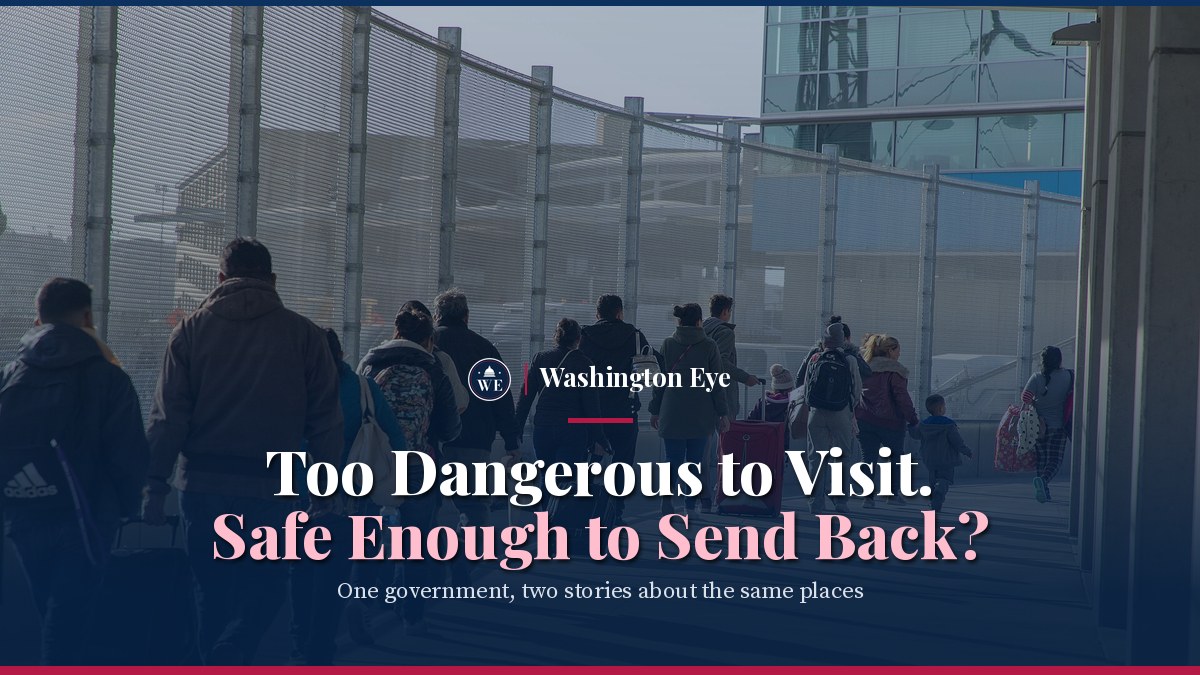
If you are an American thinking of a trip to the Gracias a Dios region of eastern Honduras, your own government has a short message for you: do not go. Its travel advice warns of violent crime, armed robbery, murder and active terrorist groups. If you are a Honduran from Gracias a Dios standing in an American immigration court, the same government has written something rather different about the same place. "Overall, Gracias a Dios is a low-crime, functioning department," says a State Department background report prepared for those courts. Its violent crime rates, the report adds, "compare favorably with rates of violent crime in many parts of the United States."
Both documents cannot be the whole truth. One of them is guiding where Americans spend a holiday. The other is helping to decide whether a person who says they will be killed at home is sent back there. We think the second deserves at least as much care as the first, and right now it is not getting it.
The reports came to light this week through a wire service investigation that obtained short background papers on Honduras, Guatemala, Mexico and El Salvador, all written for use in immigration courts. They run to about six pages each. They read, in places, like travel brochures. They mention good schools, low crime, quality hospitals and constitutions that protect individual rights, with brief caveats that "the availability of services" can vary across each country.
The El Salvador paper is the most striking. The government of President Nayib Bukele has faced years of accusations of widespread abuse, including torture. The report takes a far kinder view, saying the government's approach to rights abuses "is no different than that of developed countries in Europe and North America, including the United States itself." It points to a handful of prosecutions linked to a civil war that ended in 1992. And it offers a line that could excuse almost anything: "In any country, a rogue official can mistreat those under their power."
Elliot Young, a professor at Lewis & Clark College who analysed the documents for the college's Migration and Asylum Lab and has testified as an expert witness in more than 700 asylum cases, described them as "reverse-engineered." In his words: "They're trying to hit the most frequent kinds of (asylum) cases that come up and provide counterevidence to the overwhelming evidence that these are dangerous places." The State Department did not respond to a request for comment. Neither did the Justice Department, which runs the immigration courts, when asked what weight the papers carry.
Why these six pages matter so much
To understand the damage, look at how asylum law actually works for people fleeing gangs or abusive partners, who make up a large share of claims from Central America. An applicant has to show a reasonable fear of persecution because of race, religion, nationality, political opinion or "membership in a particular social group." They must show their own government cannot or will not protect them. And they must show they cannot escape the danger simply by moving somewhere else inside their own country.
That last test is where these reports seem aimed. They single out specific places: an off the beaten track tourist destination in Guatemala, a province in El Salvador with low crime and round the clock emergency medical care. The implication is obvious. If there is a quiet corner of the country, why not go there instead of coming here?
Neela Chakravartula, an asylum attorney at the Center for Gender & Refugee Studies at the University of California College of the Law, San Francisco, answered that better than we could. "The fact that there may be pockets of a country that are relatively safe for some people doesn't mean that everybody can just move to that part of the country," she said. If it did, she added, "We'd all be living in Malibu."
The context makes the stakes plain. Denials of asylum claims have jumped from roughly 72 per cent at the end of the Biden administration to 94 per cent in June under President Donald Trump, according to the Transactional Records Access Clearinghouse, a nonprofit that tracks court data. The administration has reshaped the courts to speed removals, organising mass hearings, authorising military lawyers to serve as immigration judges and giving judges more room to throw out claims without a full hearing. In a system moving that fast, a short, official looking document from the State Department is exactly the kind of evidence a busy judge reaches for.
Meanwhile the fuller record is missing. The State Department's traditional human rights reports, long, country by country studies of more than 100 nations, have been cut back and delayed in this administration. "These shorter reports clearly don't address the full range of human rights issues that the country reports have traditionally addressed," said Scott Busby, a former deputy assistant secretary in the department's human rights bureau who now advises the group Human Rights First. They are "especially problematic," he said, "given that the country reports themselves for last year have yet to be issued."
The fair case for the other side
We should be honest about the argument the administration would make, because parts of it are right. Asylum was never meant to be a general remedy for poverty or for living in a rough neighbourhood. Even under President Joe Biden, most asylum claims were rejected. Voters were genuinely alarmed by the scale of crossings in recent years, with border arrests from Mexico hitting a record of about 250,000 in December 2023, and the courts carry a backlog of millions of cases. President Trump has said for years that asylum is "a very special protection intended only for those fleeing government persecution based on race, religion and other protected status," as he put it in 2018, and many Americans agree with him.
A government that believes the system is being gamed is entitled to argue that in court. It is entitled to send lawyers who challenge weak claims, to press for faster decisions and to ask Congress to tighten the law. What it is not entitled to do is hand judges a picture of a country that its own diplomats would not stand behind if an American tourist asked. The definition of asylum was widened long ago to cover some people fleeing domestic and criminal violence. If this administration wants to narrow it, the honest route runs through Congress, not through softer adjectives in a background paper.
Same government, same standard
The fix is not complicated, and it does not require anyone to agree on how many asylum seekers the country should accept.
First, publish the reports. Evidence the government uses to decide life and death cases should be public, dated and signed by an office that can be questioned about it. If the papers are sound, daylight costs nothing.
Second, require consistency. Any country condition report filed in an immigration court should be read alongside the State Department's own travel advice for the same place, and any clash between the two should be explained in writing. A region cannot be too dangerous for a tourist from Ohio and safe for a mother from the same region without a reason someone is willing to put on paper.
Third, finish the real human rights reports. The department has produced them for decades, and courts on both sides of many arguments have relied on them. Releasing them late and thin while circulating six page summaries tilted one way is the worst of both worlds.
The incoming Congress, which takes office in January, has the tools to demand all three. Oversight hearings, appropriations language and simple letters asking who wrote these papers and when would go a long way. Lawmakers who care about the integrity of the courts, whatever they think about the border, should want to know.
A system already under strain
This is not the only sign that the scales are being tipped in ways most Americans would not choose if asked. A report released this week by the California Collaborative for Immigrant Justice, which advises people held at four immigration detention centres in Kern County, found that slow legal mail has left some detainees missing appeal deadlines, being denied bond or being deported, according to advocates. On Monday the Supreme Court will hear Wassily v. Blanche, which asks whether people whose asylum has been terminated can still apply for a green card. A divided appeals court said no, and a ruling is due by early July. Reasonable people can differ on that legal question. But the case is a reminder that asylum outcomes are now being decided at the margins, where a single document, deadline or phrase can decide everything.
That is precisely why the government's evidence has to be honest. A country can choose to be strict. It can choose to deport people who do not qualify. It cannot claim to be a nation of laws while telling its own citizens one thing about a place and telling its own judges another.
So here is our test, and it is a simple one. Before any State Department paper describes a region as safe enough to send a person back to, someone in the department should be willing to put the same words on the travel advisory page for Americans. Until that happens, these reports are not evidence. They are advocacy dressed as fact, and the people paying for them are the ones with the least power to answer back.