
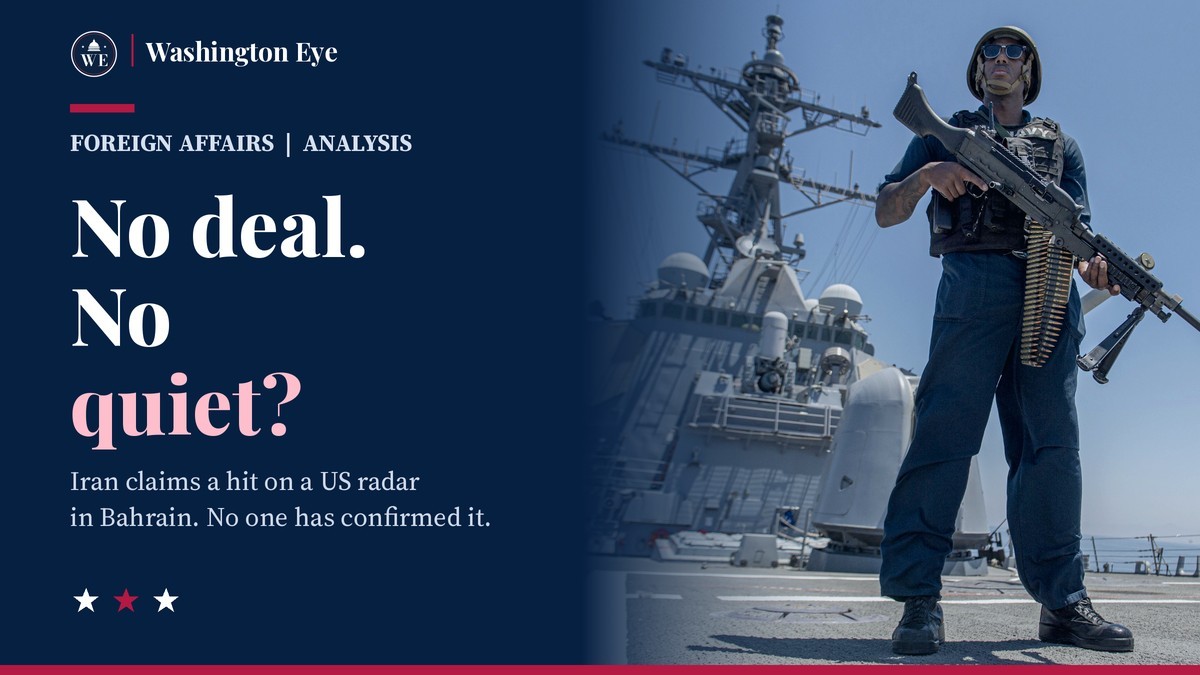
In the days since the midterm elections, President Donald Trump has been signalling that he sees no need either to fight harder in Iran or to bargain his way out. On Thursday he said so in plain terms. "We don't need a deal with Iran," he wrote online. "Those days have long since passed. We've got their money, Hundreds of Billions of Dollars, and we've got their Strait!" Within a day, Iran's Revolutionary Guards answered with a claim of their own.
In a statement carried by Iranian state media early on Friday, the Guards said their aerospace force had "targeted and destroyed" an American early-warning radar "on the island of Bahrain", in response to what they called "air aggression against a telecommunications tower in Sirik", a coastal county in Iran's southern Hormozgan province. They described the operation as "a serious warning to the aggressor enemy to stop its aerial provocations and oil smuggling in the Strait of Hormuz" and added a threat: "Should these violations and acts of aggression recur, the IRGC Aerospace Force stands in full readiness to engage without limits."
None of this has been verified. As of Friday afternoon in the Gulf, neither Washington nor the government of Bahrain had confirmed that any radar was hit, and United States Central Command had not responded publicly to the claim. Iranian state media had reported on Thursday that Sirik had been struck by "enemy" fire, but gave no details of the target, the damage or any casualties, and did not say who fired. In the reports available on Friday, no American official had said publicly whether the United States carried out a strike there.
Even unverified, the claim matters. According to a wire service, it is the first time since early September that Iran has claimed an attack on American military assets in a Gulf country. It arrived a day after the president publicly shut the negotiating channel his vice president had been working, and it puts the strategy that replaced that channel to its first public test.
How the war got here
The conflict began on 28 February with American and Israeli strikes on Iran. Tehran answered with missile and drone attacks on American bases in Gulf states and moved to restrict shipping through the Strait of Hormuz, the narrow waterway that carries a large share of the world's oil and gas. Washington responded with a naval blockade of Iranian ports. A ceasefire agreed in April fell apart in July without a lasting truce, and the months since have settled into a tense lull punctuated by incidents at sea.
The bet on limbo
Mr Trump's choices since the election have pointed one way. Before polling day he hinted at a new military escalation to break the stalemate. Afterwards he told a television interviewer that he did not see "any reason" to do so. On Thursday he took JD Vance off Iran diplomacy and told him to focus "his complete and total attention" on what the president called "Massive Corruption and Crime" in Democratic-run cities and states. According to a major American newspaper, the vice president had been weighing a face-to-face meeting with Mohsen Rezaei, the secretary of Iran's Supreme National Security Council.
What remains is neither war nor peace. The blockade stays. Sanctions stay. American forces keep helping Gulf oil move through the strait: Central Command said in October that it had helped Gulf countries export 1.5 billion barrels since the summer. Aaron David Miller, a veteran American Middle East negotiator, told a US magazine this week that Mr Trump has had three options since July, "negotiate, escalate, strangulate", and argued that the third is the likeliest course for now.
The appeal for the White House is easy to see. A deal on terms Tehran would accept could look like a retreat. A new bombing campaign would revive the costs that Mr Vance blamed for the Republican defeat when he wrote on 4 November that "The reason we lost is the war." Squeezing Iran slowly lets the president keep claiming success, as he did in a speech on Wednesday when he said "we won", while lowering the political temperature at home.
The weakness is just as easy to see. Limbo only holds if the other side agrees to stay in it. Friday's statement was Iran's way of saying that it has a vote too.
Three things to watch
The first is verification. The Guards have a record of claims that American commanders later rejected. In early September, when the Guards said two tankers had struck mines in the strait, Central Command replied that "No ships have hit mines in the Strait of Hormuz" and called it "yet another IRGC attempt to intimidate regional commercial shipping through disinformation." Yet in that same week Bahrain's armed forces said they had intercepted and destroyed Iranian air strikes, so not every claim from that period was empty. If Washington stays silent about the radar for long, the silence will itself be read closely in Tehran and in Gulf capitals.
Friday's statement also carried a second claim: that a liquefied petroleum gas tanker exploded after hitting a mine in the eastern part of the strait, having ignored repeated warnings to turn back. That too could not be independently confirmed, and there was no immediate report of the incident from the United Kingdom Maritime Trade Operations centre, which tracks shipping incidents in the region. The Guards also warned that vessels using what they called "unauthorised and dangerous routes" would meet the same fate.
The second is the retaliation ladder. Mr Trump has said he is in no hurry to resume large-scale strikes, but he has kept the threat alive. Asked by the conservative radio host Hugh Hewitt on Thursday whether he would use force to stop Iranian threats against American allies and shipping, he replied: "No. No hesitation." He went on: "If I saw things going the other way, I would do that. And it's possible I would do it right now." Asked whether the Iranian government outlasting his presidency would count as a defeat, he said: "Yes, that would be a defeat." A claimed strike on an American installation in an allied country is exactly the kind of event that could move him along that line.
Tehran has drawn its own lines. On Thursday Mr Rezaei warned that military bases involved in any renewed American attack would become legitimate targets, including bases in Europe. Separately, an Israeli public broadcaster reported that Central Command had advised Israel to prepare for a possible resumption of operations against Iran. A Central Command official dismissed that report as "pure speculation" in comments to a Turkish news agency and said there had been no change to the American force posture in the region.
The third is the hosts. Bahrain is home to the headquarters of the US Navy's Fifth Fleet, the main command for American naval operations across the Middle East. Earlier in the war, Iranian missiles and drones were aimed at American bases in several Gulf states. Mr Trump said this week that Washington's Gulf partners had asked him to hold off on renewed large-scale attacks, a request he said in a separate interview that he was "not sure I agree with". The countries that host American forces carry the first risk of any new exchange of fire, and by the president's own account they would rather live with the stalemate than test it.
What it means in Washington
The timing complicates the politics at home as well. Democrats take control of both chambers of Congress in January, and their incoming committee chairs have already promised aggressive oversight of the administration. A war that the White House describes as won, but which still produces claimed strikes on American installations, hands them an obvious line of questioning: what the end state is supposed to be, and who is responsible for reaching it now that the vice president has been reassigned.
For Republicans the question is sharper still. Mr Vance's argument after the election was that the war cost the party dearly. Mr Trump's answer has been to declare the matter settled without a deal. Every Iranian claim of a hit on American assets, confirmed or not, reopens that argument inside the party at the moment it is choosing its next leaders in Congress and thinking about 2028.
The narrowest reading of Friday is that little has changed: an unverified claim, an unexplained strike on a telecommunications tower, and no new orders from the White House. The broader reading is that the policy of waiting Iran out met its first public challenge within a day of the president's "no deal" post. Which reading holds will depend on what Central Command says next, and on whether Mr Trump decides that "no hesitation" means now.