
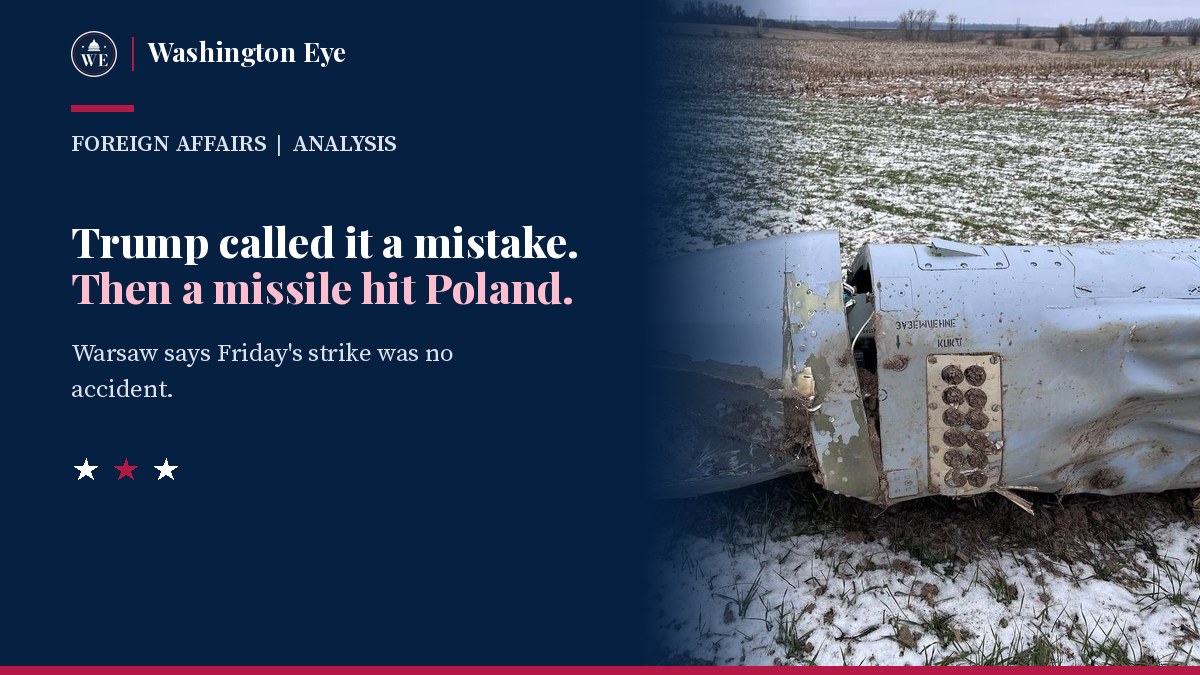
On Thursday, speaking in a television interview on his way home from Asia, Donald Trump offered a relaxed reading of Russia's habit of sending weapons into Poland. "Putin has been landing drones in Poland and a couple of little missiles, by mistake," the president said. A few hours later, at about 6:30 on Friday morning local time, a Russian Kh-101 cruise missile slammed into farmland at Nowy Lipowiec in southeastern Poland.
Poland's government does not think this one was a mistake. "This doesn't look like an accident," Prime Minister Donald Tusk told reporters in Warsaw, adding that he was choosing his words carefully because the matter was serious. "It appears that we are dealing with an intentional provocation." He also made a point of answering the American president directly. "To put it mildly, I don't always agree with the American side's assessment and interpretation of these incidents," he said.
Nobody was hurt and Polish officials reported no damage. But the incident lands at the most sensitive possible moment: a day after Mr Trump's three-way summit with Vladimir Putin and Xi Jinping, a day after his envoys told European leaders that Moscow could live with Western security guarantees for Ukraine, and in the middle of the first military exercise by the European countries preparing a force to keep the peace in Ukraine after a ceasefire. It also puts Washington and its most hawkish ally in Europe on visibly different pages.
What fell, and where
Defence Minister Wladyslaw Kosiniak-Kamysz said three objects came down at three sites in southeastern Poland. The one at Nowy Lipowiec, which exploded on impact, was confirmed as a Kh-101, a long-range cruise missile that Russian bombers fire from far behind the front line. Polish officials placed the impact site roughly 50 to 60 kilometres from the Ukrainian border. A second object, near Rudnik nad Sanem, is also believed to be a missile. The third, near Molodycz, was probably a jet-powered drone.
A local resident told a British broadcaster she was getting her children ready for school when she heard "a whistle and a dull impact". A farm camera caught the moment of the explosion. Another villager told a Polish broadcaster that her "whole house shook".
The objects were stragglers from one of the heaviest Russian air attacks of the war. Major General Ireneusz Nowak, who heads the Polish armed forces' operational command, said Russia used seven bombers and fired 26 Kalibr cruise missiles, 72 Kh-101 cruise missiles and more than 500 drones overnight, and that as many as 11 objects were identified as a danger to Polish airspace. Ukrainian President Volodymyr Zelensky gave a slightly different count of more than 110 missiles and more than 400 attack drones, launched in waves 20 to 30 minutes apart. Polish and Swedish jets were scrambled on the alliance's eastern flank, and air traffic control at Rzeszow-Jasionka airport, the main transit hub for Western military aid to Ukraine, was briefly evacuated for the first time since the full-scale invasion began.
Why Warsaw says it was deliberate
Tusk's case rests on location and timing. The three impact sites lie between about 50 and 100 kilometres from Nowa Deba, where thousands of troops from 11 countries are taking part in Koalicja 2026, an exercise led by Britain and France to rehearse deploying a multinational force to Ukraine once the fighting stops. Tusk said the objects "fell close" to where the "armies of the Coalition of the Willing" were training, and that it was "no coincidence". He called the link to the drills a hypothesis, but said the judgement that the incursion did not look accidental was "not just my own assessment, but also that of our foreign partners, including those within NATO".
NATO Secretary General Mark Rutte did not go quite that far in public. He condemned what he called "grave violations" of Polish airspace, said alliance jets had been scrambled, and added: "This incident is clearly dangerous, a consequence of Russia's ongoing war against Ukraine." Tusk said Rutte, who is due in Warsaw on Saturday, agreed that the timing did not seem to be a coincidence, and that he had asked the NATO chief for recommendations on strengthening the eastern flank. Kosiniak-Kamysz said Poland would ask the alliance for additional support. Britain's defence secretary, Wes Streeting, who is in Poland for the exercise, called the incursion "very serious".
Moscow had not commented by Friday afternoon, and the Russian embassy in Warsaw did not respond to requests for comment from reporters.
A pattern Washington keeps calling an accident
Poland has been here before, which is partly why its leaders are losing patience with the benign explanation. In July, a Kh-101 fell in the Lublin region after veering off course during a Russian attack on Ukraine. In September last year, more than 20 Russian drones crossed into Polish airspace, prompting Tusk to warn that his country was closer to military conflict than at any time since the Second World War. In November 2022, a Russian Kh-55 missile crashed near Bydgoszcz, hundreds of kilometres from Ukraine, and was not found until the following year.
Each episode has raised the same question: is Russia probing NATO's air defences and political nerve, or are these simply misfires in a war fought with thousands of long-range weapons? Mr Trump's answer on Thursday was the second. Tusk's answer on Friday was the first, and he went out of his way to say American officials have access to the impact sites and debris. "I think that in this particular case, no one will try to pretend anymore that this was just an innocent accident," he said.
That is an unusually pointed message from a close American ally, and it is aimed at an audience in Washington as much as in Moscow. If the Polish assessment holds up once the wreckage is examined, the administration will face pressure to say so, and to explain how it squares with the president's description of earlier incursions.
The diplomacy it collides with
The timing is awkward for the White House's peace effort. On Thursday, at a summit of the coalition in Berlin, presidential envoy Jared Kushner told European leaders that he and Steve Witkoff had "gotten the Russians comfortable with the concept that any security guarantee for Ukraine would be based on Article 5", the clause of NATO's founding treaty that treats an attack on one member as an attack on all. Mr Trump dialled into the Berlin talks from Air Force One and reportedly questioned European plans to commit 70 billion euros in military funding for Ukraine.
Moscow pushed back this week. Deputy Foreign Minister Sergei Ryabkov said any form of "quasi membership" of NATO for Kyiv was totally unacceptable, according to Russian state media. Overnight into Friday, the missiles flew. Zelensky said Mr Putin went ahead with the strike after what he called "weak meetings" with the American and Chinese leaders. Ukraine's foreign minister, Andrii Sybiha, said the violations of Polish airspace showed that "Russian missiles and drones directly undermine the existing security order in Europe".
Tusk drew his own conclusion about the talks. "Today's incident shows clearer than ever before why Poland must participate in decisions on Ukraine's future," he said, a reminder that the eastern flank countries do not want a settlement negotiated over their heads by Washington, Moscow and Beijing.
Inside Ukraine, a night aimed at bridges
In Ukraine itself the attack was deadly. At least eight people were killed, most of them in Kyiv, and nearly 30 were injured, according to Ukrainian officials. Ballistic missiles struck three crossings over the Dnipro in the capital, the Podilsko-Voskresensky, Darnytskyi and Southern bridges, which were closed to traffic. In the western city of Lviv, an entry point for aid and refugees, the Sknyliv railway station was badly damaged and two people were killed. France's foreign minister called for a meeting of the United Nations Security Council and described the strikes as "crimes".
The assault followed Ukraine's operation earlier this week that brought down part of the road section of the Kerch Strait bridge linking Russia to occupied Crimea. Mr Putin had promised that Russia's response would be "far more painful". Striking Kyiv's bridges looks like a deliberate mirror of that blow.
What to watch
Three things will show whether Friday becomes a turning point or another entry in a long list. The first is the forensic verdict on the wreckage, and whether American officials who have seen it say anything that matches or contradicts Warsaw's reading. The second is what NATO does after Rutte's visit on Saturday: extra air defence and fighter patrols over southeastern Poland would signal that allies share the Polish assessment. Poland's statements on Friday asked for support and recommendations rather than formal crisis consultations, leaving room to escalate later.
The third, and most important for American readers, is how the White House talks about it. Mr Trump was due to hold a news conference on Friday after returning from Asia. His envoys are trying to sell Moscow and Europe on a guarantee modelled on Article 5. A Russian cruise missile exploding inside a NATO country, near allied troops, and described by that country's leader as intentional, is exactly the kind of event such a guarantee is supposed to deter. How Washington describes it will tell allies a great deal about what that promise would be worth.