
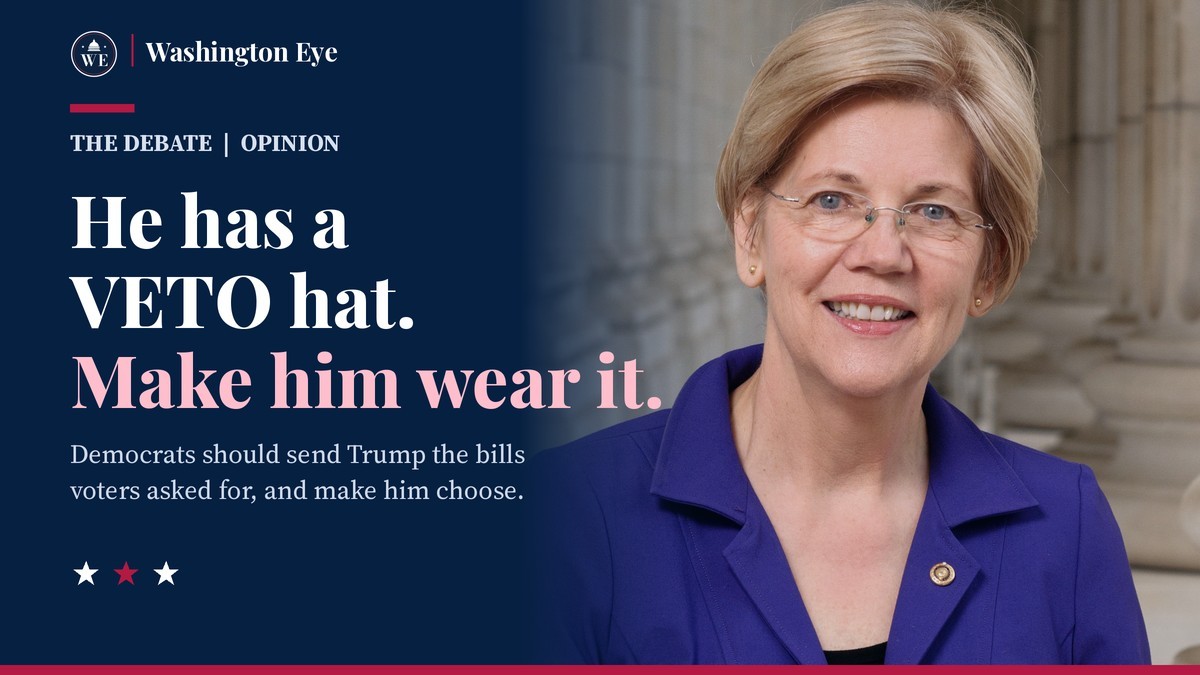
Two days after the midterm wave, the White House released a photograph of President Donald Trump signing an executive order in the Oval Office. Next to him sat a red cap. It did not say Make America Great Again. It said VETO.
The message was hard to miss. Democrats are projected to hold at least 255 House seats to 169 for Republicans, with a dozen races still uncounted, and at least 55 Senate seats, possibly one more once Alaska finishes counting. That is a landslide. It is not two thirds of either chamber, which is what it takes to override a president. The hat was a reminder of the arithmetic, and an invitation to give up before January.
Democrats should accept the invitation, just not in the way the White House intends. If the president wants to be Mr. Veto, the new majority should give him plenty to veto, and it should choose the order carefully enough that every no costs him something.
Senator Elizabeth Warren of Massachusetts, who is in line to chair the Senate Banking Committee, put it bluntly in a post online the same day the photograph appeared. "If Donald Trump wants to be Mr. Veto, let's test that out," she wrote. "The new Democratic majority in Congress should pass bills to make life more affordable and our government less corrupt." A day later Senator Tammy Duckworth of Illinois answered with a list: end the Iran war, cancel the Medicaid cuts, restore the Affordable Care Act tax credits, raise the minimum wage, end the tariffs and refund consumers, make data centres pay for their own energy and water, and ban stock trading by presidents and members of Congress.
That is a fine list. It is also, if taken all at once, a recipe for the thing Democrats should fear most: a winter of messaging bills that die quietly, followed by two years in which voters conclude nothing changed. The question is not whether to dare the president. It is how to make the dare land.
Start with the voters, because Democrats at their own gathering in Denver this week were unusually honest about them. "Our party is on probation with voters, who might not like us very much or know exactly what we stand for, but who have given us a chance anyway," Stephanie Valencia, co-founder of the research firm Equis, told the conference. "We maybe have the next year to 18 months to show voters who we are, or the pendulum might swing right back."
That warning cuts against two temptations at once. The first is to spend the next two years mainly on investigations. Representative Robert Garcia of California, the incoming chairman of the House Oversight Committee, has already told administration officials to "lawyer up" and named four lines of inquiry, from the president's family business to immigration enforcement and the Epstein files. Oversight is part of the job, and the White House counsel's letter warning that Democratic plans "may cross the line into blatant criminality" shows exactly why it is needed. But Senator Chris Coons of Delaware made the political point plainly at the same conference: "If all we do is investigations and we don't deliver," he said, the voters who swung against Republicans this year "are going to vote against us."
The second temptation is to treat cooperation as surrender. Iowa's Democratic governor-elect, Rob Sand, was asked whether delivering for voters meant working with Mr. Trump. "Yes, because he's there," he said. That is not timidity. It is the same insight from the other direction. The goal is results voters can feel, and a signature is a result. So is a veto that forces the president to own a decision.
The way to reconcile those two instincts is sequencing. The first bills out of the gate should be the ones that already split Republicans, because those are the ones where a veto is costly, an override is at least conceivable, and a signature is a genuine win.
The obvious first candidate is a stock trading ban. Mr. Trump called for one in his State of the Union address this year, telling Congress to pass it "without delay" so that lawmakers "cannot corruptly profit from using insider information." The House passed a Republican version in July by 232 to 198. Critics noted that it would still let members keep existing holdings and that it did not apply to the president at all. That matters, because the president's own disclosures listed more than 21,000 trades in 2025, according to a review of his filings by a business news network.
Senator Josh Hawley of Missouri, a Republican, has spent more than a year pushing the stronger version. In July 2025 he joined every Democrat on the Senate homeland security committee to advance a bill that covered the president and vice president too, delayed until their next term. Mr. Trump responded by calling him a "second-tier Senator" on his social media platform. Mr. Hawley has not backed down. "I'd be in favor of a uniform rule for everybody," he has said. Asked this week whether he would support bipartisan bills in the new Congress, including a stock trading ban, he was emphatic. "Absolutely. It's my bill that's currently pending," he said.
That is the template. Democrats should pass a real ban, covering members, spouses and the executive branch, in the first weeks of January, with Mr. Hawley's name on it. Senator Brian Schatz of Hawaii, the likely No. 2 Senate Democrat, has said his party "confidently" wants to do it. House Democratic leader Hakeem Jeffries, expected to become Speaker, has called it the place to begin "cleaning up the mess." If the president signs, voters get a reform they have wanted for years. If he vetoes a bill he once demanded because it finally reaches his own trading accounts, the explanation will write itself.
Next should come the bills where Republicans have already put their names on the Democratic side of the ledger. Mr. Hawley told a reporter this week that he supports raising the federal minimum wage and reversing his party's cuts to rural hospitals. He and Ms. Warren have a joint bill aimed at pharmacy benefit managers, the middlemen blamed for inflating drug prices. Senator Kirsten Gillibrand of New York has pointed to a possible bipartisan package restoring Medicaid funding and improving access to affordable medicines. "I dare him to veto that," she said. "I dare him to stand in front of the American people and say, you don't deserve access to healthcare."
The minimum wage is the cleanest test of all. The federal floor has sat at $7.25 an hour for 17 years, the longest freeze since Congress created it. Twenty states still use it. There is precedent for a divided government acting: in 2007 a new Democratic Congress sent a Republican president, George W. Bush, a minimum wage increase, and he signed it. Mr. Trump has, over the years, sounded open to raising it. Make him decide.
Here, though, Democrats have homework. They have not agreed on a number. Many have endorsed a gradual rise to $17. Senator Ruben Gallego of Arizona has proposed $20 by 2029. A House bill with 34 cosponsors would require large employers to pay $25 by 2031. "We're having those discussions," said Representative Debbie Dingell of Michigan, a co-chair of the labour caucus. A dare only works if it arrives on the president's desk while voters are still paying attention. The party should settle on a figure that can win four or five Republican senators, not the figure that wins the loudest applause at a progressive summit.
Then there is the procedural shortcut. Ms. Warren has argued that budget reconciliation, which needs only 51 Senate votes, can "reverse the healthcare cuts the Republicans put in place, expand healthcare coverage, and fund universal childcare" without a single Republican. That is true as far as the Senate goes. It does nothing about the president. A reconciliation bill still goes to the White House like any other bill, and it can be vetoed like any other bill. Reconciliation solves the filibuster problem. It does not solve the hat.
That is not an argument against using it. It is an argument for using it after the bipartisan bills, not instead of them. A veto of a party line package is easy for the president to frame as a partisan exercise. A veto of a stock trading ban carrying a Republican senator's name, or a minimum wage bill with Republican votes, is much harder to explain away. The order in which the bills arrive will shape how voters read every veto that follows.
None of this works if Democrats cannot run the floor. This week, before they even take the majority, they gave Republicans two easy wins. On Tuesday the House voted 211 to 204 to set aside Representative Thomas Massie's effort to impeach Defense Secretary Pete Hegseth, after nearly a dozen Democrats were absent. The next day Republicans passed a veterans bill by voice vote over Democratic objections. Those are small stumbles in a lame duck session. In January they would be fatal to the strategy. A party that wants to dare a president needs every member in the chamber when the dare is called.
Ms. Warren described the lesson she drew from a housing bill this summer, which the president declined to sign but which ultimately became law without his signature. Democrats, she said, told him: "The ball's in your court now, Mr. President. Veto it. Let it go through, but we're not backing down." The alternative, she warned, is going to the White House "with a begging bowl that only has two tablespoons' worth of ideas in it."
She is right about the begging bowl. But the hat is a challenge, not a wall. Senator-elect James Talarico of Texas urged his party to make Mr. Trump's final two years "the most productive of any presidency in American history." That will not happen if Democrats send nothing. It also will not happen if they send everything at once, with no Republican fingerprints, and call each veto a victory. Voters did not elect this majority to collect vetoes. They elected it to change things.
The best way to honour that is simple. Lead with the bills Republicans have already endorsed. Keep the oversight serious and separate. Use reconciliation for what only reconciliation can do. And make sure that every time the president reaches for that red cap, he has to explain to the country exactly what he just said no to.