
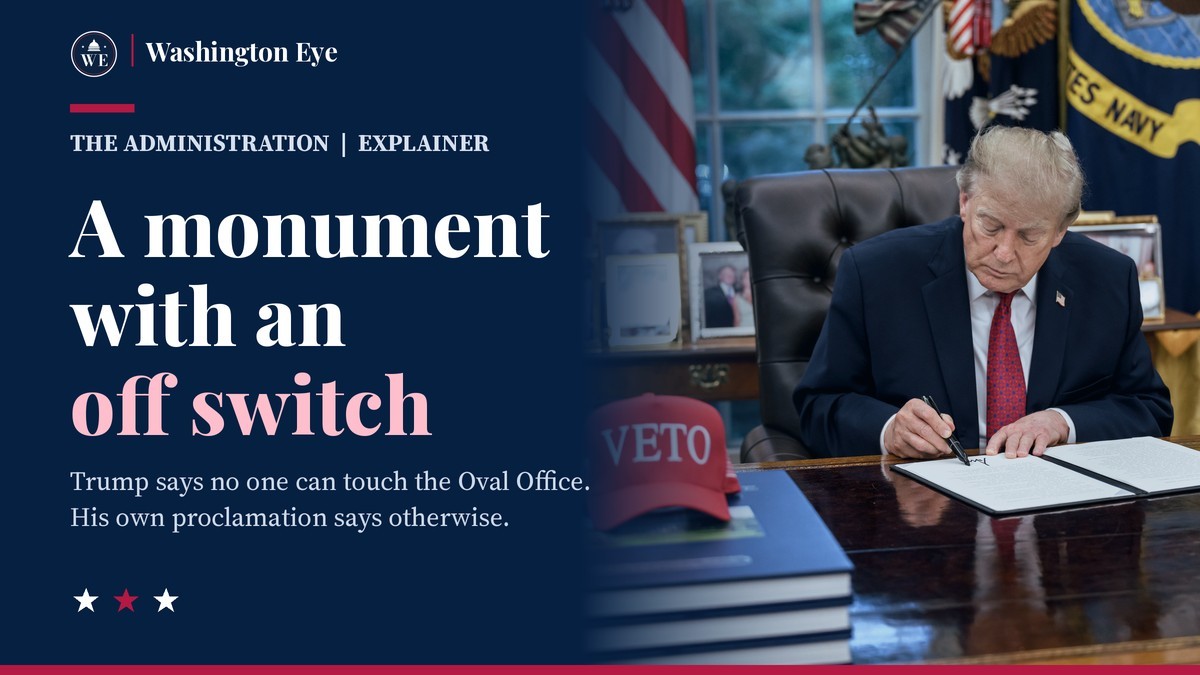
On Thursday, a week after he signed it, President Donald Trump's proclamation turning the Oval Office into a national monument appeared in the government's official journal of rules and presidential documents. Publication makes the text formal public record and makes plain how far the document's wording sits from the way the president described it in front of the cameras.
"We're making it a national monument, and it will not be allowed to be touched by anybody," Mr. Trump told reporters on November 5, seated behind the Resolute Desk two days after his party lost control of both chambers of Congress. The rooms would not be "destroyed, ripped down by stupid people, in order to build something in a slightly different shape," he said, calling the document "a landmark for the ages." Then he went further. "No major modification without the approval of Congress," he said, suggesting that a successor who wanted to make the room square would "have to go back to Congress."
The proclamation itself says something narrower. It does not bar change, it does not give Congress a veto, and it rests on a legal power that Mr. Trump's own Justice Department concluded last year a later president can use to shrink or erase a monument. Read closely, it is less a lock on the West Wing than a new layer of paperwork that a future president could remove with a pen.
The new Oval Office National Monument consists of four rooms identified by number: the Oval Office itself (Room 110), the Outer Oval Office (Rooms 106 and 108) and the Cabinet Room (Room 105). It invokes the Antiquities Act of 1906, the law that lets a president declare "historic landmarks, historic and prehistoric structures, and other objects of historic or scientific interest" on federal land to be national monuments, as long as the protected area is "the smallest area compatible" with their care. The proclamation states that the boundaries of the four rooms meet that test.
Management goes to the Secretary of the Interior, acting through the National Park Service, which already administers the White House grounds as part of the President's Park. The secretary is told to do four things: write a management plan with the White House Office of Administration that prioritizes the rooms' "structural and significant architectural features"; "require documentation, review, and consideration of alternatives" before any action that would "substantially alter or demolish" them; check proposed changes for consistency with their national significance; and coordinate with the Committee for the Preservation of the White House, an advisory body created by executive order in 1964.
Two closing sentences mark the limits. The first says nothing in the proclamation restricts "the President's authority to redecorate the monument, select furnishings, or make ordinary operational and security modifications" that do not substantially impair the rooms' historic structure. The second says the order does not alter existing exemptions for the White House under federal historic preservation law or diminish "the Congress's authority over Federal property."
Much of the reaction treated the move as an attempt to preserve Mr. Trump's heavily gilded redesign of the room. The text does not do that. The gold ornaments, mirrors and figurines that critics have mocked are furnishings and decoration, which the proclamation expressly leaves to each president. A future occupant could box them up on the first afternoon without asking anyone. Mr. Trump appeared to accept as much when reporters pressed him, according to accounts of the signing, saying a successor could remove such items if done carefully.
What the proclamation does reach is structural work: the walls, the oval shape, the architectural fabric. Even there, it requires a process rather than a prohibition. Documentation, review and a look at alternatives slow a decision and create a record. They do not forbid the outcome. And the official who runs that review is a cabinet secretary who serves at the pleasure of the president who wants the change.
Nor does the text say anything about congressional approval. Its only reference to Congress preserves the legislature's existing authority over federal property. The Antiquities Act gives the designation power to the president alone and contains no ratification step. The monument took legal effect when Mr. Trump signed it, without a vote. His remark that "we're going to send it over to Congress to have it ratified" describes a possible future bill, not anything the proclamation requires. A statute requiring a vote before structural changes would bind later presidents in a way a proclamation cannot, but no such bill had surfaced in public reporting reviewed for this article.
The larger tension is about permanence. For most of a century, the government's working view was that a president could create a monument but could not abolish one. That view came from a 1938 opinion by Attorney General Homer Cummings concerning Castle Pinckney, a fort in Charleston Harbor, which treated a monument proclamation as if it carried the force of an act of Congress.
On May 27, 2025, the Justice Department's Office of Legal Counsel threw that out. In an opinion requested by the White House as Mr. Trump weighed reversing two California monuments created by President Joe Biden, the office concluded that the Antiquities Act "permits a President to alter a prior declaration of a national monument," including by finding that the protected objects "either never were or no longer are deserving of the Act's protections," and that such an alteration "can have the effect of eliminating entirely" the monument. The 1938 opinion, it said, "was incorrect, and that opinion can no longer be relied upon."
The administration has since acted on the narrower half of that power. On July 13 of this year, Mr. Trump signed proclamations cutting Utah's Grand Staircase-Escalante National Monument from about 1.87 million acres to about 181,500 and Bears Ears from about 1.36 million acres to about 121,100. The White House justified the cuts by pointing to the same "smallest area compatible" language now cited to protect the Oval Office.
The logic runs both ways. If a president may decide that a predecessor's objects no longer merit protection, a successor may decide the same of four rooms in the West Wing, or simply rewrite the management terms to drop the review requirement. Courts have never squarely ruled on whether presidents can abolish monuments, so the question is not settled. But the administration's own stated legal position is that the door is open, and it has walked through it. Congress, for its part, has abolished 11 national monuments by statute, according to the National Park Service, most recently in 1980, and could do the same here with a simple law.
Presidents have used the Antiquities Act on single buildings before. President Bill Clinton designated the cottage where Abraham Lincoln spent his summers, about 2.3 acres on the grounds of a federal retirement home in Washington, in July 2000. President Barack Obama designated the Belmont-Paul Women's Equality National Monument, a house near the Capitol tied to the suffrage movement, in April 2016. What sets the new designation apart is its scale and its occupant. Its boundary is a set of numbered rooms inside a working office building, and the official who drew it is the one who works there.
That matters because the White House sits outside the normal preservation rules. The National Historic Preservation Act states flatly that "nothing in this division applies to the White House and its grounds." That exemption is part of why last year's demolition of the East Wing, for a ballroom now put at about $600 million, did not face the review that law requires for other historic federal buildings. The new proclamation leaves that exemption in place for everything outside the four rooms.
The strongest argument for the designation is that it adds something that did not exist before. Until now, no law required any review before a president restructured the Oval Office. A written management plan, a documented review and a formal role for the White House preservation committee create a record and a pause that a future president would have to work through or formally repeal. A successor who wanted to knock down a wall would at least have to do it in the open.
Critics see it differently. Brent Leggs, president of the National Trust for Historic Preservation, told a news site that the timing was "suspicious" and that it was "disappointing to see the Administration using the legal mechanisms of historic preservation to honor only the significance of the Oval Office, especially after watching their unlawful demolition of cherished historic portions of the White House." Representative Ted Lieu of California asked in a social media post whether, after a "massive repudiation" at the polls, the president was focused on "his furniture." Kentucky Governor Andy Beshear, a possible 2028 contender, said bluntly that "that gold needs to be stripped from the Oval Office."
Some of the sharpest criticism was legal rather than aesthetic. The political scientist Norman Ornstein argued in a social media post that any such order "can be altered by another" one, which is, in substance, what the administration's own lawyers wrote in 2025.
Three things will decide whether the monument means much. The first is the management plan, which has not been written. How broadly it defines the rooms' "significant architectural features" will determine how often the review requirement applies, and whether any gilding fixed to the room's fabric counts as architecture rather than decoration.
The second is Congress. The current Republican majorities could try to codify the monument in the lame-duck session before Democrats take control in January, which is the only route to the congressional approval rule Mr. Trump described. Public reporting so far shows no sign of such a bill. Once Democrats hold the gavels, they are far more likely to scrutinize the White House construction projects than to protect them; incoming House Oversight chairman Robert Garcia has already listed the ballroom among the subjects he wants to investigate.
The third is the next president. Whoever takes the oath in January 2029 will inherit an Oval Office that is, on paper, a national monument, and a Justice Department opinion that says a president may unmake one. Mr. Trump said that if anyone ever starts "knocking down walls," he should be called "wherever I may be," and he would "make sure it never happens." The proclamation's fine print suggests that phone call, rather than the document itself, may be the strongest protection the rooms have.