
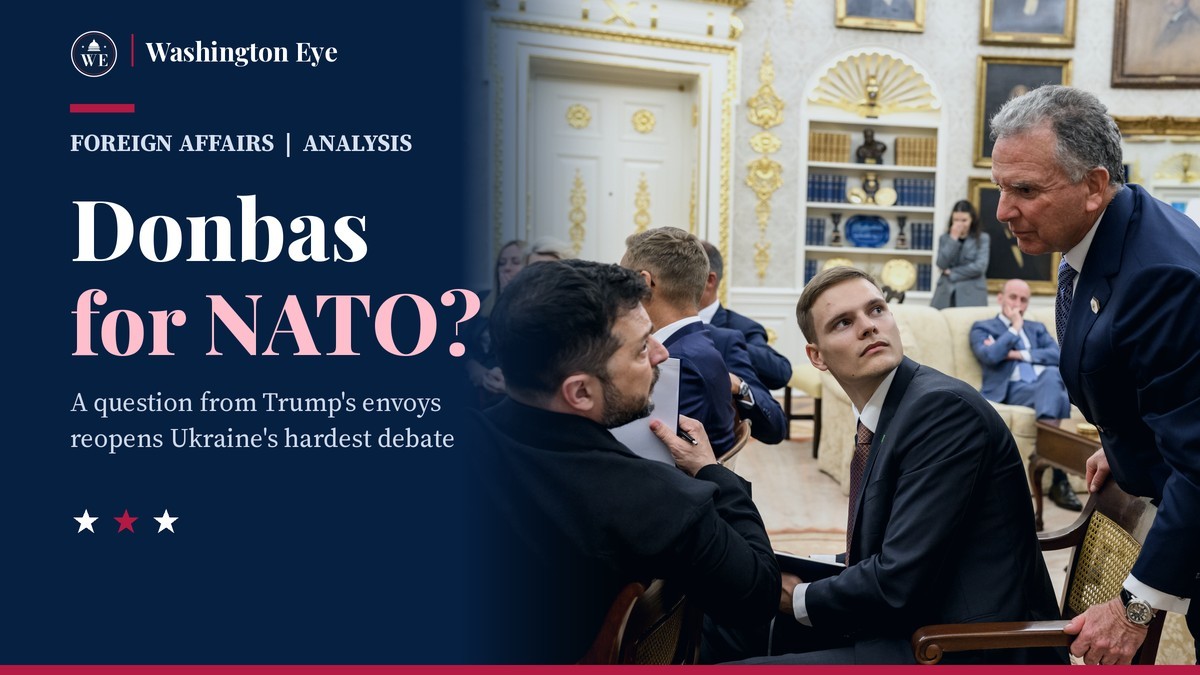
For most of the past two years, the American position on Ukraine and NATO looked settled. Donald Trump told Kyiv to stop hoping for membership, and senior officials in his administration called it an unrealistic outcome of any peace deal. Then, according to Volodymyr Zelensky, two of the president's closest envoys walked into a negotiating room and asked a question that turned that position on its head.
"The Americans raised a question: 'What if Ukraine joins NATO? Would Ukraine withdraw from Donbas?'" the Ukrainian president told reporters, in remarks released by his office on Saturday. He said it was the first time anyone in the talks had linked membership of the alliance to territorial concessions. "That is why I believe NATO is back on the agenda," he added. "But you have also heard Putin's signals, and this is an extremely difficult conversation."
The question reportedly came from Steve Witkoff and Jared Kushner during the latest round of US-brokered talks between Ukrainian and Russian delegations in Abu Dhabi last week. If Zelensky's account is accurate, it is the most significant shift in Washington's approach to the war in months. It may also turn out to be a trial balloon that pops before it ever becomes a policy.
The talks themselves produced little. Over two days in the Emirati capital, the Russian delegation, led by Kremlin aide Vladimir Medinsky, and the Ukrainian team, led by Rustem Umerov, agreed on a large prisoner exchange that Zelensky said would involve more than 1,000 people, with final numbers still being worked out. There was no ceasefire, no agreement on territory and no deal on postwar security guarantees.
Witkoff and Kushner then flew to Moscow, where they met Vladimir Putin in the Kremlin on Thursday. Zelensky said they had promised to raise an energy ceasefire, a halt to strikes on power infrastructure before winter. There was no sign of progress. "Putin personally does not support a ceasefire," Zelensky said. The envoys then went to Dublin to brief him, on the edge of a gathering of European leaders.
The one procedural breakthrough was about who sits at the table. According to Zelensky, the American negotiators told him that all sides had agreed Europe should have a seat in the next round. European Union leaders have since agreed that they will be represented by Britain, France, Germany, Italy and Poland, together with the bloc's institutions. In Abu Dhabi, European officials met the American and Ukrainian teams but never sat down with the Russians.
The United States has not confirmed that it proposed a Donbas-for-NATO trade, and the official American language has been notably vague. In a social media post after Zelensky's remarks, Kushner said the press had reported "some of the maximalist positions proposed by both sides" and stressed that the talks were private. He wrote that both sides understand "practical compromises will be necessary to end this war" and that "several new ideas" had emerged and were being explored.
In an earlier post, Kushner said the American focus was now on "facilitating direct engagement between Moscow and European partners" and preparing the agenda for the next three-way round. He also called NATO a "critical pillar" of European security and of credible guarantees for Ukraine. That phrasing is worth noting. It does not endorse membership for Kyiv, but it is warmer toward the alliance's role than much of what the administration said in 2025.
There is a plausible reading in which nothing has changed in Washington at all. Asking "what if" is a classic negotiating device: it tests how far each side might move without committing anyone to anything. Envoys often float ideas they do not expect to survive, simply to learn where the walls are. By that reading, the Americans learned quickly.
Russia's response came within a day, and it was not encouraging. Foreign Minister Sergei Lavrov said in a television interview that Moscow's negotiating line "will be structured to achieve the objectives of the special military operation," which he said were formulated by Putin "in June 2024 and have not changed since then."
Those June 2024 terms are well known. Putin demanded then that Ukraine withdraw its forces not only from the Donetsk and Luhansk regions that make up the Donbas, but also from the Zaporizhzhia and Kherson regions, including parts Russian troops do not hold, and that Kyiv formally abandon any ambition to join NATO. In other words, the Kremlin's stated price is the Donbas and more, plus permanent neutrality. A trade that gives Ukraine NATO membership in return for the Donbas offers Moscow the half it already expects and takes away the half it calls non-negotiable.
The Kremlin's spokesman, Dmitry Peskov, went further, tying any settlement in Ukraine to a wider overhaul of European security. The two, he said, were component parts, and neither could exist without the other. He warned that if Europe did not genuinely want peace, Russia would achieve its goals by force. Russia has also reportedly renewed its demand that NATO pull forces back from the alliance's eastern flank, an idea European capitals regard as a non-starter.
Lavrov was openly scornful of Europe's late arrival. European governments, he said, "realize the train is leaving and are trying to jump onto the steps of the last carriage."
Zelensky's own position is more nuanced than either a yes or a no. He repeated that Ukraine is not ready to give up territory and ruled out legally recognising any occupied land as Russian. But he also set out, for the first time in this form, the conditions under which he would put the question to the public. If Ukraine received a comprehensive package, including security guarantees, the right to keep a strong and well-funded army, and money for reconstruction, he said he would hold a national referendum.
"Then I will ask our Ukrainian society what it thinks: do we accept it or not? I have no right to make that decision on my own," he said. He added that any such package would need to be confirmed by the United States and by Ukraine's allies before it went to voters, and that its specifics do not yet exist.
That is a significant hedge. It shifts the political burden of any territorial concession from the president to the electorate, and it raises the bar for the West: no referendum without guarantees on paper first. It also keeps the door open without walking through it.
On the bigger picture, Zelensky was blunt. "Real security in Europe means the EU and NATO. That's it," he said. He also rejected Moscow's demand to settle Europe's security architecture before ending the fighting. "This war must be ended first," he said.
Even if Washington, Kyiv and Moscow could agree, NATO membership is not America's to hand out. Accession requires the unanimous agreement of every member state and ratification in each of them. Ukraine formally applied in September 2022, and the alliance remains divided. Countries on Russia's border, such as Poland and Lithuania, are the strongest supporters, while others insist that the war must end before membership can be seriously discussed.
The territorial side is just as difficult. The Donbas, made up of the Donetsk and Luhansk regions, was first partly occupied by Russian-backed forces in 2014. Russia now occupies about a fifth of Ukraine, including most of those two regions, but its forces have never captured all of the Donbas. Withdrawing from the remaining Ukrainian-held towns would mean handing over, without a fight, ground Russia has failed to take in more than four years of full-scale war. Zelensky has already rejected a Russian offer of a local humanitarian truce in the contested city of Kostiantynivka, saying it was a way for Moscow to take the city without having to capture it.
The fighting, meanwhile, has not paused for diplomacy. Zelensky said Russia launched more than 2,300 attack drones, nearly 1,600 aerial bombs and 15 missiles at Ukraine in a single week, many aimed at the power grid. "They are betting everything on this winter," he said. Ukraine, for its part, has stepped up long-range drone strikes on Russian refineries and military airfields. On Russia's border with the Baltic states, Estonia's government has moved to close its eastern frontier, likely from December, after an attempted arson attack that it blamed on Russian military intelligence.
The next test comes quickly. Trump leaves for Asia this week, starting in the Philippines before travelling to China for the Asia-Pacific Economic Cooperation summit, where he is due to hold a three-way meeting with Xi Jinping and Putin. Nuclear arms are the advertised agenda, but the wars in Ukraine and Iran will hang over the room. A face-to-face encounter with Putin is exactly where a "what if" either hardens into an American proposal or quietly disappears.
Back in Washington, the politics are shifting as well. Democrats take control of Congress in January, and some are expected to look at curbing the president's foreign policy tools. Zelensky has made clear what he wants from American lawmakers: legislation on "sanctions and weapons," which he called "the kind of motivation Putin needs." In Brussels, the European Commission says it will soon propose a 22nd sanctions package against Russia.
For now, the most accurate summary is also the least satisfying. An American question has put NATO back into a conversation that had written it off, and the Ukrainian president has sketched the conditions under which his country might consider the unthinkable. Moscow has responded by restating terms that go far beyond the Donbas. Until Washington says, on the record, what it is actually offering, the Donbas-for-NATO trade remains what Kushner's own words suggest it is: one of several ideas being explored, and possibly one of the maximalist ones.