
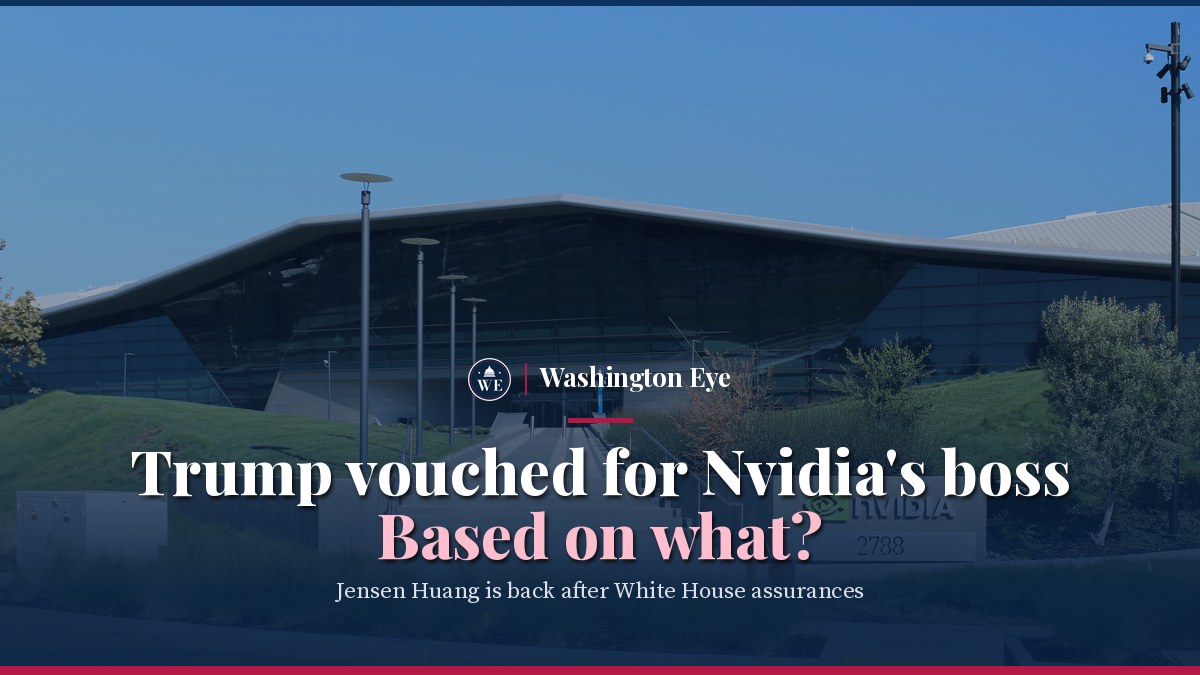
Eleven days after Jensen Huang walked out of the company he founded, he walked back in. On Monday, Nvidia's board announced that it had voted unanimously to reinstate him as president, chief executive and director, effective immediately. The board, which for weeks had insisted it was not considering his return, gave one reason above all for the reversal. It said it had "received input from senior levels of the United States government" and, based on that input, was "confident that Mr. Huang's reinstatement poses no national security risk."
That sentence is the story. Mr Huang did not resign over his strategy, his chips or his numbers. He resigned after admitting to extramarital affairs, including one with a businesswoman whom US authorities suspect of passing information to China, an allegation Beijing denies. The question that forced him out was a national security question. The answer that brought him back came not from a published finding, a court or a congressional briefing, but from the White House, and the President has been happy to say so.
"They did ask for assurance on the national security threat," President Donald Trump said in a telephone interview with a business television network on Monday morning. "And we gave him assurance at least with everything we know, and we know a lot." He said he had spoken with the board "directly and indirectly" and had talked to Mr Huang himself on Sunday night, before the decision was announced. Mr Huang, the President said, "did nothing wrong."
On a social media platform, Mr Trump went further. The board, he wrote, had "made the correct and proper decision." The country, he said, needs Mr Huang's leadership "to ensure the Success and Prosperity of not only the Company, but the American Economy," and the government has "no reason to believe" that his return poses any risk to national security. He added that the government does not possess evidence that Mr Huang engaged in any unlawful conduct, and called him "a Great Patriot and National Treasure."
Wall Street cheered. Nvidia's shares jumped by about a third, recovering nearly all of the ground lost since Mr Huang first admitted the affair on 8 November. The technology heavy Nasdaq rallied almost 6% and the S&P 500 rose about 4%, clawing back Friday's rout. A British broadcaster calculated that the rebound added roughly a trillion dollars to Nvidia's market value in a single morning. Washington, by contrast, did not cheer at all.
To understand why the reversal is so striking, recall how quickly it all moved. Reports emerged early this month that US authorities had concluded that Alice Huang, a Chinese businesswoman who is no relation to the Nvidia founder, was a Chinese intelligence asset. She had been an executive at Megaspeed, a Singapore cloud computing company that buys large volumes of Nvidia processors. Mr Huang told employees he had been unfaithful to his wife. Within days the board had accepted his resignation, installed Colette Kress, the chief financial officer, as interim chief executive and named Harvey Jones, a long serving director, as its first chair. On Sunday a major American newspaper reported that Alice Huang had been in contact with an officer of China's Ministry of State Security during at least part of the time she was in a relationship with Mr Huang.
Meanwhile the company's troubles multiplied. A wire service reported on Friday, citing two people briefed on the matter, that the Securities and Exchange Commission was scrutinising potential accounting issues at Nvidia. The shares fell by about 13% that day. Investors were also weighing a federal investigation into whether Nvidia chips sold to third parties ended up in China in breach of export controls. By the weekend the stock was down by close to half from its peak, and the slide was dragging the whole artificial intelligence trade with it.
Then the government stepped in. According to people familiar with the discussions, quoted by a US business network, senior officials briefed the board late last week and told it that no national security laws had been violated. That prompted the board to reach out to Mr Huang. They held their first conversation since his exit on Saturday and agreed on Sunday that he would return. The same people said the collapsing share price had accelerated the talks. Asked whether the market slump had shaped his own push to bring Mr Huang back, Mr Trump answered: "Probably so, but the bigger impact was the long term." Mr Huang, he explained, has "other chips in his brain that nobody else knows about."
Nobody outside a small circle knows what the "input from senior levels" actually contained. That matters, because the phrase can mean very different things. A formal finding that no secrets were compromised, reached after a proper counterintelligence review, would be one thing. A political judgment that the economy cannot afford Nvidia without its founder would be quite another. The board's statement does not say which it received, and the President's own words blur the line. "At least with everything we know" is a caveat, not a conclusion.
The company has hedged too. Its statement stressed that the independent directors' investigation into the affair, conducted with outside counsel from the law firm Wachtell, Lipton, Rosen & Katz, "will proceed to conclusion," and that Mr Huang supports it. It announced a new board committee on national security and export controls, made up solely of independent directors, and a search for a new chief compliance officer. It said it would keep cooperating with "ongoing government investigations and inquiries." In other words, the board has reinstated its chief executive before its own inquiry into him has finished.
That sequencing is what troubles governance experts. "I am absolutely astonished," said Peter Andersen, founder of Andersen Capital Management in Boston, calling the decision "a textbook example of poor governance" and arguing that the board could not have completed its due diligence in so short a time. Lindsey Stewart of Morningstar called the return "almost as big a shock as his departure" and said it left unanswered questions about who is best placed to oversee the risks at a company at the centre of the global artificial intelligence economy. Steve Sosnick of Interactive Brokers put it more bluntly: the episode suggests Mr Huang "was too big to be fired."
The political reaction cut across party lines, which is rare in a capital this polarised. Representative Don Bacon, a retiring Nebraska Republican, said Nvidia should have "ignored the Administration's inexplicable desire to save Huang" and added that "Congress needs to get to the bottom of who approved high end computer chips sales to China." Senator John Cornyn of Texas, a Republican defence hawk on his way out of the Senate, picked apart the board's key line in three words and a question mark: "No national security risk? Based on what?"
Democrats were harsher. Senator Ruben Gallego of Arizona accused the President of "selling out our national security to keep the stock market high." Illinois Governor JB Pritzker called the decision "the greed and lack of accountability that the country just rejected," a pointed reference to the midterm elections that handed Democrats both chambers of Congress from January.
The defence of the decision is not frivolous, and it deserves a fair hearing. Nvidia designs the processors on which much of the American lead in artificial intelligence rests. Its value has swung by trillions of dollars in a matter of weeks, and its suppliers, customers and lenders, from chip foundries to heavily indebted cloud start ups, rise and fall with it. If the government genuinely has no evidence of wrongdoing, keeping a founder sidelined on suspicion alone would damage a strategic company for nothing. Some analysts read Monday's move exactly that way, as the removal of two big risks at once: a messy leadership transition and the shadow of export control charges. Mr Trump has also argued for months that winning the technology race with China requires backing American champions.
The trouble is that the public is being asked to take that judgment on trust, from an administration that has its own stake in the outcome. The President has tied his political fortunes to the stock market, which he warned would fall if Democrats won the midterms. He travelled to China last week to meet Xi Jinping and told reporters on Friday that he "did discuss" the Alice Huang matter with the Chinese leader. And the question of how advanced Nvidia chips reached Chinese buyers implicates decisions taken inside his own government. When the referee also owns a share of the team, the call needs to be explained.
That explanation is now likely to be demanded under oath. Democrats will hold the gavels on every committee from January, and the Nvidia affair touches several of them at once: intelligence, banking, commerce and the House panel on competition with China. Lawmakers on both sides had already sought briefings on Mr Huang's case before he resigned. They can now ask sharper questions. Which officials gave the board its assurance? Was it based on a completed counterintelligence review? Did anyone in the administration weigh the share price when deciding what to tell a private company about a national security matter?
There are other loose ends. The board's internal investigation will eventually report, and if it finds anything the government's assurance did not cover, Nvidia will face a crisis worse than the first. The Securities and Exchange Commission inquiry into the company's accounting has not gone away. Nor has the export control probe. Any of them could reopen the question the White House has tried to close.
For now, Jensen Huang has his company back and Nvidia's shareholders have their trillion dollars. What nobody has yet is the answer to Senator Cornyn's question. In a matter that began with an alleged spy, "trust us" is a remarkable thing for any government to say. It will not be the last word.