
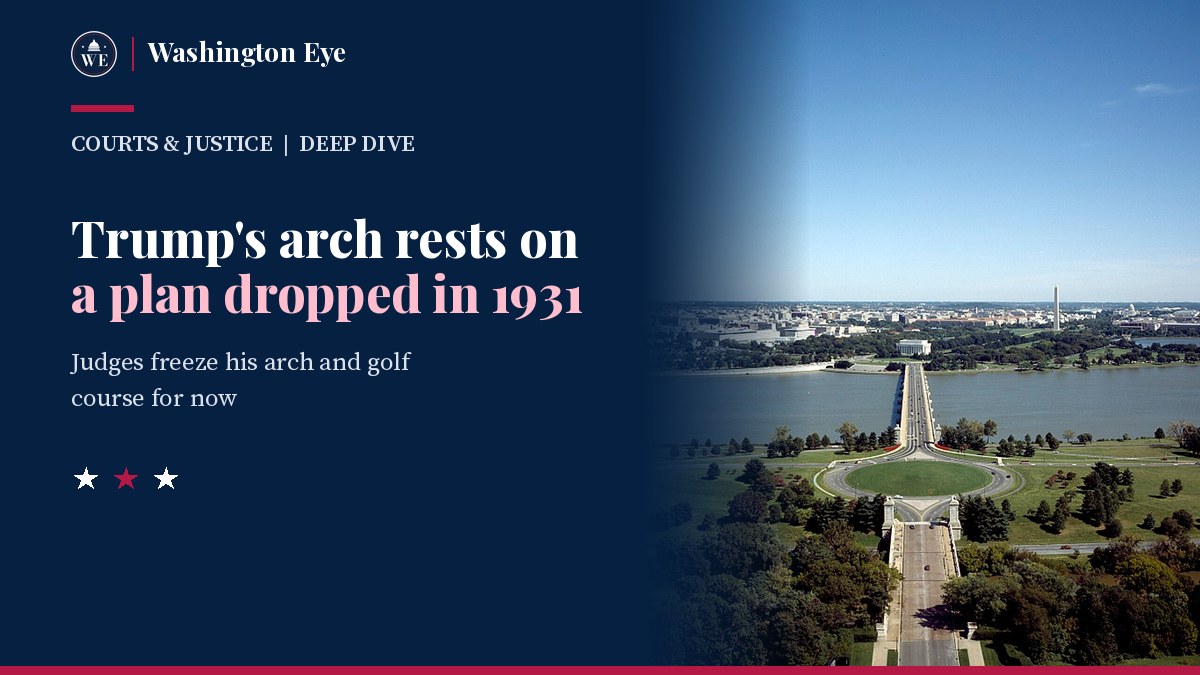
In 1924, a federal commission drew up plans for a grand new bridge across the Potomac River. On a small island at the Virginia end, it sketched two 166-foot columns, each "surmounted by statues of Victory," framing the view from Arlington toward the Lincoln Memorial. Congress approved the bridge the next year. The columns were never built. In 1931, they were dropped "in the interests of aviation safety and economy."
Ninety-five years later, that abandoned sketch has become the legal foundation for one of President Donald Trump's most personal projects: a 250-foot triumphal arch on the same spot, Memorial Circle on Columbia Island. This week a federal judge kept it frozen again. Another judge has frozen his plan to rebuild the public golf course at East Potomac Park. And on Thursday, a design panel made up almost entirely of his own appointees declined to approve the golf plan and asked for alternatives.
Taken together, the two fights show how the president's building agenda in the capital has run into the same wall: laws that say Congress, not the executive branch, decides what gets built on federal parkland in Washington. Here is how the arch got this far, why its legal case rests on a plan from the 1920s, and what happens next.
What is planned, and where
The design approved by the National Capital Planning Commission on 5 November is a 166-foot stone arch topped by three gilded figures, a 60-foot winged female figure flanked by two eagles, for an overall height of 250 feet. It includes an observation deck. The National Park Service projects two to three years of construction. The commission voted 8 to 4. Its three presidential appointees are all current administration officials, and the four votes against came from members not appointed by Mr Trump.
Mr Trump has compared it with the most famous arch in the world. "The one that people know mostly is the Arc de Triomphe in Paris, France, and we're going to top it by, I think, a lot," he said in December 2025. Counted with its statues, it would be far taller. Without them, the stone arch alone would beat Paris by only a few feet.
The site matters as much as the size. Memorial Circle sits on the axis that runs from Arlington National Cemetery across Arlington Memorial Bridge to the Lincoln Memorial, a line designed to symbolise the reunion of North and South after the Civil War. The planning commission's own staff report said the arch would allow framed views from the bridge at street level but would "fully obstruct reciprocal views of the Lincoln Memorial and Arlington from the higher elevations of Arlington House and the Lincoln Memorial terrace." The Park Service's revised environmental assessment found adverse effects on historic properties including the cemetery and the memorial.
The 1925 theory
The legal problem is old and short. A 1912 statute says: "A building or structure shall not be erected on any reservation, park, or public grounds of the Federal Government in the District of Columbia without express authority of Congress." The Commemorative Works Act of 1986 adds that a commemorative work on Park Service land in and around the capital may be built only as specifically authorised by law, with a sponsor approved by Congress and consultation with a federal advisory commission.
Mr Trump's own view, stated in May, was blunt. "We're doing it, it's, the land is owned by the Interior Department, we don't need anything from Congress," he told reporters. The administration has not sought congressional approval.
Its lawyers rely instead on the 1925 bridge law. Their argument is that Congress "undeniably authorized erecting and redesigning 166-foot-tall columns surmounted by statues," that the Interior Department inherited the old bridge commission's power to revise the design, and that this power "includes modifying the two 166-foot columns into a 250-foot Arch." Because the Commemorative Works Act exempts works authorised before 1985, the theory would take the arch outside that law entirely.
US District Judge Tanya Chutkan was not persuaded, at least at this early stage. In a 33-page opinion issued late on the night of 5 November, hours after the planning vote, she found that "Congress has not enacted any statute authorizing construction of the Arch," that the advisory commission was never consulted and that no sponsor was appointed. Of the 1925 argument, she wrote: "Merely to state this argument is to reveal its flaws." The old law allowed design changes only "without increasing the total cost of the project," and the 1924 report described columns "framing in but not interfering with" the view of the Lincoln Memorial. An arch, she noted, would squarely block it.
Who is suing, and why it matters
The case began this year with three Vietnam War veterans and an architectural historian, represented by a consumer advocacy group. It has grown since. In late October the District of Columbia and Virginia filed their own suit, now combined with the original. Last week nine members of the Kennedy family joined, arguing that the arch would block historic sightlines and cast shadows over the graves of President John F. Kennedy and others at Arlington.
"This is one man who wants to build this arch. He's violated every rule. If this is a great idea, then bring it before Congress, follow the rules and get it approved," Max Kennedy, a son of Robert F. Kennedy, said in a radio interview.
The two governments matter for a technical reason that could outlast this case. Earlier this year the Supreme Court found that plaintiffs challenging the White House ballroom likely lacked standing to sue, and the Justice Department leaned on that ruling here. Judge Chutkan grounded standing instead in the costs to the District and Virginia: Memorial Circle carries more than 27,000 vehicles, 1,100 cyclists and 1,200 pedestrians a day, and construction would mean lane closures, detours and about 1,400 truckloads of excavated soil. If that reasoning survives appeal, states and the District may have a route into court against federal construction that private citizens do not.
On Wednesday, the day before her first order was due to expire, the judge extended it through 3 December. It bars "any construction, excavation, demolition, land-disturbance, utility-installation, or roadway-closure activity, or any other construction-related activity" at the circle while she weighs a longer preliminary injunction. "The judge's order recognizes that the conditions that called for emergency relief two weeks ago remain unchanged," said Nick Sansone, a lawyer for the original plaintiffs.
The security argument and the money
In court, the administration has framed the arch as urgent, both to complete a century-old vision and for national security. Mr Trump said in September it would double as a military complex, though the approved plans contain no such details. This week Ricky Buria, chief of staff to Defense Secretary Pete Hegseth, told the court the department is "currently in the planning process to determine how to integrate national defense uses" into the arch "without changing the existing plans for the Arch." Judge Chutkan earlier called the security declarations "recent and unsupported," noting that they appear "nowhere in the planning documents."
The price is unknown. No official budget has been published, and public estimates range from more than $100 million to about $400 million without a document to support either end. Some taxpayer money is already committed: the National Endowment for the Humanities' fiscal 2026 spending plan reserves $2 million in special initiative funds and $13 million in matching funds for the arch. Mr Trump has said private money would carry much of the cost, and no donor list has been released.
The White House is not backing down. A spokesman, Davis Ingle, said the administration would "continue making the case for this beautiful and fitting monument" and was "confident we will be fully vindicated as this litigation proceeds."
The golf course across the river
Not far downstream, the same pattern is playing out at East Potomac Park, a public peninsula of golf courses, a historic miniature golf course, cherry trees and a perimeter road loved by runners and cyclists. Mr Trump wants a championship-level course there. After floating the idea in May, he toured the grounds with Interior Secretary Doug Burgum and the golf architect Tom Fazio, and said repeatedly that the park would close and work would begin on 15 November.
It did not. Last Saturday, on the eve of the planned closure, US District Judge Ana Reyes ordered the administration to keep the park open for two weeks. "In its haste to meet an arbitrary deadline, the Government has likely violated at least the National Environmental Policy Act and the Administrative Procedure Act," she wrote. The plaintiffs, local golfers and historic preservationists, argue that the government split the project into smaller pieces, such as removing hundreds of trees, to dodge required reviews. The administration appealed on Wednesday. The order runs to 28 November, and the plaintiffs want it extended to 12 December.
The case has turned personal. Government lawyers asked Judge Reyes to step aside in October, accusing her of bias; she refused. She has ordered an inquiry into whether officials and lawyers misled the court about the park plans and tapped a former US attorney, Jessie Liu, to help examine it. Mr Trump attacked the order in a post online as "highly destructive and political" and asked: "Why would a judge want to delay taking a terrible and very unsafe golf course, one that is mocked all over D.C.(and far beyond!), instead of quickly turning it into a great and admired one?"
Thursday brought a setback from an unexpected quarter. The Interior Department presented its plan to the Commission of Fine Arts, whose members were all appointed by Mr Trump. The commission's secretary, Thomas Luebke, said about 700 members of the public had sent comments, all but three opposed. The plan would eliminate the perimeter loop used by cyclists, runners and road races such as the Marine Corps Marathon. Lacking a quorum, the commission could not vote. Its vice chair, Rodney Mims Cook Jr., an ally of the president, said there seemed to be room to keep the features people care about and asked Interior to bring alternative designs to the next meeting in late January. Interior agreed to consider changes without committing to a new plan, and still intends to take the same proposal to the planning commission in early December.
What to watch
Three dates now matter. Judge Reyes's order on the park expires on 28 November unless she extends it or rules on a longer injunction first. Judge Chutkan's freeze on the arch runs to 3 December, by which point she may decide whether to block construction for the life of the case. And the planning commission meets in early December, where the golf plan could advance whatever the arts panel said.
The bigger shift comes in January, when Democrats take control of Congress. Party leaders have said they will use the new majority to resist the president's construction agenda, including by cutting off federal money. That would bring the fight back to the place the 1912 law put it more than a century ago. For the arch and the golf course, the question is no longer only what the president wants built. It is whether a plan Congress approved for two columns in 1925 can stand in for a vote Congress has never taken.