
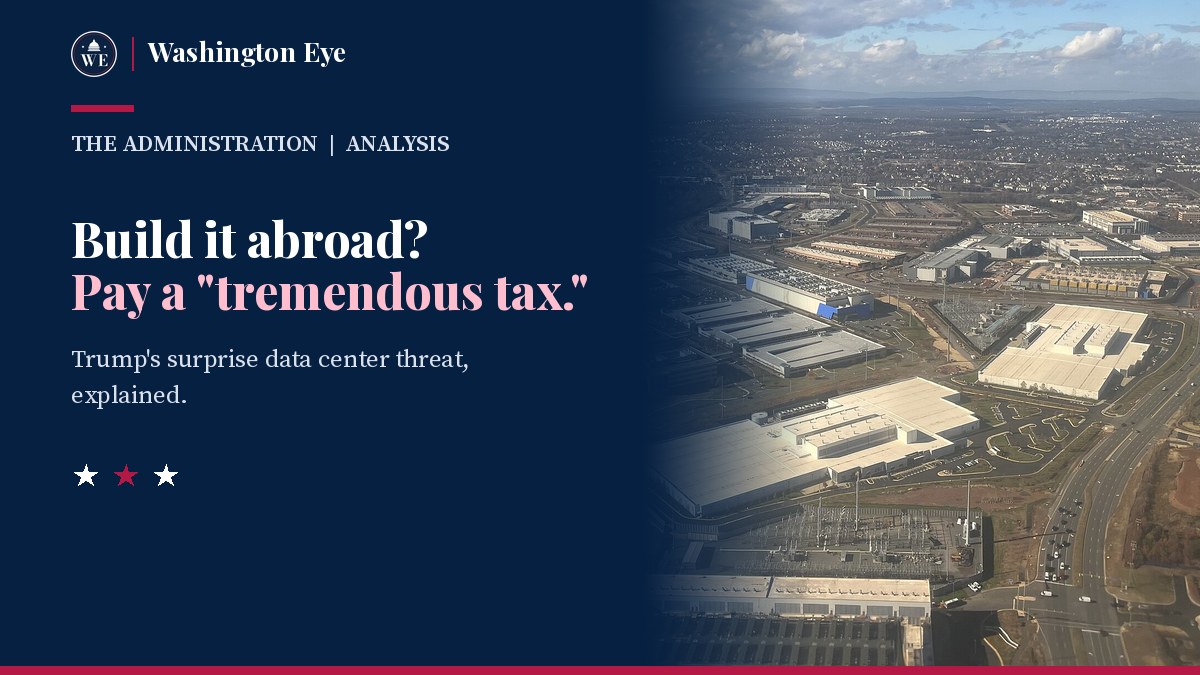
President Donald Trump walked into the White House briefing room on Friday to talk about his trip to Asia. He walked out having announced a new economic policy that, by his own account, nobody in his administration had heard of before he said it out loud.
"We're not allowing data centers to go into other countries because China will take all of them, and we're not allowing that to happen," the president said, with Vice President JD Vance and Secretary of State Marco Rubio standing behind him. "And we're going to put tremendous penalties on companies that try and do it."
Then came the line that turned a policy threat into a political story of its own. "I don't know if that's a breaking story," Mr Trump said. "I haven't even said that to my people. But I'm telling them now they're here."
It was, in fact, a breaking story. In a few sentences the president put a question mark over the overseas plans of some of the largest companies in the United States, at a moment when American voters have turned sharply against data centers at home. What he did not offer was a rate, a definition, a legal basis or a timetable. Here is what was said, what it could mean, and why the gap between the two matters.
What Trump actually said
The remarks came during a wide-ranging news conference, the president's first public appearance since a week of summitry that ended on Thursday with an unprecedented three-way meeting with Chinese President Xi Jinping and Russian President Vladimir Putin in Shenzhen. Data centers were not the advertised subject. The president raised them himself.
"We're going to fight very hard for the data centers," he said. He did not say American companies would be flatly barred from building abroad. "They can," he said, "but we're going to put a tremendous tax on them. If they do it, we want them to build it here." He added that the United States has "a lot of places that want them badly, and they're great places. They have energy, and they have everything. They're tremendous assets."
He also had a message for Americans living near proposed projects. The companies behind the artificial intelligence boom, he said, are "making so much money they don't know what to do with it." His advice to communities negotiating with them: "They have plenty of money. Take it."
In the same appearance, Mr Trump said Mr Xi had "congratulated me on how well we're doing" in artificial intelligence, a field the president prefers to call "super intelligence". The two lines sat awkwardly together. In one breath China was a rival poised to "take all" of America's overseas data centers. In the next, its leader was praising American progress.
The missing details
Almost everything that would determine whether this becomes policy is unknown. The president did not say how large the "tremendous tax" would be, whether it would apply to new projects only or to facilities already running, whether it would hit construction, ownership, or the computing power sold from those sites, or which companies would count as American.
He also did not say where the authority would come from. Under the Constitution, the power to lay and collect taxes belongs to Congress. The president did not say whether he would ask lawmakers to write such a tax or try to reach the same result through executive powers he already holds. Those are very different paths. A new tax would need a bill to pass both chambers, and from January the House will be led by Democrats after this month's midterm elections. An executive route would almost certainly be challenged in court, and would have to be built from tools designed for other purposes.
Washington does already have some leverage over where advanced computing goes. The federal government controls the export of the most powerful American AI chips through licensing, and it has used that power to shape which countries can host the largest clusters. But a licence condition on a chip shipment is not the same thing as a tax on a company's foreign investment, and the president did not say which, if either, he had in mind.
Who is building abroad
The companies with the most at stake are among the most valuable in the world. Alphabet, Amazon, Microsoft, Meta and Oracle have all built data centers outside the United States. For cloud providers, foreign sites are not a luxury. Customers want computing close to their own users so services run quickly, and many countries require that certain data be stored or processed inside their borders. Companies also spread facilities across regions so that one outage does not take everything down.
The push overseas has been accelerating. Earlier this month Alphabet announced plans to invest $15 billion in data center infrastructure in Malaysia in 2027 and 2028. Oracle says four of the seven gigawatts of power it plans to bring online over the next two years are tied to large American campuses, with the rest spread across smaller or international sites. "Outside of the U.S., there's quite a bit of locations where people are excited to have data centers," Oracle's chief financial officer, Hilary Maxson, said in a recent interview, pointing to Latin America, Southeast Asia and Australia.
CoreWeave, the specialised cloud provider, already has a large presence in Europe and Canada and has said it plans to expand into Australia, India, Indonesia, Japan, South Korea, Singapore and the United Arab Emirates. Its chief executive, Michael Intrator, described the expansion as a response to "being pulled by our clients." Google, Oracle and CoreWeave did not immediately respond to requests for comment on the president's remarks.
The Gulf question
The announcement lands awkwardly in the Gulf, where the administration itself has championed some of the biggest American-linked AI projects outside the United States. The UAE is developing a 5-gigawatt AI campus in Abu Dhabi, one of the largest such projects anywhere outside America, with US partners including Nvidia, Oracle and OpenAI. Its first 1-gigawatt phase is already under construction.
That project has already been reshaped once by geopolitics. In September, people familiar with the plans said the UAE was quietly revising it after the Iran war, possibly shifting from one huge campus to a network of hardened sites with air defences and underground construction. The Emirati AI company G42 said work was progressing as planned and that the project's specifics were under continuous review. A blanket penalty on American firms building abroad would raise a fresh question for partners who were encouraged to bet on exactly this kind of venture.
Southeast Asia raises a different concern, and one closer to the president's stated worry about China. Malaysia has emerged as a major data center hub thanks to tax incentives and fast access to power and land, but it has also come under scrutiny as a possible loophole through which Chinese companies could reach American chips via the cloud. That is the strongest version of the argument for keeping computing at home: data centers abroad are harder to police.
The politics at home
The president's pitch, build it here instead, runs straight into a public that increasingly does not want to. An economic survey by a business news network found that 64 percent of registered voters opposed an AI data center within 10 miles of their home, while just 13 percent said they would support one. Of the 53 data center measures on ballots in 13 states through November 2026, voters favoured limiting development in 52, according to an elections reference project. Democratic challengers who campaigned on AI and data center costs helped oust Republicans in Ohio, Wisconsin, Arizona and Pennsylvania this month.
Developers say the squeeze is already real. "The availability of good sites that can access power quickly in the U.S. is shrinking by the day," said Ben Alingh, chief executive of the data center developer Monarch Energy. As of December 2025, about 4,000 data centers were operating in the United States, with almost 3,000 more under construction or planned.
Seen from the White House, the logic has a certain neatness. If local opposition pushes companies overseas, a penalty on going overseas pushes them back, and the president's advice to communities, take the money, is meant to make the bargain easier to swallow. Seen from the industry, it looks like a pincer: rising resistance at home, and now a threatened cost for leaving.
What to watch
The first test is whether the president's staff turn Friday's remarks into anything written down. Until there is a proposal, a draft order or a request to Congress, companies will be left to read the signal rather than the rule. The second is whether the threat applies to projects the administration itself has blessed, including in the Gulf. The third is Congress, which holds the taxing power and, from January, will have a Democratic House more inclined to restrain data centers than to protect them.
For now, the most striking fact about the policy is the one the president volunteered himself. A measure that could touch hundreds of billions of dollars in planned investment was announced first and explained later. His own officials, by his account, learned of it at the same moment as everyone else in the room.