
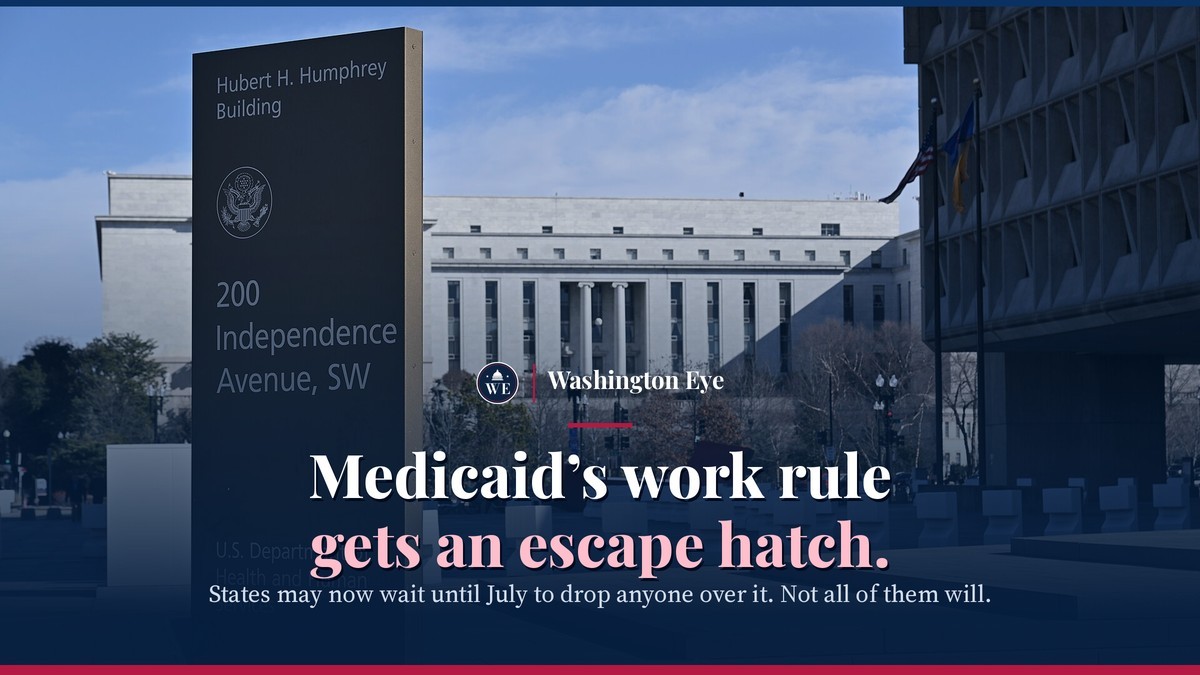
For months the Trump administration insisted that the Medicaid work requirement would start on schedule. On Friday it built a door out of it. The Centers for Medicare and Medicaid Services announced an optional "hold harmless" period running through June 30, 2027, during which states that opt in will still check whether adult enrollees are working, studying or volunteering, but will not deny applications or remove otherwise eligible people solely because they failed to meet the rule.
The requirement itself has not moved. Under the 2025 tax and spending law that Republicans named the One Big Beautiful Bill Act, certain Medicaid applicants and beneficiaries aged 19 to 64 must, from January 1, 2027, show at least 80 hours a month of work, community service, a work programme or a combination of those, or be enrolled in education at least half time, or meet a monthly income threshold, unless they fall into one of the law's exemptions. What changed on Friday is the penalty. In states that take the offer, no one loses coverage for falling short until July 1.
States must tell the federal agency by December 11 which path they intend to follow. Those that want to enforce the rule from the first day of January may still do so.
What the agency said. The official announcement framed the delay as a chance to get the machinery right rather than as a retreat. "States have made real progress, and they've been clear with us about what it takes to get this right for beneficiaries, at scale and for the long term," said Dan Brillman, the deputy administrator who runs the agency's Medicaid and CHIP centre. "If the state can use data to show that someone is working or qualifies for an exclusion, that person should not have to track down paperwork to prove it."
A letter sent to state officials on the same day, as described in reporting by a Washington political news site, said the transition period responded to feedback from around the country about "impediments to successful launches at scale, policy updates, operations, and overall readiness." Alongside the delay, the agency urged every state to maximise automated verification, send clearer notices, test their systems end to end and work with community groups to connect people to jobs and training. The White House declined to comment, according to a national television network.
Why it happened now. Pressure had been building since the summer. In June the agency issued an interim final rule setting out how the requirement would work, and states said the details arrived too late for them to rebuild eligibility systems, rewrite notices and train caseworkers before January. On October 1 the governors of Oregon, California, Maine, New Mexico and Virginia, all Democrats, wrote to Health and Human Services Secretary Robert F. Kennedy Jr. asking for a delay tied to proven state readiness.
Then came a court defeat. On October 29, Judge Richard Stearns of the federal district court in Massachusetts ruled for a coalition of more than two dozen states that had sued over the agency's narrower definition of who counts as "medically frail," one of the law's main exemptions. The agency had required people with disabilities, serious mental illness or complex medical conditions to also show that their condition significantly impaired their ability to comply. Judge Stearns held that Congress had already written the definition, making the agency's version "contrary to law." The ruling left the work requirement standing but forced states to adjust their systems for the exemption only weeks before launch.
And then came the election. Democrats won control of both chambers of Congress on November 3, in part on a promise to reverse the law's cuts to health care and food assistance. Earlier this week, 16 Democratic senators asked Senate leaders to push the requirement back by two years, and Senator Ron Wyden of Oregon and Representative Frank Pallone of New Jersey, the senior Democrats on the committees that oversee Medicaid, called for a full delay. Friday's announcement arrived ten days after the vote.
What is at stake. The numbers explain why both sides care so much about timing. The Congressional Budget Office estimated that the work requirement alone would leave 5.3 million more people uninsured by 2034 and save the federal government about $317 billion, part of nearly $1 trillion in Medicaid reductions in the law. For the bill's authors, those savings were the point: a requirement that able-bodied adults work or prepare for work in exchange for public health coverage, and a way to slow the growth of a programme that covers tens of millions of Americans.
The early evidence also explains why states asked for time. Nebraska chose to start enforcing the federal requirement on May 1, months ahead of the national date. Through August, more than 1,000 people there had lost coverage or been denied benefits under the new rules, according to state figures cited in national reporting. Montana and Iowa also planned early starts, according to a health policy research group that tracks implementation, and Georgia has run its own work requirement under a separate waiver that expires at the end of this year.
Critics of the requirement have long argued that most people who lose coverage under such rules are not refusing to work but are tripped up by paperwork: missed notices, unreported hours, exemptions never recorded. Supporters reply that the answer is better systems, not a weaker rule, and the agency's own guidance on Friday leaned heavily on that argument, urging states to use data they already hold so that working people are verified automatically.
How each side read it. Democrats claimed vindication but said it was not enough. "The Trump-Vance Administration finally admitted what Democrats have said from the very beginning: Republicans' chaotic maze of red tape requirements jeopardize the health care of millions of Americans," Mr. Wyden and Mr. Pallone said in a joint statement. They called the delay "a small step in the right direction" that "does not avert the disaster ahead," and urged every state to take it. Sarah Lueck, a vice president at the Center on Budget and Policy Priorities, a left-leaning research group, wrote in a social media post: "Today's news lets states delay the harm."
On the right, the worry runs the other way. Two fiscal policy analysts who favour the rule published a commentary the day before the announcement under the title "Don't Delay OBBBA's Medicaid Work Requirements," pushing back on the Democratic senators' request for a two-year postponement. For supporters of the rule, any slip matters more now that Democrats are about to take the gavels. The agency's careful wording suggests it heard that concern too: the requirement still starts in January, assessments still begin then, and states are encouraged, not ordered, to wait.
The real choice now sits with the states. The design of the offer means the map of who is protected will be uneven. Democratic governors who asked for a delay are likely to take it. Republican-led states that moved early, or that have built their systems and want to show the rule works, may decline and begin enforcing in January. A Medicaid enrollee in one state could keep coverage for six months while a neighbour across the state line, with the same job and the same paperwork problem, loses it.
That unevenness will also shape the political argument. If states that enforce early produce large drops in enrollment, Democrats will hold them up as proof of harm when they take control in January. If states using the grace period finish the year with smooth systems and modest losses, the administration will argue that the requirement can work when it is run well.
What to watch. Three dates matter. December 11 is the deadline for states to choose; it is also the day current federal funding runs out, which gives Democrats in the lame-duck Congress a possible lever if they try to attach Medicaid language to a spending deal. January 1 is when assessments begin everywhere and enforcement begins in states that decline the delay. And July 1, 2027, is when the grace period ends, by which time a Democratic Congress will have had six months to try to change the law itself, though any repeal would still need President Trump's signature.
For now, the administration has kept its signature policy alive while conceding, in effect, that the original timetable was too tight. Whether the six months buy better systems or simply a longer argument will depend on what the states do with them.