
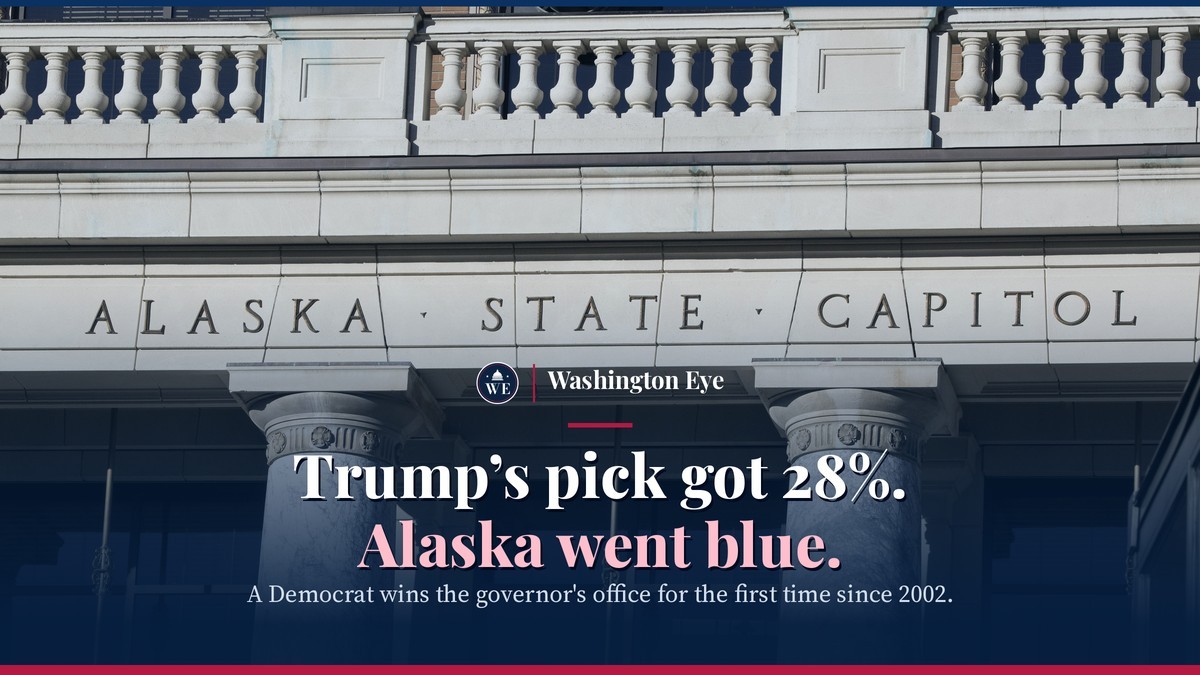
Alaska has not had a Democratic governor since Tony Knowles left office in 2002. It will have one on December 7. Jonathan Kreiss-Tomkins, a 37-year-old former state House member from Sitka, was declared the winner of the governor's race on Friday after the latest count gave him a majority of first-choice votes, enough to settle the contest without the ranked-choice tabulation that Alaska uses when nobody clears half. A television network had called the race on Thursday night; a wire service followed late on Friday, Alaska time.
The numbers are not close. With roughly 95 percent of the expected vote counted, Mr. Kreiss-Tomkins had 139,293 votes, or 50.8 percent. Bernadette Wilson, an Anchorage business owner whom President Donald Trump endorsed in October and again on Election Day, had 77,110, or 28.1 percent. Former Anchorage Mayor Dave Bronson had 13.6 percent and former state Attorney General Treg Taylor had 7.2 percent. In other words, the lone Democrat on the ballot won more votes than his three Republican opponents combined, in a state Mr. Trump has carried in every one of his three presidential campaigns.
He will be the youngest governor in Alaska's history and, from next year, the youngest sitting governor in the country. His running mate, Zac Johnson, is an independent member of the Anchorage Assembly. The result is expected to be certified on November 25, and the new governor will be sworn in just 12 days later, one of the fastest executive transitions in the United States.
"Alaskans voted for change and for a government that works across party lines to move Alaska forward," Mr. Kreiss-Tomkins said in a statement on Friday morning. "Our administration will not waste a single day getting to work to solve problems for Alaska."
Why it matters beyond Alaska. On its own, a governor's race in a state of about 730,000 people would be a regional story. In context, it is the latest data point in a midterm that has redrawn the map of state power. According to a wire service tally, the victory means Democrats will control the governor's office in 30 states next year, including several they flipped after years of Republican control, among them Iowa, Georgia, Ohio and Texas. Kansas, one of the most conservative states in the country, also elected a Democrat, Cindy Holscher, who campaigned on pausing new data-center construction.
That last detail links the two races. Mr. Kreiss-Tomkins also called for a moratorium on all new data centers in Alaska until the state Legislature passes rules to govern them, and said he would not allow direct or indirect subsidies to data centers for their electricity costs. In a state where energy is already expensive, and where the war with Iran has pushed up fuel and energy costs, that message landed alongside more conventional Democratic pledges: more money for public schools, lower energy costs, expanding Medicaid and protecting fisheries. It is one more sign that the backlash against the artificial intelligence building boom reached well beyond the coasts.
How a Democrat wins Alaska. The first explanation is arithmetic. Alaska's election system sends the top four finishers in an open August primary to the general election, regardless of party. Seventeen candidates ran in this year's primary, including 12 Republicans, two Democrats and three independents. Mr. Kreiss-Tomkins, who did not announce until February, finished first. Tom Begich, a former Democratic state senator, finished a close second, then dropped out and endorsed him. That left the Democratic and independent vote consolidated behind one candidate while three Republicans divided theirs.
The second explanation is money and effort. According to a major Alaska newspaper, Mr. Kreiss-Tomkins raised more than $5 million, more than all his opponents combined, and was helped by millions more from the Democratic Governors Association, which far outspent its Republican counterpart in the state. His campaign says he visited 62 communities and travelled 40,000 miles, including a 350-mile snowmachine trip to Northwest Arctic villages, a 450-mile boat trip down the Yukon River and a ferry ride along the Aleutian Chain. The Republican finalists, by the same account, concentrated on party strongholds along the Railbelt while struggling to raise money.
The third explanation is the Republican field itself. Ms. Wilson never fully explained a history of unpaid business and personal debts. Mr. Bronson carried a reputation from an acrimonious term as Anchorage mayor and, late in the race, tried to distance himself from the president he had previously praised. Mr. Taylor, until recently the state's top lawyer, was briefly removed from the ballot for failing to make required financial disclosures. In an unusual move, the Alaska Republican Party declined to endorse or spend money on any of them.
Then there is the question of the president's endorsement. On Election Day Mr. Trump wrote that Ms. Wilson had his "Complete and Total Endorsement" and called on Republicans to "unite behind Bernadette." He described her opponent as "Reckless, Radical, and Dangerous!" The endorsement does not appear to have consolidated the Republican vote. Ms. Wilson finished more than 22 points behind, and her two Republican rivals together took nearly 21 percent, which suggests that a large part of Alaska's Republican electorate either did not hear the president's appeal or chose to ignore it.
Ms. Wilson herself pointed to division rather than the president. Speaking by phone to a local news site on Friday, she said she was disappointed but not surprised. "JKT was on top on election night, on top in the first round. He's gonna be your governor," she said. She added that the result was "a very direct result of not being able to consolidate and collaborate," and that conservatives "really got to look at ourselves in the mirror." Mr. Bronson conceded in a post on a social media platform, writing that "Alaskans have made their choice, and I respect their decision."
Cross-party support. Mr. Kreiss-Tomkins also drew Republican votes and Republican names. A week before Election Day he was endorsed by Senator Lisa Murkowski, the state's senior Republican senator, who said he "understands that governing requires listening to people with different perspectives and finding common ground." He was a strong supporter of the bipartisan coalitions that run both chambers of the state Legislature, and he says his transition will be overseen by three co-chairs: a Republican, a Democrat and an independent. He has also said he may keep some commissioners from the outgoing administration of Governor Mike Dunleavy, a conservative Republican who was term-limited.
His own account of the coalition is straightforward. "I always felt like there was a commonsense majority of Alaskans who wanted change and have been discouraged by the last eight years," he told a local newspaper on Friday. The bet was that a campaign could unite voters "from the center right to the left and all points in between." On these numbers, it did.
What he inherits. The first test comes almost at once. Alaska's new administration must submit a draft budget to the Legislature by mid-December, about a week after the swearing-in. "It's like we've got to eat an entire elephant," Mr. Kreiss-Tomkins said on Friday.
Unusually for a new governor, he may have more money than he expected. Higher oil prices linked to the Iran war are set to bring hundreds of millions of dollars in extra revenue into the state treasury. Mr. Kreiss-Tomkins, who campaigned on a promise to "make balanced budgets sexy again," has said he wants a "moderate" Permanent Fund dividend, more spending on areas such as public education, and a significant deposit into state savings. Under Mr. Dunleavy, savings stayed below recommended levels as the governor repeatedly called on lawmakers to pass deficit spending.
He has also promised to revive a proposal he first introduced as a lawmaker in 2019: writing the Permanent Fund into the state constitution and limiting how much can be drawn from it each year. That would require a two-thirds vote in both chambers and then approval by voters, a high bar in a state that has not amended its constitution in more than two decades. Smaller, more measurable promises may come first, including a public website to track how long Alaskans wait for services such as Medicaid eligibility decisions. "Even if those numbers are ugly, I think it's important to confront them," he said this week.
The rest of the Alaska ballot. The governor's race was not the only result to move. Ballot Measure 2, which would have repealed the state's open primaries and ranked-choice voting, was defeated, with the No side ahead by about 53.5 percent to 46.5 percent. That keeps in place the very system that helped shape this year's governor's race.
The Senate race remains open, and it is now the last uncalled Senate contest in the country. After Friday's release, Democrat Mary Peltola led Republican Senator Dan Sullivan by 10,412 first-choice votes, 138,240 to 127,828, according to state results reported by local media. Including write-in votes, she was just short of 50 percent, which means the race will probably go to a ranked-choice tabulation on November 18. If she wins, Democrats would hold 56 Senate seats in January and she would become the first Indigenous Alaskan elected to the Senate. Her lead is now more than double the vote total of the second Dan Sullivan on the ballot, whose candidacy is the subject of a Justice Department lawsuit and a federal criminal inquiry. In the House race, Republican Congressman Nick Begich led independent Bill Hill by 47.8 percent to 41.7 percent.
What to watch. Three things are worth following in the next month. First, whether the remaining absentee and overseas ballots push Mr. Kreiss-Tomkins further above 50 percent, as his campaign projects, and whether the November 18 tabulation hands Ms. Peltola the Senate seat. Second, the shape of his cabinet: a blended administration that keeps some Dunleavy commissioners would test whether his bipartisan language survives contact with the jockeying for jobs among Democrats who have been out of the executive branch for eight years. Third, the December budget, which will show whether his promise of restraint holds when the state is unexpectedly flush.
For national Republicans, the lesson is less comfortable. In a state Mr. Trump won easily two years ago, a split field, a weak bench and a party organisation that sat the race out produced a Democratic governor with a clear majority. Mr. Dunleavy could run again in four years. Whoever leads Alaska's Republicans then will have to answer Ms. Wilson's question first: how to stop dividing the vote.