
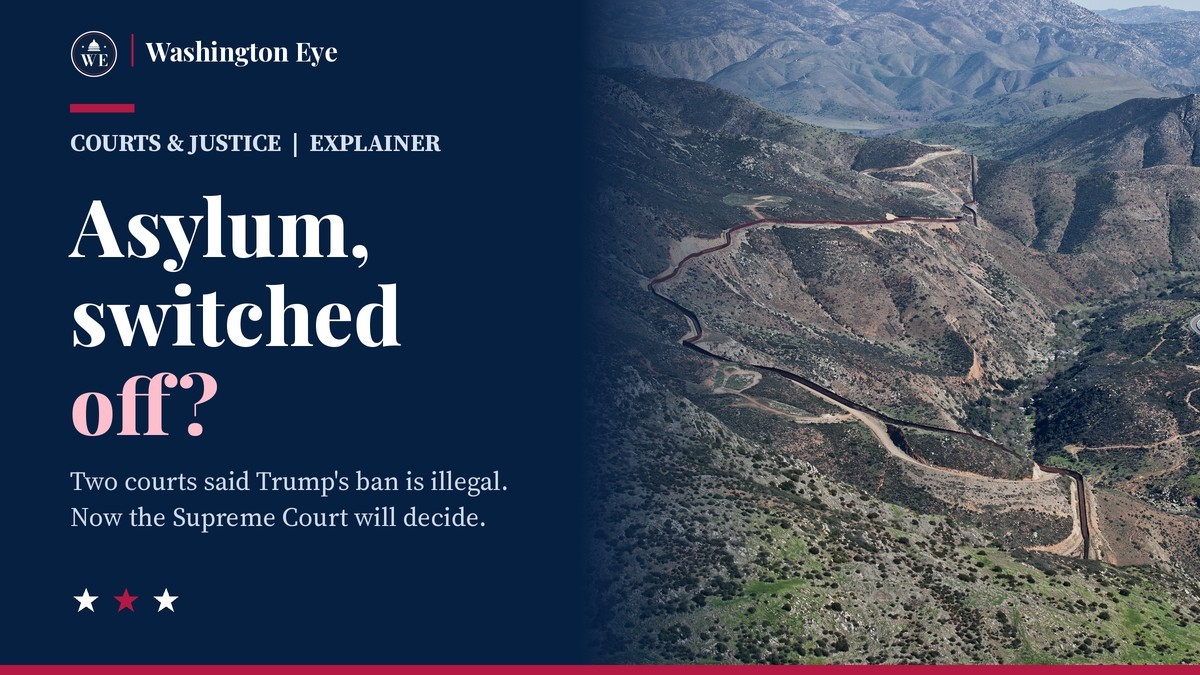
On his first day back in office, President Donald Trump signed a proclamation declaring that the United States faced an "invasion" across its southern border. Buried in the text was one of the most consequential immigration measures of his second term: people caught crossing without the required paperwork could be removed without ever getting the chance to ask for asylum.
A federal judge in Washington ruled in July 2025 that the president had no power to do that. In April of this year, the federal appeals court in the capital agreed. And yet the policy never stopped. Because the appeals court put its own ruling on hold while the administration sought further review, the asylum restrictions have remained in effect the entire time.
On Friday the Supreme Court agreed to settle the fight. The justices granted the administration's petition in Mullin v. Refugee and Immigrant Center for Education and Legal Services, docket number 26-239, after considering it at two successive private conferences. Arguments are expected in the coming months, with a decision due before the term ends in late June 2027.
The case is about more than one border policy. It asks a question that has hovered over American immigration law for decades: when Congress writes a detailed procedure into statute, can a president switch it off by declaring an emergency?
What the proclamation does
Proclamation 10888, issued on 20 January 2025, suspended the entry of migrants "engaged in the invasion across the southern border" and barred those covered from invoking the provisions of immigration law that would let them remain in the country, including asylum. It also authorised removal procedures outside those Congress had established.
The restrictions reach beyond people who cross between official ports. According to a wire service account of the case, the ban also applies to migrants who arrive at official crossings without certain medical or criminal history information, a requirement advocates say is often impossible to meet for people fleeing violence. The proclamation states that it will remain in force until the president determines that the "invasion" has ended.
Two statutes collide
The legal fight turns on two sections of the Immigration and Nationality Act that seem to point in opposite directions.
The first is the asylum statute itself. It says that any noncitizen "who is physically present in the United States or who arrives in the United States (whether or not at a designated port of arrival...), irrespective of such alien's status, may apply for asylum." Under that framework, a migrant who says he fears persecution or torture at home can claim a "credible fear" and have the claim screened before removal.
The second is the president's long-standing power over entry. A separate provision says that whenever the president finds that the entry of any noncitizens or class of noncitizens "would be detrimental to the interests of the United States," he may suspend their entry by proclamation for as long as he deems necessary. That was the authority the Supreme Court relied on in 2018 when it upheld Mr Trump's first-term travel ban on travellers from several mostly Muslim-majority countries.
Solicitor General D. John Sauer leans heavily on that second power. The policy, he told the justices in court papers, "rests on a commonsense understanding of the President's inherent and delegated powers to exclude aliens." The administration's petition argues that asylum is discretionary in any case, so the president may categorically deny it to everyone the proclamation covers. Requiring officials to accept applications the government has already decided to reject, it contends, serves no purpose, and leaving the lower-court rulings standing would threaten to revive chaos at the border.
Iowa and 21 other states filed in support of the administration, arguing that the appeals court's decision undermines the federal government's constitutional duty to protect the states against invasion.
The challengers' answer
The policy was challenged by 13 individual migrants, who are not named in court papers, and three immigrant advocacy organisations: the Refugee and Immigrant Center for Education and Legal Services, the Las Americas Immigrant Advocacy Center, and the Florence Immigrant and Refugee Rights Project. They are represented by lawyers from the American Civil Liberties Union.
Their core argument is textual. Congress, they say, expressly gave noncitizens who are physically present in the country the right to apply for asylum regardless of how they entered, and a president cannot erase that right with a proclamation. The president "may not invent by fiat a new removal system that eviscerates the protections Congress mandated by statute," they wrote.
They also dispute the factual premise. The administration credits the policy with helping to drive down border crossings. The challengers counter that apprehensions had already fallen by more than 90 per cent from their peak before the proclamation was signed, and they accuse the government of overstating the crisis.
How the lower courts ruled
In July 2025, US District Judge Randolph Moss sided with the challengers. Nothing in the Constitution or in immigration law, he wrote, "grants the president ... authority to replace the comprehensive rules and procedures set forth in the INA." He certified a class covering people subject to the proclamation who are or will be in the United States, held the asylum restrictions and the alternative removal procedures unlawful, and issued a classwide injunction.
A divided panel of the appeals court for the District of Columbia Circuit largely upheld that ruling this spring, though it narrowed the definition of the class. Its reasoning was careful. Asylum is discretionary, the majority accepted, but the executive branch still cannot categorically cut covered migrants off from applying by proclamation and informal guidance rather than through the procedures Congress prescribed. Judge Justin Walker dissented in part.
The government then asked the Supreme Court to step in, and the appeals court's mandate was stayed in the meantime. That is why a policy that has lost at every level so far is still being enforced at the border tonight.
Three questions, not one
The justices agreed to take up more than the headline issue. Beyond whether the proclamation and its implementing guidance are lawful, the administration asks whether a provision of immigration law, which limits lower courts' power to block the operation of certain immigration statutes on a classwide basis, barred the sweeping relief Judge Moss granted. It also challenges whether the certified class satisfies the Constitution's standing requirements and the federal rules on class actions.
Those procedural questions could matter as much as the merits. A ruling that the lower court lacked power to issue classwide relief would leave the policy largely intact even if the justices doubted its legality, forcing migrants to litigate case by case. The court has shown strong interest in limiting broad injunctions against presidential policies in recent terms.
Why the court took it
There was a reason for doubt that the justices would hear the case at all. No other appeals court has ruled the other way, so there is no conflict among the circuits, which is usually the strongest signal for review. But the court rarely leaves a major presidential policy struck down without taking a look, and the government had pressed the national security stakes hard.
The asylum case now becomes the third significant immigration dispute on the court's docket this term. The justices will hear arguments on 9 December over the administration's effort to deport migrants to "third countries" with which they have no connection. A separate case concerns the administration's attempt to hold thousands of people in deportation proceedings in detention indefinitely, a break from previous administrations, which generally released such migrants while their cases were decided.
The recent record cuts both ways for the White House. In June the court backed the federal government's authority to turn away asylum seekers when officials deem border crossings too overburdened to take more claims. In September it allowed the administration to resume third-country deportations without first giving migrants a chance to show the harm they might face. But the same month of June also brought one of Mr Trump's sharpest defeats, when the court blocked his executive order seeking to limit birthright citizenship.
What a ruling could change
If the administration wins, the decision would confirm that a president can use an emergency declaration and the entry-suspension power to override a procedure Congress spelled out in detail. That would reach well beyond this proclamation. Future presidents of either party could cite it to reshape asylum, and perhaps other statutory programmes, without new legislation.
If the challengers win, the government would have to resume screening asylum claims from migrants who cross between ports of entry, though officials could still deny many of those claims on the merits. The administration would also be left to argue for its goals through rulemaking or legislation rather than by proclamation.
That second path runs through a very different Congress. Democrats won control of both chambers in last week's midterm elections and take power in January. A ruling that rests on what the statute says would effectively hand the next move to lawmakers, but any bill rewriting asylum law in either direction would still face a presidential veto, and Republicans would retain enough Senate seats to block most legislation under the filibuster.
For now the practical effect of Friday's order is simple. The ban stays in place. Migrants who cross without papers will keep being removed without the chance to claim asylum through at least the spring, and quite possibly into next summer, while nine justices decide whether two lower courts were right that the president went further than the law allows.
For a court that has spent much of the past year sorting out how far Mr Trump's emergency powers reach, this may be the cleanest test yet. The words of the asylum statute are plain. So are the words of the entry-suspension law. The justices must now decide which one wins when a president says the country is under invasion.