
Five days after American voters handed both chambers of Congress to the Democrats, Iran's foreign minister decided to tell the White House what the result meant. "American voters have made their choice. Time for the White House to make its own," Abbas Araghchi wrote on Sunday in a post on a social media platform. "Our 2-day proposal stands: meet the requirements, including end to war on all fronts, and you will see results." Then came the threat: "Or choose war, and see our alert and battle-hardened warriors rain down hell."
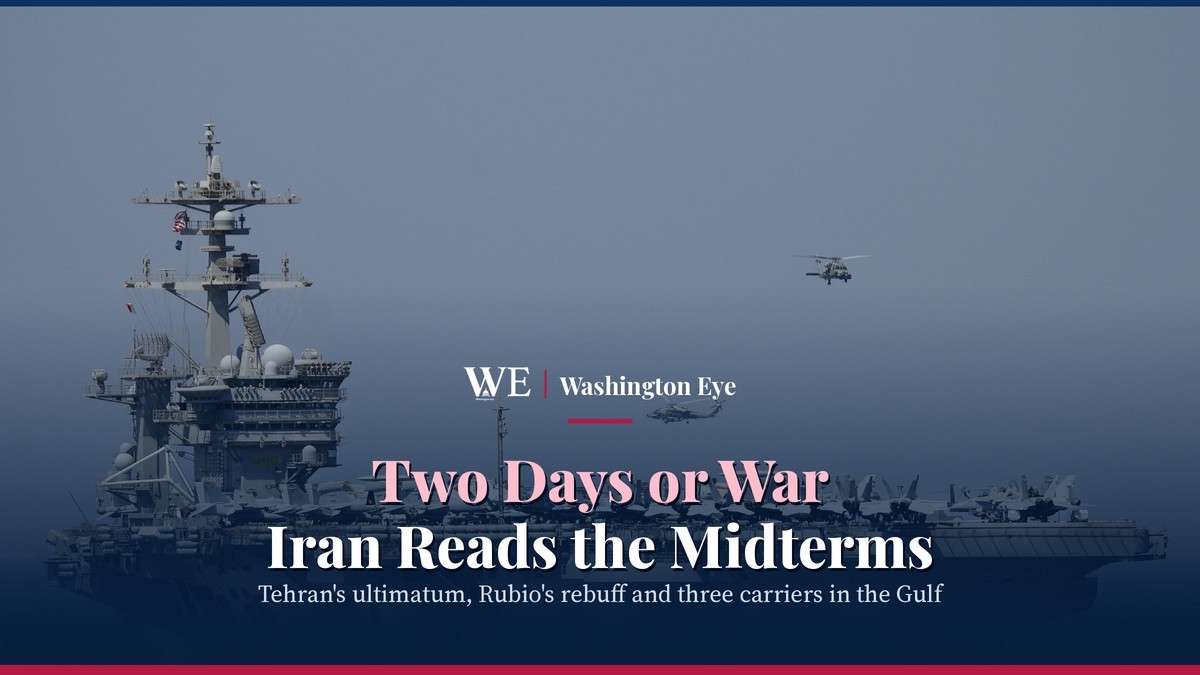
Within hours, Washington answered with two voices that did not quite sound alike. Secretary of State Marco Rubio, speaking to reporters in Florida before flying to a meeting of Group of Seven foreign ministers in Paris, called Iran's demands "not just unacceptable, but in some cases outrageous and ridiculous and really not realistic." President Donald Trump, in a telephone interview with a cable news network, said renewed American strikes were "highly unlikely" to be necessary, while reminding Tehran that three aircraft carriers were in the region and "fully locked and loaded."
Taken together, the weekend's exchanges show something important about the eight-month war that began with American and Israeli strikes on 28 February. Both governments now see the midterm elections as a source of leverage. Tehran believes the vote weakened the president and will push him toward a settlement on its terms. The administration wants to show that nothing about its military posture has changed. The next few weeks, before a Democratic Congress is sworn in on 3 January, will test which reading is right.
The Iranian offer is not new, but its packaging is. In September, Tehran put forward a seven-step plan to reopen the Strait of Hormuz, the waterway through which a large share of the world's seaborne oil normally passes and which Iran has kept largely closed. Its conditions included an end to the war on all fronts, the release of frozen Iranian assets, the lifting of oil sanctions and an end to the American naval blockade of Iranian ports. Last Monday, Foreign Ministry spokesman Esmaeil Baghaei said the plan remained the basis for indirect talks and had been condensed so that it could be carried out within two days. That is the "2-day proposal" Araghchi invoked.
A senior Iranian official told a wire service that Tehran has also passed a proposal on its nuclear programme through mediators in Doha, but that further discussion depends on Washington first meeting Iranian demands, including sanctions relief, access to frozen funds and war reparations. The United States insists the nuclear file must be dealt with in the opening phase of any talks. That sequencing dispute, rather than any single demand, is the core of the deadlock. Iran wants economic relief before it discusses its nuclear work. Washington wants nuclear commitments before it offers relief.
Araghchi was also candid about the state of diplomacy. In an interview with Iranian state television, he said the mediators had stopped travelling since what he called the "shock" of the American election results. "We now have to see how long it will take for them to digest these results, in order to determine how we are going to move forward," he said. He added that Iran was "prepared for all scenarios" and that its forces had "upgraded our weaponry, addressed our vulnerabilities, and tested new arms."
That message has an obvious audience in Washington. Vice President JD Vance said after the vote that the war was the main reason Republicans lost. "The reason we lost is the war. The president himself said so last night," he wrote in a long social media post. High gasoline prices, which climbed as the war disrupted Gulf shipping, also weighed on Republican candidates. Iran's leaders are betting that a president who has just been punished at the polls for a war will be more willing to end it on generous terms.
Rubio's answer was that the bet is wrong. "You have a number of countries that continue to engage them with different ideas, but I wouldn't say we're on the verge of a breakthrough," he said. "The president would always prefer to solve this and every problem diplomatically. Sometimes that's not possible, unfortunately." He also set out when the United States might strike again. "If there's a threat to shipping or to our forces in the region, we have a right to defend ourselves," he said, describing American actions as defensive. And he defended the war itself, arguing that the president had confronted a threat other presidents had avoided and calling for bipartisan agreement that a nuclear-armed Iran would be unacceptable.
Trump's tone was more relaxed but his message was similar. "It depends on whether or not they sign a very strong agreement," he said of further strikes. "The answer is highly unlikely it's going to be necessary. They're a failing nation." He repeated an earlier threat to target Iranian infrastructure if fighting resumed, saying the United States had "38 bridges" in its sights that it could "knock down in literally one hour," while adding that he did not want to do so because it would take about ten years to rebuild them. He claimed Iran retained only about 10 percent of its missile capacity and 15 percent of its drone capability. Those figures were not independently verified.
Later on Sunday, the president used his own social media platform to praise the new Central Command unit created on Saturday to choke off Iran's land and Caspian Sea supply routes. "Task Force Iron Gate is in full force and effect," he wrote, adding that "coupled with history's greatest Naval Blockade, very little gets into, or out of, Iran!" The Revolutionary Guard dismissed the initiative and said attempts to isolate Iran from its neighbours would fail.
There are signs that the weekend was closer to escalation than the public statements suggest. An Israeli newspaper reported, citing two sources, that American and Israeli forces had prepared for possible renewed strikes on Iran but that Trump did not give the order. The same report said, citing diplomatic sources, that the president had given Vance and other senior officials "a few days" to reach an agreement. Neither claim has been confirmed by the White House. Qatar, which leads the mediation with support from Egypt, Saudi Arabia, Pakistan and Turkey, denied reports on Saturday that the talks had failed.
The waters around Iran have not waited for the diplomats. Iranian outlets reported explosions on Qeshm Island and in Bandar Abbas on Sunday, following blasts reported on Saturday, though Iranian officials gave conflicting accounts of their cause. The Revolutionary Guard said tankers caught fire after striking mines on what it called an unauthorised route through the strait, a claim that could not be verified. The British military's maritime trade centre said a tanker had been hit by an unidentified projectile while leaving the strait. In Saudi Arabia, air defences intercepted missiles fired by the Iran-backed Houthi movement in Yemen toward Riyadh, and falling debris damaged an administrative building of the state oil company, with no casualties reported.
Each of these incidents carries the risk that the war restarts by accident rather than by decision. That is the practical danger in an ultimatum. Araghchi's phrasing ties Iran's restraint to American behaviour, which means any strike Washington calls defensive could be presented in Tehran as a choice for war. Rubio's phrasing does the same in reverse.
Supporters of the administration's line argue that the ultimatum proves the pressure is working. In their view, Iran is trying to turn an American domestic setback into concessions it could not win at the negotiating table, and the right response is to keep the blockade in place, add land-route enforcement and refuse to release frozen funds or pay anything resembling reparations before Tehran makes binding nuclear commitments. Easing off now, they say, would reward a strategy of waiting out American elections.
Critics of the war, a group that includes many of the Democrats who will soon chair the relevant committees, see a conflict with no clear end point that has already cost the president's party its majorities. For them, the weekend shows an administration still relying on threats while its diplomacy stalls. There is also a reading in which the gap is narrower than the rhetoric suggests. Both governments say they want the strait reopened and the shooting stopped, and much of the dispute is about the order of steps rather than the steps themselves. The incoming majorities will be able to hold hearings, demand documents and shape defence spending on exactly these questions, even if a presidential veto still blocks a binding war powers resolution.
The G7 foreign ministers' meeting in Paris on Monday and Tuesday, where the Iran conflict is expected to be discussed, gives Rubio an early chance to test how much support the American position has among allies whose economies have absorbed the energy shock. A visible split there would strengthen Tehran's argument that time is on its side. A united line behind the blockade would undercut it.
Three things are worth watching this week. First, whether the mediators resume travel between Doha and Tehran, which Araghchi has made the measure of whether diplomacy is alive. Second, whether any further incident at sea or on the Iranian coast is described by either government as the moment the other side chose war. Third, whether the White House offers any public movement on sequencing, the one issue on which a deal truly depends.
Iran has framed its offer as a test of whether Washington has learned from the election. The administration has framed its response as proof that it has not been weakened by it. Both cannot be right for long. The ultimatum has no formal deadline, but the political calendar does: by early January, a Congress hostile to the war will hold the gavels, and the question of who gained leverage from the midterms will have been answered, one way or the other.