
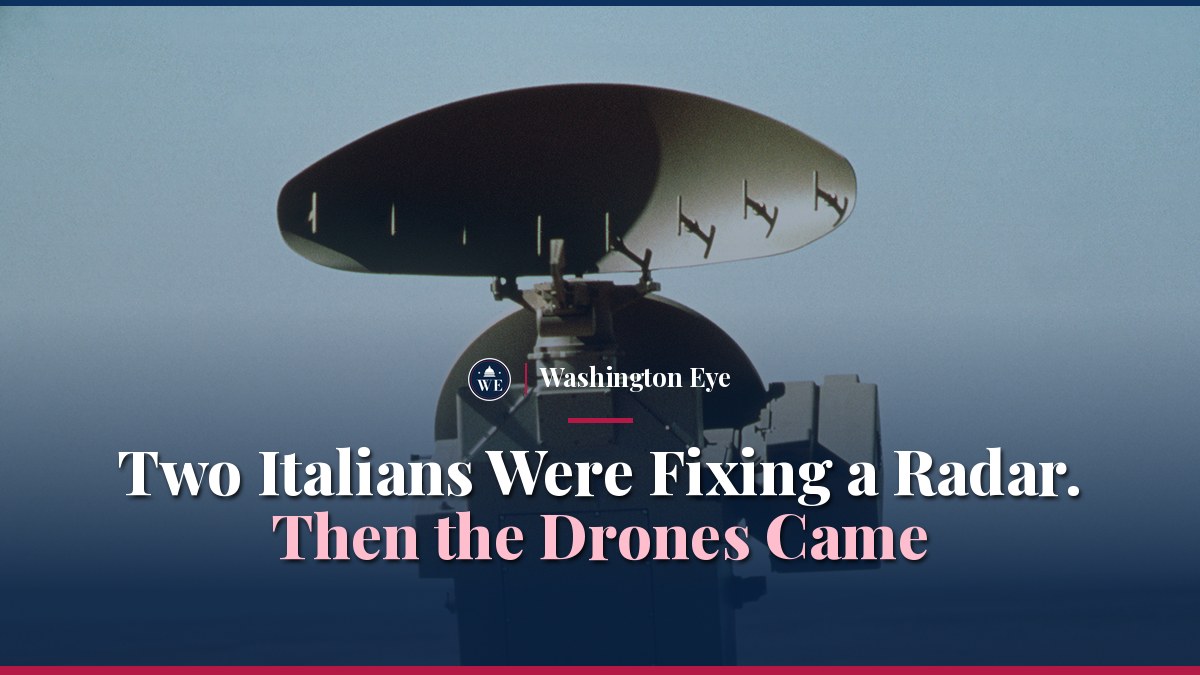
At about two o'clock on Thursday afternoon, two Italian engineers were at work on a radar in the Kuwaiti desert. Antonio Saccoccio, 65, from the coastal town of Formia, was close to retirement. Emanuele Lo Russo, 36, was from Rome. Both were employed at the Rome plant of Rheinmetall Italia, the Italian arm of the German defence group, and both were in Kuwait to maintain the detection antennas of Skyguard, an air defence system the Kuwaiti armed forces have bought from Italy since the 1990s.
Then the drones came. Kuwait's defence ministry says its forces detected and intercepted several of them over what it called a "vital site". The interception did not end the danger. Fragments fell on the air defence detection station where the two men were working. They were taken to hospital with a Kuwaiti army captain and a Pakistani worker, and the ministry later confirmed that both Italians had died of their injuries. Italian reporting described them as the first Italian citizens killed in the war that began when the United States and Israel attacked Iran at the end of February.
Kuwait blamed what its army called "heinous Iranian aggression". Iran said it had nothing to do with it. Between those two statements sits one of the most consequential questions of the war so far: whether Tehran's campaign against the Gulf states that host American forces has now pulled Europe in, and what Europe intends to do about it.
What Rome says happened
The news reached Italy's foreign minister, Antonio Tajani, in the middle of question time in the Senate, and he shared it with the chamber almost as soon as he received it. "Around 2:00 PM today, drones of Iranian origin targeted Kuwaiti military installations," he told senators, including the station where the two technicians were working. "A powerful explosion occurred," he said, and both men had died.
Mr Tajani has been careful about the difference between where a drone was made and who launched it. Investigators, he said, had established that the drone was manufactured in Iran, but he added that pro Iranian armed groups across the region also fly Iranian drones. Reporting from Rome on Friday suggested the drone may have been aimed at a desalination plant not far from Kuwait City, which the Rheinmetall radar was there to protect, and that Italian intelligence did not rule out a launch from neighbouring Iraq, where several militias aligned with Iran's Revolutionary Guards hold such aircraft. None of that has been confirmed publicly, and the destruction of the radar itself is reported to have complicated the analysis.
Even so, Italy announced it would lodge a formal complaint with the Iranian embassy in Rome. "They must also bear in mind that it is not just Kuwaitis or Americans," Mr Tajani said. "There is no need to ignite new flashpoints at this time." He argued that there was "no reason to attack the Arab countries that face Iran, as they are not involved in the war." His stated priority now is to bring the bodies home.
Prime Minister Giorgia Meloni heard the news in Brussels, where European Union leaders were meeting, and offered her "deepest sympathy" to the families in a message on social media. Defence Minister Guido Crosetto said he was deeply saddened. Ursula von der Leyen, the President of the European Commission, went further than condolences. "We must step up pressure on Iran to end these unacceptable attacks against its neighbours and our partners in the Gulf," she wrote, adding that "security in the Gulf is a security issue for us all." The Gulf Cooperation Council, Saudi Arabia, Qatar and the United Arab Emirates all condemned the attack.
Tehran's denial, and its calendar
Iran's answer came in layers. Its armed forces spokesman, Abolfazl Shekarchi, said "no military or offensive operations have been conducted" by Iranian forces in the region, and suggested the accusations were cover for "false flag" tactics by Israel and the United States. Iran's embassy in Rome said it "categorically rejects" the claim. Iran's ambassador to Italy, Ali Akbar Rezaei, offered condolences to the families. Then the foreign minister, Abbas Araghchi, called both Mr Tajani and his Kuwaiti counterpart, Sheikh Jarrah Jaber Al Ahmad Al Sabah, to deny any involvement and to propose a joint investigation with Kuwait and Italy. The incident, he wrote, "is suspicious and looks like a precooked recipe for war."
The denial deserves to be weighed against the record. On November 18, Iran's regular army openly claimed a drone strike on Patriot batteries at Kuwait's Ali Al Salem air base, which hosts American forces. That attack, which followed an American strike on an Iranian island, was the first on Kuwait in more than two months, and Kuwait said it caused no casualties. Thursday's was the second attack on the emirate this month. Since the war began, Kuwait, home to Camp Arifjan as well as Ali Al Salem, has been one of the Gulf states repeatedly in Iran's sights, alongside Bahrain.
Claiming a strike on American air defences is one kind of message. Owning the deaths of two European civilians would be another, and a far more costly one. That is the logic behind Tehran's offer of a joint inquiry: it keeps Iran talking to Rome at a moment when Italy is visibly reluctant to escalate. Whether investigators eventually trace the launch to Iranian territory or to an allied militia, the result for Europe may not be very different. A drone built in Iran killed two Italians on the territory of a partner that Italian engineers were helping to defend.
Why a radar crew matters
It is tempting to file Thursday's deaths as a tragic accident of interception. In one sense they were: the drone was shot down, and the shrapnel did the killing. But the identity of the victims says something larger about this war. The Gulf's air defences do not run themselves. They depend on a web of foreign contractors, many of them European, who install, repair and calibrate radars and launchers under fire. Iran's strategy of pressuring Washington by hitting the states that host American bases puts those people directly in the line of fire.
Italy knows the risk already. In mid September, according to Italian reporting, an Iranian attack damaged an Italian Eurofighter at the King Fahd air base at Taif in Saudi Arabia. Since then Rome has quietly reduced its "Task Force Arabia", the mission set up last summer to support Gulf states, from about 400 personnel to about 300. Only around thirty Italian troops are now reported to be in Kuwait. Government sources have signalled a further reshaping of forces in the region in the next missions decree, due early next year, while the Foreign Ministry works on bringing home civilians, including defence industry staff.
The domestic pressure points the same way. Elly Schlein, the leader of the opposition Democratic Party, has asked the government to report to Parliament. Giuseppe Conte, the former prime minister, spoke of a "spiral" that puts Italian citizens at risk. The metalworkers' union Fiom urged companies to bring workers home from the war zone. Yet Italy is not retreating from the region. A day before the attack its chief of defence staff, General Luciano Portolano, said Italy was ready to lead the military pillar of a new European mission in Lebanon that will replace the United Nations force there when its mandate ends this year.
The American question
For Washington, the deaths arrive at an awkward moment. Secretary of State Marco Rubio said on November 10 that the American "economic campaign" against Iran was "working so well" that the President had no need to conduct major combat operations, while warning that the military stood ready if Iran crossed certain red lines. The blockade has continued to squeeze Iran's economy, but diplomacy has stalled, and Iran has kept up attacks on shipping in the Strait of Hormuz.
On Thanksgiving, speaking to American service members, President Donald Trump struck a confident note. "We have victory at hand," he said. "It's going to be whenever, sort of, whatever I want it to be." He added that the United States was "giving them every chance to make a deal and save a lot of lives", but said he was not sure Tehran would take it.
The Kuwait attack tests that posture from an unexpected direction. Washington's pressure strategy works best with European partners pulling in the same direction, and the European Commission's call to step up pressure on Iran suggests some appetite in Brussels. But the government most directly affected is the one most clearly urging calm. Rome's message to Tehran is a complaint, not a threat, and its message to its own public is that it will protect citizens by pulling some of them back. That is a reasonable response for a country with two coffins to bring home. It is not the response of an ally preparing to join a harder line.
Markets, meanwhile, are reading the region as a whole. On the same day as the Kuwait strike, a projectile hit Saudi Aramco's Jazan refinery, killing a Nepalese worker, a day after the Houthis in Yemen claimed attacks on Saudi energy and port facilities. Brent crude rose above $97 a barrel on Friday, on course to snap a three week losing streak. Each new strike on Gulf infrastructure, whoever launches it, adds to the case that the war is not winding down simply because the large scale bombing has paused.
What to watch
Three things will decide whether Thursday becomes a turning point or a footnote. The first is the investigation. If Italy and Kuwait publicly trace the drone to an Iranian launch site, Rome will face pressure to go beyond a diplomatic complaint, and Brussels will face pressure to match Ms von der Leyen's words with measures. If it is traced to a militia in Iraq, the focus will shift to Baghdad and to how far Iran controls the groups that use its weapons.
The second is the European summit table. EU leaders are already arguing over money, the long term budget and support for Ukraine. Adding a Gulf security dimension, at a time when European workers are maintaining the region's air defences, would mark a shift in how the bloc sees a war it has largely treated as an American and Israeli affair.
The third is Washington. Mr Trump says the timing of victory is his to choose. Iran's response to Thursday, a denial paired with an invitation to investigate together, looks designed to keep Europe on the sidelines. Whether that works will depend partly on whether the United States presses its allies to treat the deaths of two radar engineers in Kuwait as an attack on the West, or as one more grim incident in a war that Washington still says it can end on its own terms.
For the families in Formia and Rome, none of that changes much. Two men went to Kuwait to keep a radar working so that others would be protected from drones. Their deaths are a reminder that in this war the front line runs wherever the air defences are, and that the people who keep them running are not always soldiers.