
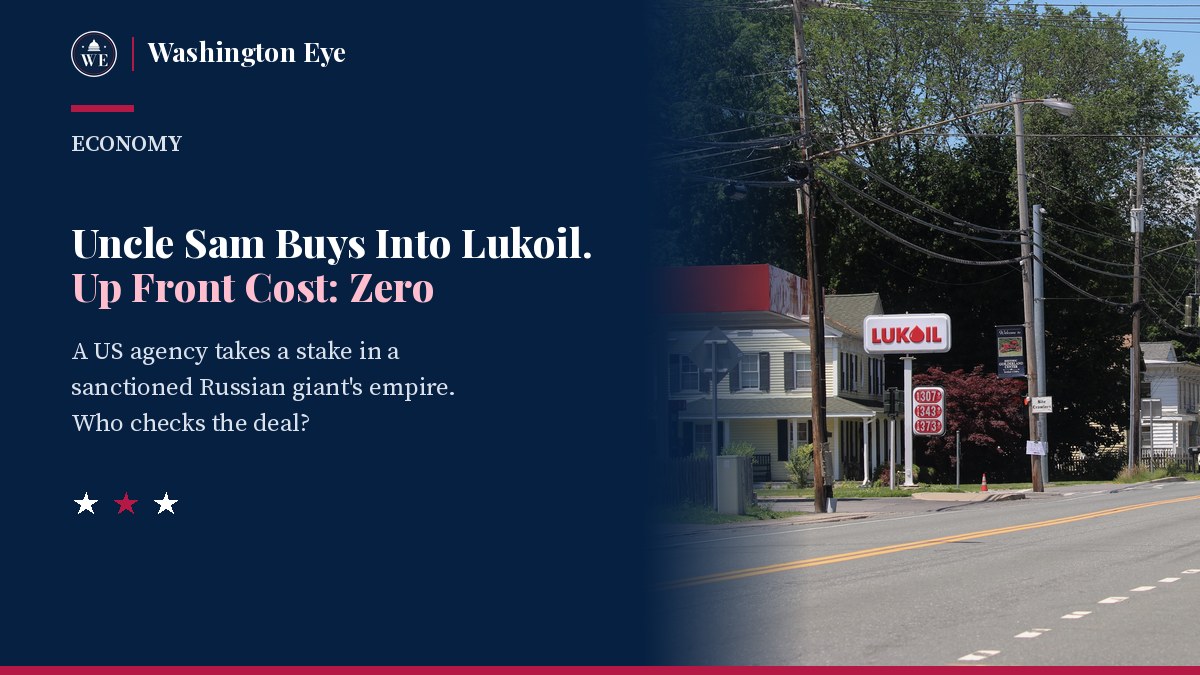
Thirteen months ago, the Treasury Department put Russia's two largest oil companies under sanctions and said exactly why. "Given President Putin's refusal to end this senseless war, Treasury is sanctioning Russia's two largest oil companies that fund the Kremlin's war machine," Treasury Secretary Scott Bessent wrote. One of those companies was Lukoil.
On Wednesday, the United States government agreed to become a part owner of Lukoil's empire abroad.
A consortium led by Eldridge, the asset manager founded by the billionaire Todd Boehly, announced that it had signed an agreement giving it exclusive rights to buy Lukoil's international assets: refineries in Europe, oil and gas fields in Central Asia and the Caucasus, and filling stations from the Balkans to upstate New York. Its members include the US International Development Finance Corporation, a federal lender known as the DFC, alongside Xtellus Partners, a US investment bank, and Catena Investment Holding, a company based in the United Arab Emirates. The deal still needs a licence from Treasury's Office of Foreign Assets Control, which polices sanctions, and the parties have 60 days of exclusivity to finish it.
The administration will present this as a win: a portfolio worth roughly $20 billion pulled out of Russian hands, with American taxpayers sharing in the upside. Critics in both parties see something else. The facts so far support a harder question than either side is asking: who, exactly, is checking a deal in which Washington is both a buyer and the referee?
What Washington gets, and what it pays
Start with the price. According to an analysis by Thomas Glynn Hanley of the Center for Strategic and International Studies, the DFC will take a stake of roughly 15 percent in Lukoil's international assets without investing any capital up front, which appears to be a first for the agency. Its return comes from what is called a profits interest: the difference between what the assets are worth at the moment of sale and what they are worth later. Because sanctioned assets trade at a deep discount, that gap could be large. Once the sale closes and US sanctions no longer apply to the new owners, the value is likely to rise sharply.
Lukoil, for its part, is not being paid in cash. It will receive its own shares, with a face value of about $10 billion. A bank acting for the consortium has reportedly been buying up frozen Lukoil securities from roughly ten American and British funds and from US depositary banks, which had written them down as untradeable in the West. Those shares will be handed back to Lukoil in exchange for the foreign assets.
Here is the detail that matters most. The shares will not sit in an American account. According to US officials cited in the analysis, they will be held in an Emirati custodial account, and Lukoil will be able to take them when sanctions are lifted or after five years, whichever comes first.
That appears to clash with Treasury's own rules. When it licensed Lukoil to negotiate a sale in November 2025, Treasury published guidance saying any deal must "completely sever" the international arm's ties with Lukoil, "block any funds owed to Lukoil until sanctions are lifted by placing them in an account subject to U.S. jurisdiction," and "not provide a windfall to Lukoil, such as by providing up-front value to Lukoil, including through asset or share swaps." The new structure uses a share swap, places the proceeds outside US jurisdiction, and sets a release date that does not depend on sanctions being lifted at all.
A trail of rejected bids
What makes those terms striking is that earlier bidders were turned away for less.
On October 30, 2025, Lukoil accepted an offer from the commodity trader Gunvor. Treasury killed it on November 6, saying in a post online that "the Kremlin's puppet, Gunvor, will never get a license to operate and profit." In December 2025, Xtellus proposed paying Lukoil not in cash but through a swap of Lukoil securities held by American investors. Treasury reportedly rejected it because it lacked permission to use sanctioned securities. In January 2026, the private equity giant Carlyle signed a nonexclusive deal that would have put the proceeds in a blocked US account, as the rules required. Moscow reportedly saw that as a nonstarter, the agreement lapsed in July without a Treasury decision, and Carlyle walked away in October.
The deal that has now been signed borrows the share swap Treasury once refused, drops the US account Treasury once demanded, and adds a federal agency as a partner. The licence that allows the negotiations has been extended twelve times and is due to expire on December 19.
Who negotiated it
A British financial newspaper reported in September that Mr Boehly, who has given $2 million to pro-Trump causes, had assembled a consortium that included the DFC. Early versions of the group reportedly also involved prominent Gulf investors whose business ties to people close to the president raised conflict of interest questions. Those investors have been dropped from the group announced this week.
The White House's envoys were in the room, at least for part of the talks. President Putin raised the Lukoil sale with Steve Witkoff and Jared Kushner during their September 5 trip to the Kremlin, making clear that no deal would go ahead without his approval. A senior administration official told a major American newspaper that the two men played a direct role in shaping the terms so that they included "a substantial upfront payment and profits interest for the United States." Officials have said the private partners wanted the government in the deal as a "security blanket."
Read together, those facts describe an unusual chain. The Kremlin signed off on the buyer. A US agency joined the buyer. Another arm of the same government must now decide whether to license the buyer.
The case for the deal
It is worth stating the administration's argument fairly, because it is not frivolous. After three failed bids, officials can say this was the only structure that both kept an immediate cash windfall away from Russia and was acceptable to Moscow, without whose consent the assets were not going anywhere. A completed sale would put a large energy portfolio in Western hands for good.
It would also restart real capacity. The three European refineries at the heart of the package, Zeeland in the Netherlands, Neftohim Burgas in Bulgaria and Petrotel in Romania, can together process about 350,000 barrels a day. A person involved in the sale told a British financial newspaper that a completed deal could bring 100,000 to 150,000 barrels a day back online. That is only about 0.1 percent of global refining capacity, so pump prices in America will barely notice. But Burgas is Bulgaria's only major refinery and Petrotel supplied about a fifth of Romania's domestic fuel, so the effect on fuel supply in southeastern Europe could be significant.
The administration has done something similar before. The Pentagon's investment arm took a 35 percent stake in a firm developing Venezuelan oil fields at what it called "no cost to the American taxpayer."
The case against, from both parties
The objections are not confined to Democrats. In an October letter to Secretary of State Marco Rubio and Mr Bessent, Senators Roger Wicker, a Mississippi Republican, and Jeanne Shaheen, a New Hampshire Democrat, raised concerns about any Lukoil agreement that would give Russia a financial benefit. Their letter also raised concerns about the United Arab Emirates as a hub for intermediaries in Lukoil transactions, the same jurisdiction where the shares are now to be held.
On Wednesday, Representative Gregory Meeks, the top Democrat on the House Foreign Affairs Committee, went further. "Congress banned the DFC from investing in Russia less than a year ago, yet this Administration is circumventing that restriction by buying $10 billion in energy assets from Russia's largest oil company," he said. "DFC exists to advance development in emerging markets, not serve as a finance vehicle for President Trump's wealthy and well-connected friends." He called it a "shameful deal" and demanded the administration stop it. He had already introduced legislation on the issue in October.
There are three concrete weak points.
The first is enforcement. Western sanctions are not part of Emirati law. In May 2025, an appeals court in Dubai ruled that US sanctions did not carry the force of law there and ordered a local bank to return funds to beneficiaries linked to Russian entities. If Lukoil sought its shares early, the main protection would be the contract with the custodian bank, and with a stake of about 15 percent, it is not clear how the DFC could force the consortium to enforce it.
The second is oversight. The DFC must formally notify Congress of projects it supports above $20 million. Because it is putting in no appropriated money, its lawyers will likely argue no notice is needed. Critics answer that the law covers any "financial commitment," and a multibillion dollar equity stake received in exchange for the government's participation can surely be valued.
The third is mission. Congress created the DFC in 2018 as a counterweight to China's Belt and Road Initiative, to back projects in mostly developing countries. Lukoil's portfolio includes roughly 200 American filling stations. When lawmakers reauthorised the agency in December 2025, they added nonbinding language saying its resources "should not be diverted for domestic or other activities extending beyond the scope of such mission and purpose."
What to watch
The decision now sits with Treasury's sanctions office, which must judge a bid that its own government helped build. Watch for whether it issues the licence before the negotiating licence lapses on December 19, and whether the final terms keep the Emirati account and the five year release. Watch the Senate, where a Republican defence hawk and a Democratic foreign policy veteran have already signalled concern. And watch Congress more broadly: even without a formal notification, lawmakers can hold hearings, slow nominations or attach conditions to must-pass bills.
The administration may be right that this is the best deal on offer. But a sanctions policy only works if it means the same thing for everyone. Thirteen months ago, Treasury said Lukoil funds the Kremlin's war machine. The burden is on Treasury to explain why, for this buyer, its own rules no longer apply.