
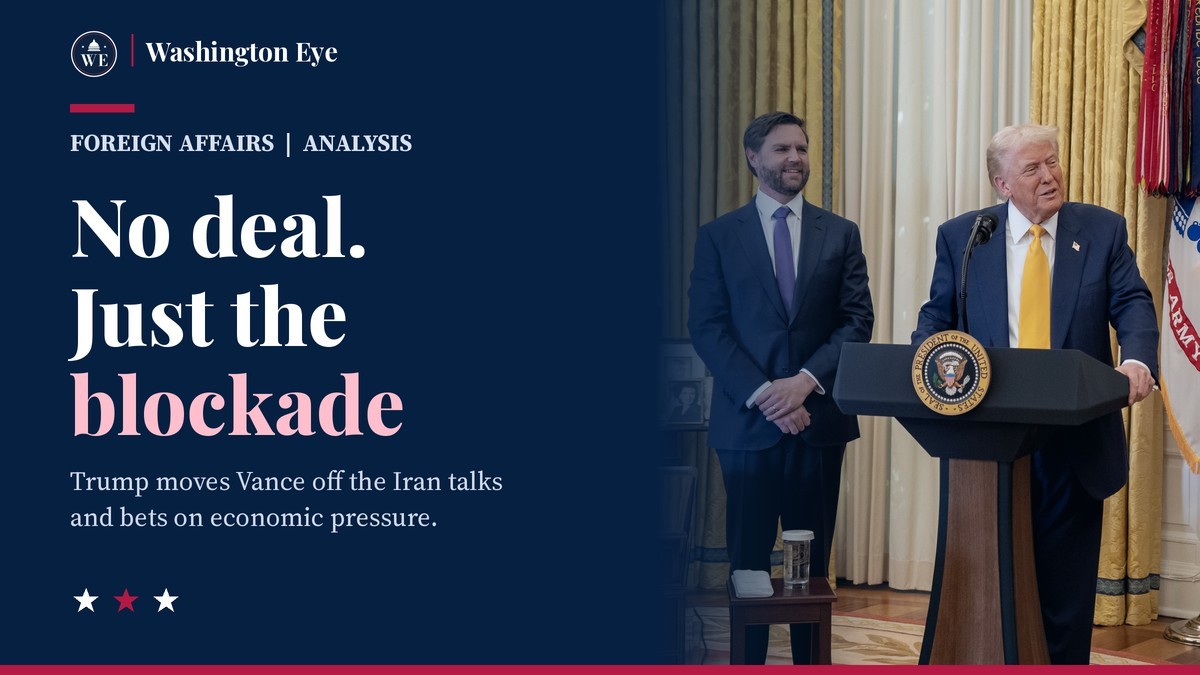
For most of the autumn, the quietest channel in Washington's war with Iran ran through the vice president's office. On Thursday morning President Donald Trump closed it with a single post. "We don't need a deal with Iran. Those days have long since passed," he wrote on his social media platform. "We've got their money, Hundreds of Billions of Dollars, and we've got their Strait!"
In the same message he gave Vice President JD Vance a new assignment. "I have asked Vice President Vance to focus his complete and total attention on the Massive Corruption and Crime taking place in Democrat run Cities and States throughout the U.S.," the president wrote. He named Minnesota, California and Illinois as "poorly run, corrupt disasters" and claimed that "Our Budget could be quickly BALANCED with the correction of this large scale criminal activity."
Read one way, the post is a reshuffle of duties inside a White House that has just lost both chambers of Congress. Read another way, it is the clearest statement yet of how Mr Trump intends to manage a war now in its ninth month: not by negotiating an exit, but by keeping the naval blockade of Iranian ports in place and squeezing Tehran's economy until something gives. Both readings matter, and they point to the same conclusion. The diplomatic track that looked most alive a week ago has been switched off from the top.
According to reporting by a major American newspaper, Mr Vance had in recent days begun outreach to hard-liners in Tehran to test whether a negotiated end to the conflict was possible, one that would reopen the Strait of Hormuz and place limits on Iran's nuclear programme. Another major newspaper reported on Wednesday, citing American and Middle Eastern officials, that he was weighing face-to-face talks with Mohsen Rezaei, a senior Iranian security figure and former commander of the Revolutionary Guards.
That outreach did not come from nowhere. The vice president had led earlier rounds of diplomacy with Iran this year and helped negotiate a memorandum of understanding in June. It was also reported, citing two officials, that Mr Trump had in recent weeks privately criticised that June arrangement and questioned whether it had been a costly mistake, arguing that it gave Iran time to regroup and earn oil revenue before the United States imposed its blockade. If that account is accurate, Thursday's post was less a sudden turn than the public end of a private argument.
The timing makes the reassignment hard to separate from the midterm elections. On 4 November, the morning after Democrats won control of both the House and the Senate, Mr Vance posted a message that startled much of his own party. "The reason we lost is the war," he wrote. "If you'd like to argue it was worth it, that losing the Senate for the next 6 years was worth it, then do so." He also described an earlier recommendation to end the war as "sound advice."
Mr Trump responded mildly at first. "I know how he feels about it," he told reporters, before defending the campaign. "We stopped them from having a nuclear weapon," he said, and he told a newspaper interviewer, "I did the right thing. I would have done it again." A White House adviser was quoted at the time saying that some officials and staff saw the vice president's post as a foreign policy break with the president.
Eight days later, the president has moved the man who blamed the war for the defeat away from the job of ending it. Mr Trump did not say that was his reason, and the White House has not described it that way. But the sequence is now on the record: the vice president questioned the war in public, took on a growing role in trying to wind it down, and has been told to spend his "complete and total attention" on something else.
There is a second political logic in the post. Corruption was one of the issues that broke in the Democrats' favour in the midterms. By pointing his vice president at what he calls corruption in Democratic-run states, Mr Trump is trying to turn that issue around before a Democratic Congress arrives in January with subpoena power and stated plans to investigate his administration. For Mr Vance, who is widely seen as a leading contender for the 2028 Republican nomination, the new brief offers a domestic platform. It also removes him from the one portfolio on which he had begun to set out a view of his own.
The substance of the president's position is a wager that leverage, not a signed agreement, is the better outcome for the United States. His phrasing points to two levers. The first is money: he refers to "Hundreds of Billions of Dollars" of Iranian funds, a figure he did not break down. The second is the Strait of Hormuz, the narrow passage through which a large share of the world's seaborne oil normally moves, and which American naval forces now patrol under the blockade.
That fits the line Mr Trump took earlier this week. On Monday he told reporters that "Iran militarily is effectively over" and that "We're just keeping it the status quo," while describing renewed strikes as quite unlikely and keeping the blockade in place. Thursday's post goes one step further. On Monday he still spoke of wanting a long-term solution to Iran's nuclear programme. On Thursday he said a deal was no longer needed at all.
Supporters of the approach argue that a blockade costs Washington far less than a bombing campaign, keeps American aircraft out of Iranian air defences and denies Tehran the oil revenue it would need to rebuild. They also point out that Iran has shown little sign of accepting the core American demand, that it reduce uranium enrichment to zero. Iranian leaders say no talks can begin until the United States accepts a list of seven conditions that Tehran has never formally published, and that its own officials describe in different ways. On that reading, chasing a deal only invites more delay.
Critics see a different set of risks. The war has already driven up fuel and food prices at home, and stock futures fell after the president's post on Thursday morning. A blockade with no diplomatic channel also leaves no obvious off-ramp if the situation at sea deteriorates. Earlier reporting, citing a United States intelligence official and others briefed on the assessments, said that renewed strikes would not fundamentally change Tehran's negotiating position. If force will not move Iran and diplomacy has been set aside, the remaining question is how long economic pressure alone can hold, and who blinks first.
The sea lanes themselves offered a reminder on Thursday of how fragile the standoff is. A British maritime security firm said a merchant vessel was struck by an unidentified projectile near the United Arab Emirates as it left the Strait of Hormuz. A British maritime trade agency separately reported that a tanker sailing eastbound in the Gulf was struck on Tuesday, leaving several people injured. No one has publicly claimed either incident. Each one raises shipping and insurance costs and adds to the pressure on oil prices that voters felt so sharply this autumn.
Israel, the United States' partner in the war since it began in late February, also signalled on Thursday that it does not consider the fight finished. Defence Minister Israel Katz said Israel would continue to act against Iran as circumstances required. A Washington policy of pressure without talks leaves more room for that kind of independent action, and less American influence over when and how it happens.
Gulf capitals, which Mr Trump said on Monday he is protecting at their request, now face a war that the White House describes as effectively over on the battlefield but has no declared end. For states that depend on open shipping through the strait, a frozen conflict is better than renewed bombing, but it is not peace.
Three things will show whether Thursday's post is a lasting doctrine or an opening position. The first is whether any back channel survives. Other mediators have worked to keep messages moving between Washington and Tehran, and on Thursday a senior Iranian security official gave his own account of how those messages are being passed. If those exchanges continue without the vice president, the question becomes who in the administration now owns them.
The second is Congress. Democrats will hold at least 55 seats in the new Senate and a majority in the House from January. War powers votes, oversight hearings on the cost of the blockade and questions about the June memorandum are all likely. A president who says no deal is needed will be asked, under oath by his officials if not by him, what the end state is meant to be.
The third is Mr Vance himself. He has spent a week trying to play down any rift with the president while saying in public that the war cost his party the Senate. He now has a domestic assignment that keeps him in the president's good graces and in front of Republican voters. Whether he accepts the move quietly, or finds a way to keep his own view of the war in circulation, will say a good deal about the Republican argument heading into 2028.
For now, the message from the White House is simple. The United States holds Iran's money and controls its main shipping lane, and the president has decided that is enough. Whether it stays enough depends on a strait where unexplained projectiles are still hitting ships, a government in Tehran that has not budged on its core demands, and a new Congress that takes its seats in seven weeks.