
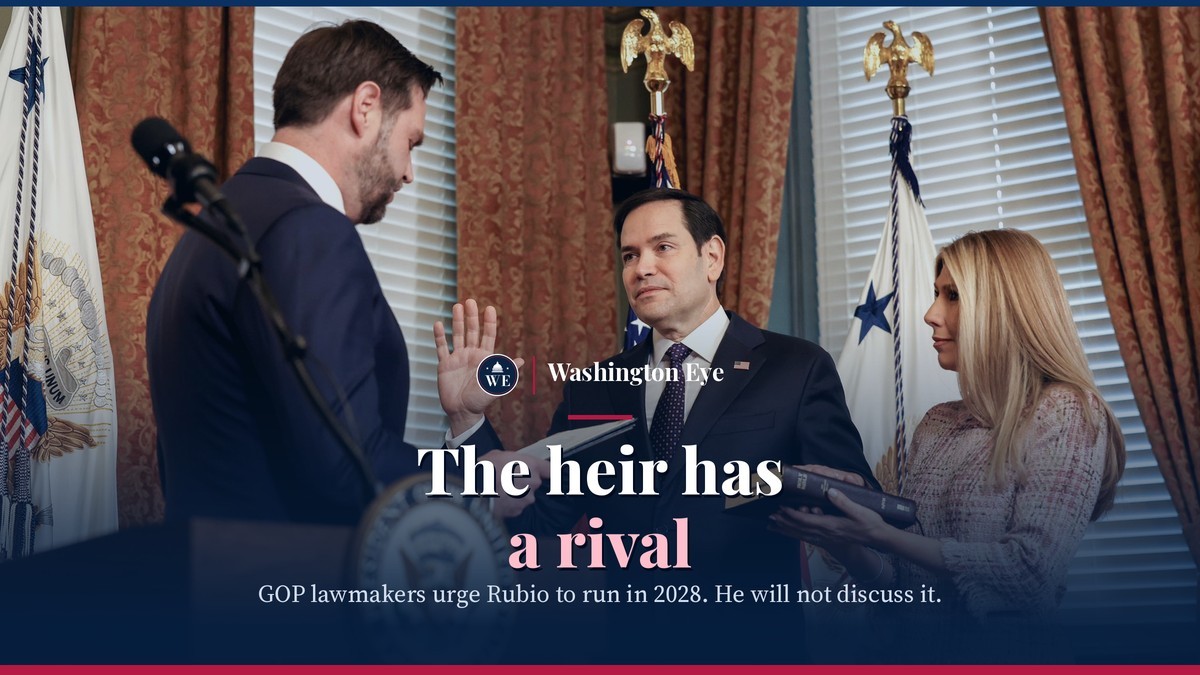
Ten days ago, the Republican answer to the question of 2028 fitted in two words: JD Vance. The vice president had the title, the donor list, the national name and, as finance chairman of the Republican National Committee, a seat at the centre of the party machine. Then the midterms happened. Republicans lost the House and the Senate, Democrats will hold at least 55 seats in the new Senate, and the man who was supposed to inherit the movement is now being asked whether he can inherit it without inheriting the wreckage.
Into that silence a new name is being spoken aloud on Capitol Hill. A growing group of Republican lawmakers wants Secretary of State Marco Rubio to run for president, according to interviews with roughly two dozen of them published by a Capitol Hill news site this week. Some speak on the record. Others do not, which tells its own story about how delicate the subject has become inside a party still run by Donald Trump.
"I hope he runs. I think he's the best person to communicate, to unify," said Representative Marlin Stutzman of Indiana. "I think he's the most talented Republican by far," he added. "We're going to have to continue to re-message, put some new faces up." A Republican senator, speaking anonymously, said the results "certainly make it harder for Vance." A House Republican went further: "I think Rubio is our best hope to lead Republicans out of this wilderness, and I hope he makes his break from Trump and JD early next year." A second senator admitted: "Some of us are still hoping we can draft Marco."
This column takes a simple position. Republicans should welcome this argument rather than smother it. A party that has just lost both chambers of Congress does not need a coronation. It needs a contest, and the early signs suggest it is going to get one whether its leaders like it or not.
The draft talk is not only gossip in Senate corridors. A national poll completed on Monday asked voters in each party to rate possible 2028 candidates. Some 45 percent of Republican voters said Rubio would be an "excellent" candidate, against 43 percent for Vance. The poll surveyed 1,705 adults, including roughly 500 registered voters from each party, and its margin of error for each party's voters was five percentage points, so the gap between the two men is statistically meaningless. That is precisely the point. Before the midterms nobody would have described the race for the Republican nomination as a tie between the vice president and the secretary of state.
The same survey found Florida Governor Ron DeSantis rated excellent by 32 percent of Republicans. About one in six Republicans said they did not know who Rubio was, a reminder that a man who ran for president in 2016 and served 14 years in the Senate still has room to introduce himself. Prediction markets, for what they are worth, still make Vance the favourite for the nomination, with Rubio and DeSantis well behind.
One Florida voter who backed Trump in the last three presidential elections captured the appeal in a sentence. "Rubio has managed to do his job," she told pollsters. "He's stayed off most people's radar because he hasn't done anything too far left, too far right, too crazy."
The vice president's problem is not that he lacks talent or support. It is that he cannot easily separate himself from the administration he serves, and in the days after the election he tried to do exactly that. "The reason we lost is the war," Vance wrote in a long post online on 4 November, blaming the conflict with Iran for driving away voters who had backed the Trump and Vance ticket in 2024. "If you'd like to argue it was worth it, that losing the Senate for the next 6 years was worth it, then do so," he added. "Agree or disagree, that's at least honest. But everyone knows why we lost."
It was a bold move, and it may yet prove shrewd. Vance has long been sceptical of foreign wars, and blaming Iran lets him criticise one decision without repudiating the movement. But it carries two costs. The first is with loyalists. Representative Randy Fine of Florida said in a television interview on Sunday that he would not back Vance in 2028 because of that criticism. "You have to be loyal to those people who brought you to the dance," Fine said, naming Rubio and Senator Ted Cruz of Texas as alternatives.
The second cost is with the evidence. In one survey of House voters, 34 percent called the war crucial to their vote, while 49 percent cited the cost of living and 55 percent government corruption. That points to a broader backlash against an administration Vance has defended for nearly two years. His own backyard did not help. Democrats won both marquee races in Ohio, where Amy Acton beat Vivek Ramaswamy for governor and Sherrod Brown took back Vance's old Senate seat.
Then came Thursday. President Trump said he was pulling Vance off the Iran talks so he could focus on domestic fraud. Whatever the president's reasons, the vice president who blamed the war for the defeat no longer has a hand in ending it.
Rubio is making the opposite wager. Rather than run from the war, he defends it. "Sometimes, when you do the right thing, you don't know whether it's popular or not, but it's still the right thing to do," he told reporters on Sunday before leaving for France. He stayed largely off the campaign trail this autumn and has kept out of the blame game, which is exactly why some colleagues now see him as unstained by the defeat.
That reading flatters him. Rubio is not only secretary of state but also national security adviser, which ties him directly to the foreign policy record that voters punished and that a Democratic House will soon pick apart. If the war is the albatross Vance says it is, Rubio is wearing it too. He has simply chosen to wear it proudly.
Nor has Rubio given his admirers anything to work with. In a newspaper interview last week he dismissed reports that he might leave the administration to prepare a run. "Working for President Trump for the duration of his second term has always been my plan," he said. "I literally will not talk about 2028 anymore. I just won't do it." Pressed by a reporter at a meeting of G7 foreign ministers in Paris on Monday about his earlier promise to be the first to back Vance, he refused again. "You can ask it eight different ways, and you're not gonna get it." The State Department has called reports of his departure baseless.
That refusal is the right answer for a sitting chief diplomat in the middle of a war. It is also, notably, not a no.
It would be a mistake to write the vice president off. Senator Jim Banks of Indiana was blunt: "If JD runs, he has my full support. He continues to lead in all the polls on the Republican side to be the nominee." Representative Brandon Gill of Texas also pointed to the advantages that come with the vice presidency. And on Tuesday Vance's fellow Ohioan and ally Jim Jordan was chosen as the incoming House minority leader, giving him a friend at the top of the next Republican conference.
Trump, meanwhile, is keeping everyone guessing. He has praised both men and has quizzed allies on which one they prefer. In a Sunday television interview he said he would "not necessarily" endorse anyone in the primary. "Maybe I'm better off not getting involved," he said. For a party that has not held a genuinely open nomination fight since 2016, that may be the most important sentence of the month.
Conservatives should want that fight, and not only between two members of the current cabinet. DeSantis called the midterms "close to an extinction-level event" for Republicans and said the party "really were fighting yesterday's battle." Cruz called the result a "Watergate-level repudiation" and blamed tariffs and the long war with Iran. Governors such as Brian Kemp of Georgia and Sarah Huckabee Sanders of Arkansas, and former Virginia governor Glenn Youngkin, are also mentioned. Nikki Haley, by contrast, said on Wednesday that she is not running in 2028.
Each of these Republicans offers a different diagnosis of what went wrong, and that is healthy. Vance says the war. Rubio says the policy was right even if it was unpopular. DeSantis says the party fought culture battles that no longer move voters. Cruz says it lost touch with voters' economic pain. A primary is how a party decides which of those stories is true. Skipping it in favour of an heir would mean deciding the most important question facing the right by default.
There is a practical argument too. Democrats are not crowning anyone. A veteran strategist who ran a winning presidential re-election campaign says more than two dozen Democratic campaigns are already exploring 2028 bids. Republicans who treat the nomination as settled will face a hungry, crowded and newly confident opposition with a candidate who has never had to win an argument inside his own party.
None of this means Rubio is the answer. He may never run, and he has been explicit that he does not want to discuss it. Vance may yet recover, and his argument about the war may look prescient if the conflict drags on. But the point of the draft talk is not really Rubio. It is a signal from Republican lawmakers that the succession is open, and that the next nominee will have to earn it.
For a party that just lost Congress, that is not a crisis. It is the beginning of a recovery. The nomination contests are more than a year away. The worst thing Republicans could do with that time is pretend the question has already been answered.