
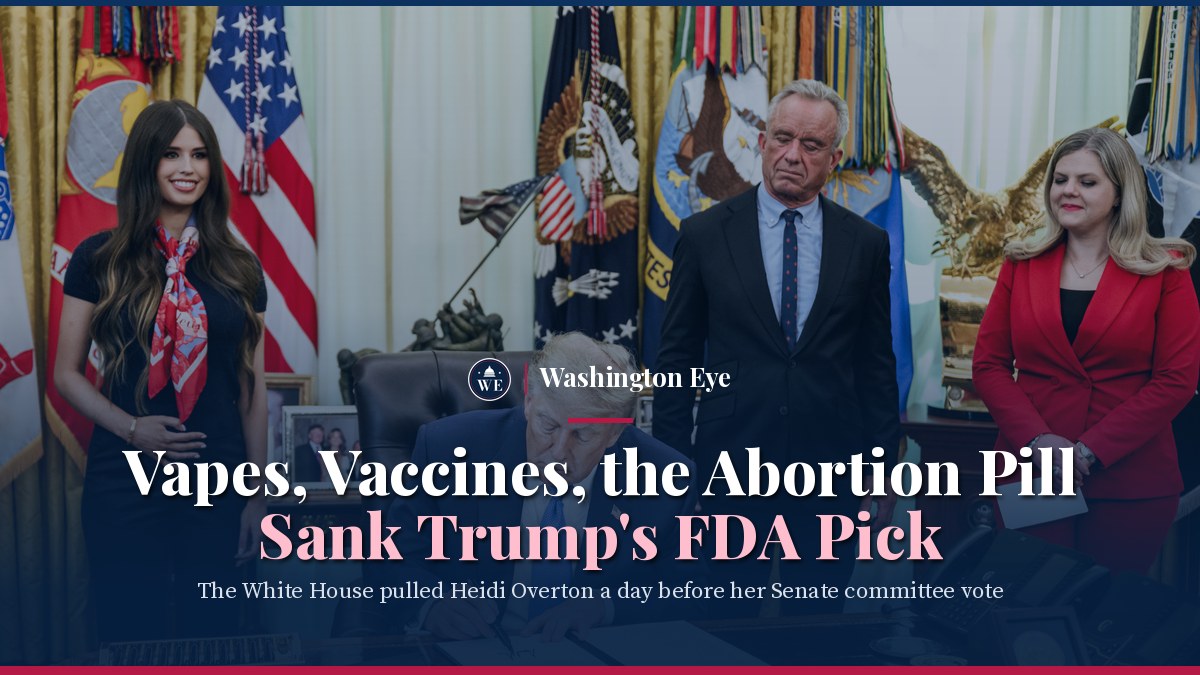
The White House withdrew Dr. Heidi Overton's nomination to lead the FDA on Tuesday night, hours before the Senate health committee was due to vote on her. The decision ends a three-month confirmation fight and leaves the Food and Drug Administration, which regulates drugs, vaccines, food and tobacco, with no confirmed leader in sight.
The official explanation was short. "FDA nominee Heidi Overton lacks the support on the Hill to move forward with her confirmation," a senior administration official told a US news site late on Tuesday. The fuller story is more interesting, because the nomination did not collapse under one objection. It was squeezed from several sides at once, by Republicans worried about vaccines, by anti-abortion senators worried about the abortion pill, by public health advocates angry about flavoured vapes, and by Health Secretary Robert F. Kennedy Jr.'s own movement, which saw her as an obstacle. Each camp wanted something different.
A nominee meant to calm things down
President Trump picked Overton in August. A preventive medicine physician, she serves as deputy director of the White House Domestic Policy Council, where she has worked on the president's health agenda, and she has spent most of her career working directly for Mr. Trump or for conservative groups aligned with him. Her selection was read as an attempt to put a steady loyalist in charge of a shaken agency.
That year ended badly for her predecessor. Dr. Marty Makary resigned as commissioner in May after clashing with the administration, most visibly over pressure to authorise fruit-flavoured e-cigarettes. In a statement this month, Makary said "big tobacco exploited their connections" to administration and health department officials to press him to approve "fruit-flavored vapes that appeal to children," adding: "I wouldn't do it." Since then the agency has been run by an acting commissioner, Kyle Diamantas, its deputy commissioner for food. According to a wire service, the FDA has lost more than 4,500 staff over the past year. It oversees products that account for roughly a fifth of American consumer spending.
The arithmetic of confirmation was unforgiving from the start. Republicans hold 12 seats on the Senate Health, Education, Labor and Pensions Committee and Democrats hold 11. With no Democrat expected to support her, Overton needed every Republican on the panel. One defection could stop her in committee, and taking a nomination straight to the floor without a committee vote would likely have faced significant obstacles.
Pressure point one: vaccines
The first and loudest problem came from the committee's own chairman. Sen. Bill Cassidy of Louisiana, a physician, had called Overton's support for the president's plan to break up combination vaccines, including the shot against measles, mumps and rubella, "almost disqualifying." In August, Overton stood beside Mr. Trump in the Oval Office as he signed an executive order calling for fewer federally recommended childhood vaccinations and for splitting the MMR shot into three separate injections. During that event, according to a television network's account, the president twice wrongly described the measles vaccine as "lethal," and none of the health officials present corrected him.
At her September hearing, Cassidy pressed her on her scientific independence and whether she would push back against the president and the health secretary. As recently as Sunday, in a television interview, he said he was still working the phones and would not say how he would vote. He also laid out the dilemma plainly: whether senators wanted "a series of short-term administrators who probably will have more influence from the secretary," or a permanent commissioner who might not be "the perfect candidate in somebody's mind" but would have "the ability to establish some independence."
Pressure point two: the abortion pill
If the vaccine worry came from the centre of the Republican conference, the decisive pressure appears to have come from its anti-abortion wing. Overton is herself an abortion opponent. In a 2023 policy brief for the America First Policy Institute, she argued that Congress should strictly regulate the abortion pill mifepristone "to protect women and children" and wrote that abortion "is corrosive to children, women, and society broadly."
That was not enough for some senators. At her hearing she said the FDA's current assessment was that mifepristone is safe and that she was focused on finishing the agency's review of the drug. Sen. Josh Hawley of Missouri, who has pushed for that review, emerged as a skeptic after she sidestepped questions about how she would handle it. The anti-abortion group Susan B. Anthony Pro-Life America urged the Senate to delay her confirmation and wants the agency to commit to ending mail orders of the pill. On Tuesday, Hawley told a Christian news magazine that Overton had promised to review the most recent data, complete the report by March and release it early enough for any policy changes to be finished by September 2027. He still said he did not know how the vote would go.
Meanwhile two Republicans who support abortion access, Sens. Susan Collins of Maine and Lisa Murkowski of Alaska, had not said how they would vote either. Murkowski had asked Overton at her hearing whether she would restrict mifepristone, which is used in more than half of abortions in the United States. That left the nominee caught in a narrow corridor: any firm promise to the senators on one side risked losing a senator on the other.
Pressure points three and four: vapes and the MAHA movement
The vaping fight that helped push out Makary followed Overton into her own nomination. At her September hearing she defended the FDA's May authorisation of fruit-flavoured vapes, saying there was evidence they could help some adults quit smoking. Last Friday a nonpartisan advocacy group, Health in Office, launched a campaign branding her "Heidi Vaperton," with posters and yard signs in Washington and other cities urging senators to reject her.
The most unusual opposition came from inside the president's own coalition. Prominent supporters of the Make America Healthy Again movement criticised her ties to health and agriculture interests and argued that she had worked to undermine Kennedy's agenda. Calley Means, a former top adviser to the health secretary who recently left his post, urged his followers to help block her and said in a television interview that "Heidi Overton was the biggest block to MAHA policies I encountered in the government." The White House statement on the withdrawal seemed to nod in that direction: "We need to go in a new direction at FDA," the senior official said, adding that "everybody fully supports Secretary Kennedy's vision."
Overton was not without defenders. Supporters pointed to her medical training and to endorsements from two former FDA commissioners, and as late as Monday the White House promoted an account of support from a former dean of the University of New Mexico School of Medicine.
Two versions of the final hours
The most striking feature of the collapse is that the two sides now tell different stories about it. The White House says she lacked the votes. Cassidy says she had them. In a social media post on Tuesday night, the chairman wrote that he had held "productive conversations" with committee members and that "I believe she would have had the votes to pass out of committee and pass the full Senate." He said the administration had "abandoned a viable confirmation path."
The last obstacle, in his telling, was the anti-abortion senators, who "sought final assurances" about the administration's "commitment to life issues." He added: "The Administration withdrew Dr. Overton rather than make such commitments." That is a pointed charge from a Republican chairman. It suggests the White House chose to give up the nominee rather than make a firm promise on mifepristone.
Both accounts can contain some truth. A nominee who would clear committee only after commitments the White House would not make is, in practice, a nominee without the votes. But the difference matters, because it tells the next nominee where the real line is.
The election changed the clock
Behind all of this sits the midterm result. Republicans lost control of both the House and the Senate this month, and according to a wire service, some officials working on the nomination began doubting her support after those losses. Several members of the health committee were defeated, including Cassidy, Collins and Sen. Roger Marshall of Kansas. Lame-duck senators have less reason to take a hard vote for a contested nominee, and the White House has only a narrow legislative window of roughly three weeks before Democrats take the majority in January.
Overton was not the only nominee in trouble. On the same day, the president's pick for Navy secretary, Hung Cao, faced bipartisan questioning, and retiring Sen. Thom Tillis of North Carolina said he would oppose Eric Ueland's nomination to lead the Government Accountability Office over his role in carrying out cuts by the cost-cutting team known as DOGE.
What to watch next
The first question is who comes next, and how. Two people told a wire service the White House is weighing Marshall, a former obstetrician who lost his reelection bid to Democrat Adam Hamilton, as a replacement. Another option is to skip the Senate altogether: the administration has spoken with candidates about serving in an acting capacity, according to a television network. That would keep the agency under temporary leadership, which is exactly the outcome Cassidy warned would give the health secretary more influence over it.
The second is the mifepristone review. The FDA has told a Louisiana court it expects results by mid-December and plans to make them public in March. Whoever leads the agency then will own one of the most politically charged decisions on its desk, with abortion rights groups already mobilised. "If Republicans try to rush through another nominee who threatens our healthcare, we're ready to keep fighting," said Mini Timmaraju, president of Reproductive Freedom for All.
The third is the Senate itself. Cassidy's closing line, that "confirming a permanent FDA Commissioner will fall to Senate Democrats," may prove the most consequential sentence of the night. From January, any nominee will need the approval of a Democratic Senate that is unlikely to sign off on the administration's vaccine changes. The White House can try to move fast in the lame duck, or govern the FDA through acting officials into 2027. Either way, an agency that has lost thousands of staff and one commissioner already faces another stretch without a permanent boss, just as its calls on vaccines, vapes and the abortion pill draw the most scrutiny.