
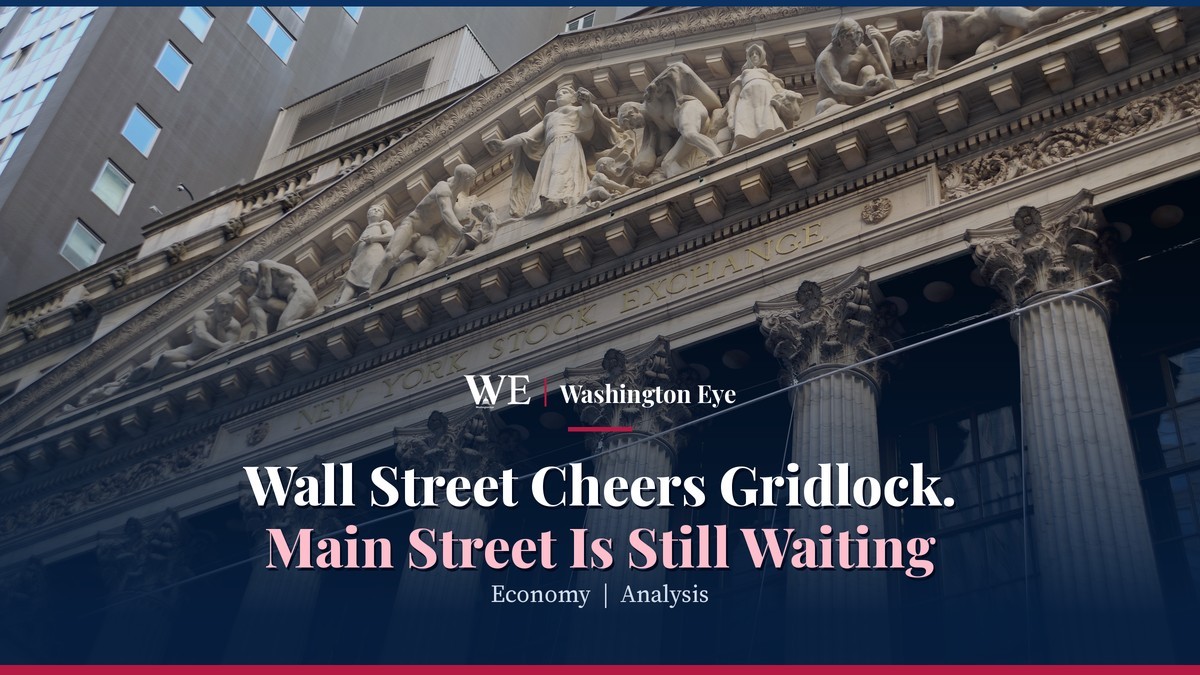
Wall Street gave its verdict on the midterm elections before most of the votes had been certified. On Wednesday, the day after Democrats won both chambers of Congress, the Dow Jones Industrial Average rose 1,569 points, or 3 per cent, to close at 53,356, its largest gain since April 2025. The S&P 500 climbed 1.6 per cent to 7,689, its best day in three months, and the Nasdaq composite gained 1.4 per cent. Oil fell 8.3 per cent to about $88 a barrel in New York. In posts on social media, one chart captioned "elections have consequences" drew thousands of replies from Americans who said, in much blunter language, that they did not care what the stock market did.
Both reactions contain a truth. The rally was real and its logic was sound. The scepticism is also justified, because the things that lifted share prices on Wednesday are not the things that will decide whether households feel better off next year. A conservative reading of the week starts from a simple proposition: the market cheered not because it expects Washington to do more, but because it expects Washington to do less.
Start with what investors actually said. Analysts cited three reasons for the rally. The first was the end of uncertainty. Market strategists had worried for weeks that a disputed outcome, including legal fights over the count, could drag on into the winter. President Donald Trump's statement overnight that he accepted the results and would work with Democrats removed that risk. "Investors are happy to have the midterms out of the way," Adam Crisafulli of Vital Knowledge wrote to clients. "This was a major source of uncertainty, and putting it in the rear-view mirror removes a key obstacle heading into a very favorable time of year seasonally."
The second reason was gridlock. With Democrats in control of Congress and Mr Trump holding a veto, sweeping legislation in either direction became far less likely. Stephen Brown of Capital Economics put it plainly: the scale of the Democratic gains "does not change too much for the near-term policy outlook, given the party still lacks a filibuster-proof majority in the Senate and President Trump has veto power to block legislation." Analysts at the Wells Fargo Investment Institute wrote, "We do not expect sweeping policy changes," and suggested that the most likely areas of agreement were affordability, energy policy and artificial intelligence.
The third reason was oil. Prices had already been falling, and traders read comments from the president and Vice President JD Vance about the unpopularity of the war with Iran as a sign that American forces might leave the region sooner. Oil completed its largest three-session percentage decline in almost five years, and Treasury yields slipped, with the ten-year note falling to 4.891 per cent.
None of this is unusual. Investment firm Edward Jones has calculated that the S&P 500 rose an average of 15.5 per cent in the six months after each of the last 14 midterm elections since 1970. Markets tend to like the end of campaigns and the arrival of divided government, regardless of which party wins. The Wells Fargo analysts made the point in their note: growth, inflation, interest rates and corporate earnings "have historically mattered more to broad investment performance than the party composition of Congress."
That is the first lesson conservatives should draw. Free markets do not need Washington to be busy. They need it to be predictable. Gridlock is not a failure of government in the eyes of investors; it is a form of insurance against abrupt changes to taxes, spending and regulation. A Republican Party that spent two years in full control and still lost the confidence of voters might reflect on the fact that the market's best day of the year came when its own power was curtailed.
The rally also contained warnings, and they were sector-specific. Shares of hospital owners, dollar stores serving lower-income customers and solar companies led the gains, as investors bet that a Democratic Congress would protect health spending and green-energy incentives. Trump Media and Technology Group lost nearly a quarter of its value in a day. Tesla shares fell 3.3 per cent, as investors priced in risks for businesses tied to Elon Musk, who gave heavily to Republicans. Chipmakers such as Nvidia and Micron fell, even as Apple and Microsoft reached record highs.
The chip sell-off points to the most consequential economic fight of the next two years, and it will not be settled in Congress. Voters in several states backed candidates and ballot measures sceptical of the giant data centres being built to power artificial intelligence. "In divided government, the policy implications at the federal level may be limited, but data center policy decisions sit at the state and utility-commission level," Jeff Buchbinder of LPL Research told clients, noting in particular Governor Greg Abbott's defeat in Texas. He expects the buildout to continue but said Democratic gains in key data-centre states "may slow it down some."
Here the conservative argument cuts in an uncomfortable direction for some Republicans. Florida Governor Ron DeSantis said after the election that young voters were comparing socialism not with free enterprise but with "crony capitalism," pointing specifically to tax breaks and subsidies for hyperscale data centres. If the market is now worried about a political backlash against those projects, part of the reason is that ordinary voters noticed who was being subsidised and who was paying higher electricity bills. A party committed to markets ought to welcome competition for capital on equal terms rather than special favours, and the backlash is a reminder of what happens when that principle is ignored.
Which brings the story back to the people who said they did not care. They have a point. Roughly speaking, a large share of American households own few or no shares outside retirement accounts, and a stock rally does nothing for a renter whose lease is rising or a family paying more for groceries. Friday's jobs report showed strong hiring, with 165,000 jobs added in October and unemployment at 4.1 per cent, but it also showed long-term unemployment at its highest level in years. The Federal Reserve is widely expected to consider raising interest rates in December, which would make mortgages and car loans dearer.
But the dismissive replies also miss something. Stock prices matter to anyone with a pension, a 401(k) or a job at a company that raises money in capital markets. More important, the reasons for Wednesday's rally are the same things that help ordinary households: lower oil prices mean cheaper petrol and diesel, a peaceful transfer of power avoids the kind of crisis that freezes hiring, and a government that cannot lurch from one extreme to another is one in which businesses can plan. The rally was a vote for stability, and stability is not only a Wall Street interest.
The test now is whether Washington can turn that stability into something people can feel. The new Congress does not take office until January, and until then Mr Trump retains unified control. After that, the realistic agenda is narrow: bills on energy supply, health-care costs and perhaps housing that both a Democratic Congress and a Republican president can sign. That is not the ambitious programme either party campaigned on. It may be exactly what the economy needs.
For Republicans, the market's message is that restraint has value, and that a pro-business party is not the same as a pro-market one. For Democrats, it is that investors are pricing in limits on their power, not a mandate to use it. For everyone else, the next number that matters is the October inflation report due on Tuesday. If prices are cooling, the rally will look like the first sign of a better year. If they are not, Wednesday will be remembered as a good day on Wall Street that never reached Main Street.