
On Friday, the United Nations' two food agencies published a map of where people are likely to starve next. It has 16 marks on it, up from 13 in June. The man whose name sits at the bottom of the press release is an American. Luke J. Lindberg, a former senior official at the US Department of Agriculture, was the Trump administration's nominee to run the World Food Programme, and he took charge of it on October 26. His message on Friday was blunt. "I've called upon all nations to banish famine to the history books," he said. "This is not a problem of operational ability, it is a question of whether world leaders have the political courage to act decisively."
We agree with every word. The trouble is that the first world leader who needs to hear it is in Washington. The United States won the top job at the world's largest humanitarian agency. It has not sent the money to go with it. If America wants to lead the fight against famine, and it should, it has to pay for the fight it says it is leading.
What the map shows
The new Hunger Hotspots report, produced twice a year by the Food and Agriculture Organization and the World Food Programme, looks at the six months from December to May and asks where hunger will get significantly worse. The answer is grim. Five places sit at the highest level of concern: Sudan, South Sudan, Somalia, parts of northern Nigeria and Yemen. In four of those five, the latest analyses identified or projected people in Catastrophe, the most severe phase on the international scale used to measure hunger, the phase defined by starvation and death.
In Sudan, the agencies see a risk of famine in 13 areas of North Darfur and South Kordofan through January. In two camps for displaced people in South Darfur, acute malnutrition has already passed famine thresholds. In South Sudan, the most recent analysis found a risk of famine in four counties of Upper Nile and Jonglei states. Afghanistan, the Democratic Republic of the Congo, Haiti and the Palestinian territories make up the next tier, with gang violence in Haiti alone having driven 1.5 million people from their homes.
Then there is the weather. An El Niño that the agencies say is gaining strength and could prove one of the most intense on record has pushed Southern Africa and the Central American Dry Corridor onto the list. Up to 3 million people in Zimbabwe, 2.6 million in Malawi and 1.8 million in Mozambique are projected to face high levels of acute food insecurity by March. In Central America, the first crop season of 2026 was the driest in four decades, with crop losses above 75 percent in many areas, and 3.2 million people in Guatemala alone are projected to go hungry through February. The report estimates that this El Niño could push some 49 million more people into acute food insecurity by the end of 2027.
The number that should embarrass rich countries
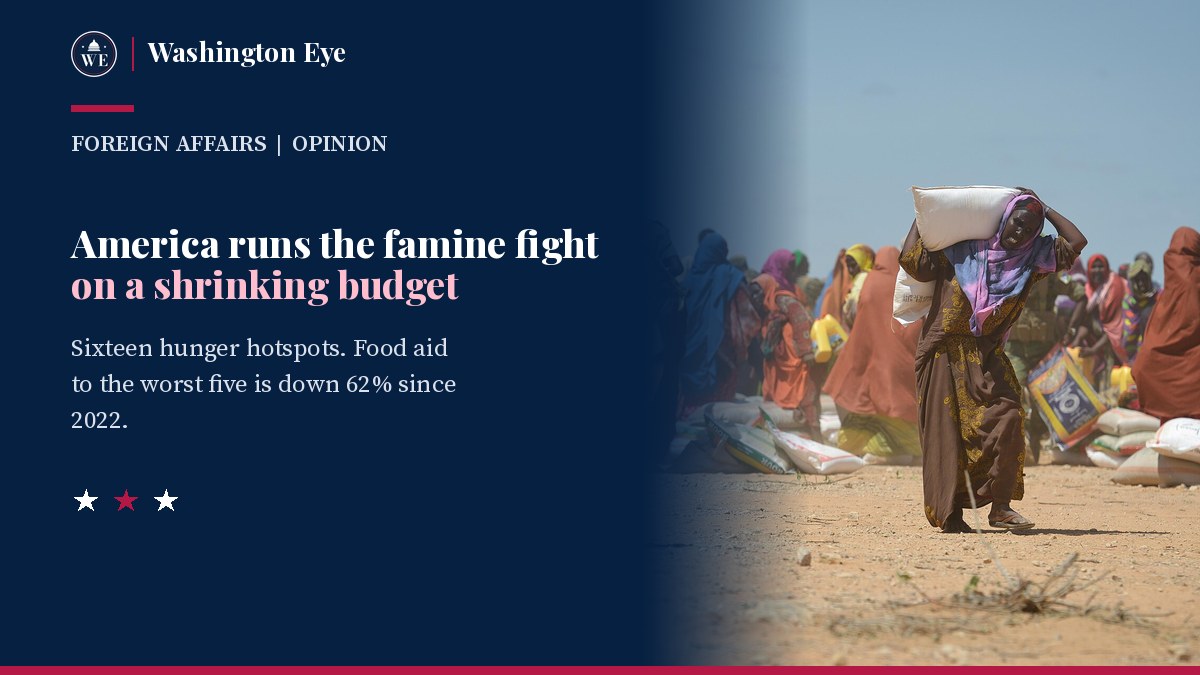
Conflict is the main driver in 12 of the 16 hotspots, and no amount of money stops a war. But one line in the report is about money, and it should shame every wealthy capital. All five hotspots of highest concern have been at that level again and again since 2022. Over the same period, humanitarian funding for food and nutrition in those five places fell by 62 percent, from $5.1 billion in 2022 to $2.0 billion in 2025.
The agencies spell out what that means. "While conflict, economic shocks, climate extremes and access constraints have remained the primary drivers of these crises, declining humanitarian resources have reduced the capacity to sustain gains and mitigate worsening conditions," they wrote. Past aid did avert famine, they note, but "the gains proved fragile and of limited duration." In plain English: the world saved these places once, then walked away, and the danger came back.
Even the cheap, sensible part of the plan is short of cash. The two agencies have a joint plan to act before El Niño's worst damage arrives, with drought-tolerant seeds, protection for livestock and water supplies, and early help for families, covering 9 million people in 22 countries. It faces a shortfall of $125 million. That is a rounding error in any national budget, and it is the kind of spending that stops a bad harvest from turning into a famine.
Where America stands
Look at the World Food Programme's own donor tables and the trend is impossible to miss. In 2024, the United States gave the agency $4.45 billion. In 2025, the year the US Agency for International Development was dismantled, that fell to $2.07 billion. This year, as of November 24, it stands at $1.71 billion. Total contributions to the agency from every donor fell from $9.76 billion in 2024 to $6.26 billion so far in 2026.
To be fair, the United States is still the largest donor by a wide margin, and the administration has not shut the tap completely. In June, the State Department announced an $800 million contribution meant to reach more than 38 million people in at least 37 countries. In October, the Agriculture Department awarded more than $182 million for food aid in Congo, Ethiopia and Haiti and for school meals in Cambodia. The department says it has put more than $1 billion into awards and agreements for emergency food assistance since Food for Peace, the country's flagship food aid programme, moved over from the dismantled aid agency.
But the direction of policy is clear, and it comes from the top. The White House budget for this fiscal year proposed eliminating Food for Peace entirely, a cut of $1.6 billion, and scrapping the McGovern-Dole school meals programme as well. The White House budget office has called both programmes "inefficient, wasteful," and out of line with "President Donald Trump's America First agenda." Congress refused to go that far, which is to its credit. It still cut Food for Peace by 25.9 percent, from $1.62 billion to $1.2 billion, in the agriculture spending law that reopened the government after the 43-day shutdown last year.
The cuts have consequences you can name. Food for Peace this year supplied American-grown food to seven countries outside emergency settings and dropped several nations at risk of famine, including Somalia and South Sudan, according to reporting on the programme. Both are on Friday's list of highest concern. Analysts at the Center for Global Development found that the Agriculture Department's spending on food aid commodities in 2025 and 2026 was about 55 percent below 2024 levels.
The America First case for feeding people
Defenders of the cuts make two arguments, and both deserve an answer. The first is that other rich countries should carry more of the load. They should. But they are moving the wrong way too. Germany, the agency's next biggest national donor, gave $991 million in 2024, $570 million in 2025 and $420 million so far this year. Britain's contribution also fell between 2024 and 2025. When the biggest donor pulls back, others do not rush to fill the gap. They follow. American leadership has always worked by example, and right now the example is retreat.
The second argument is that aid is wasteful. Some of it surely is, and reform is fair game. Yet the Hunger Hotspots report is exactly the kind of tool a careful spender should want: an early warning that says where the next crisis will hit, months before it does, so that cheap prevention can replace expensive emergency rescue. Cutting the response while the warning lights flash is not thrift. It is paying more later.
There is also a plain America First case that the White House seems to have forgotten. Food for Peace buys American crops. When the money shrank, American growers felt it. A bean farmer in western Nebraska, Jim Darnell, said losing that buyer "did disrupt it for the price of beans." Food aid built on American harvests is one of the rare policies that helps farmers in the Plains and hungry families in the Horn of Africa at the same time. It also buys goodwill in regions where rivals are competing hard for influence. Hunger drives displacement, and displacement feeds instability and migration, which the administration says it wants to stop.
What Washington should do now
The administration has already made the most important decision. By putting an American at the head of the World Food Programme, it told the world that the United States still wants to own this mission. Now it should act like it. Three steps would make Mr Lindberg's words mean something.
First, Congress should restore Food for Peace to at least its earlier level of about $1.6 billion in the next agriculture spending bill and point it back at the places where famine is a live risk, starting with Sudan, South Sudan and Somalia. Second, Washington should cover a large share of the $125 million El Niño shortfall now, before planting fails in Southern Africa, rather than paying many times more for emergency rations next spring. Third, the administration should use its new seat at the head of the agency to press Germany, Britain and other donors to reverse their own cuts, which it can only do with credibility if it has reversed its own.
None of this ends a war in Darfur or stops gangs in Port-au-Prince. The report is honest that conflict is the main cause of hunger, and that aid workers need safe access as much as money. But the report is also honest about the part rich countries control. Funding for the worst hotspots has fallen by nearly two-thirds since 2022, and the hotspots have not gone away. They have multiplied.
Mr Lindberg is right that this is a question of political courage. He was chosen by Washington, and Washington is where that courage now has to show up. America got the job. It should now send the money.