
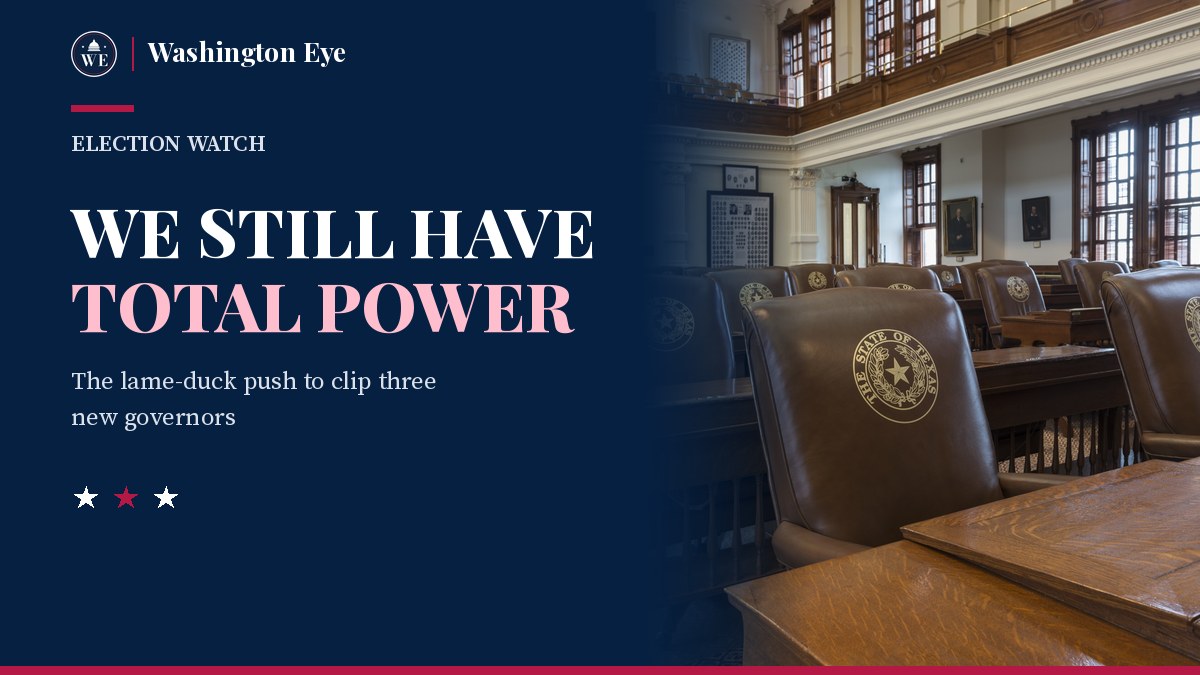
Two weeks after Election Day, Republican lawmakers in three states that just elected Democratic governors are asking the same question out loud: what can we still do before January? In Georgia, Ohio and Texas, members of outgoing Republican majorities have floated special sessions, constitutional amendments and new limits on executive power, all aimed at offices their party is about to lose. The most candid version came from Texas state Representative Brian Harrison the morning after the vote. "Republicans lost last night, but Democrats were not sworn in," he wrote in a post online. "We still have total power in Texas, and we must act like it."
So far the striking thing is who has said no. Georgia Governor Brian Kemp and Ohio Governor Mike DeWine, both Republicans, have publicly refused to help clip their successors. Texas Governor Greg Abbott has not answered Harrison at all, and in his concession speech promised to help Governor-elect Gina Hinojosa and her team through the transition. That leaves a live argument rather than a done deal, and it is an argument worth having properly, because the same question will come back in every state where power changes hands. Is a lame-duck legislature entitled to rewrite the rules for the next governor? We put both cases side by side.
First, what is actually on the table. In Georgia, Representative Charlice Byrd, who chairs the state legislature's Freedom Caucus, called on November 18 for a special session to rein in Governor-elect Keisha Lance Bottoms and redraw legislative maps. "We should address these issues now to prevent Gov.-elect Bottoms, who has proven not to be an effective executive, from abusing the powers of the Governor's office," she said in a statement. Kemp had already closed the door on November 4. "I will not be calling a special session of the Georgia General Assembly in order to curtail executive branch powers or debate redistricting changes," he said. "The voters of our state have spoken."
Georgia's constitution does offer a second route: if three fifths of the members of each chamber certify in writing that an emergency exists, the governor must call a special session, and lawmakers can convene themselves if he does not act within three days. Republicans hold majorities in both chambers but not enough seats to reach three fifths without Democratic votes, which makes the path close to impossible. Bottoms is due to be sworn in on January 11, the day the new session opens. She will govern with a Democratic lieutenant governor and a slim Democratic majority in the state House, while Republicans keep a 29 to 27 edge in the state Senate.
Ohio is the more serious case, because there the ideas have bill numbers. Democrat Amy Acton beat Vivek Ramaswamy for governor, Democrats won nearly every statewide office, and they broke the Republican supermajority in the Ohio House, which means Republicans alone will no longer be able to override her vetoes. Representative Ron Ferguson has introduced House Joint Resolution 11, a constitutional amendment for the May ballot that would let lawmakers override a veto with a simple majority instead of three fifths of each chamber. Another Republican bill would widen the legislature's power to rescind state health department orders, a pointed proposal given that Acton ran that department during the pandemic. A third, filed before the election, would limit the ability of state agencies to write regulations.
Ohio House Speaker Matt Huffman and Senate President Rob McColley have both said they do not expect the veto amendment to pass, and Huffman has insisted it is not about Acton. But he has not ruled out other changes before the year ends. "From a legislative standpoint, we're always looking at things to make sure that the Legislature stays in a position where they can monitor what the executive branch is doing," he said. Separately, outgoing Secretary of State Frank LaRose, who becomes state auditor in January, has asked Republican leaders for a bill letting the auditor inspect voter rolls. His Democratic successor, Allison Russo, called that a "back-door" way to share Ohio voter data with the Trump administration. DeWine's answer to the broader idea was blunt: "No governor is going to sign a bill that dramatically took away powers of the governor."
In Texas, Harrison wants Abbott to call lawmakers back before Hinojosa takes office on January 19 to pass limits he first proposed in December 2022. His bill would bar governors from suspending or changing statutes during emergencies and make emergency orders lapse after 30 days without legislative approval. Hinojosa, he argued, would otherwise inherit "nearly all the powers of a dictator."
Now the case for acting. Its strongest form is not partisan at all, and its defenders say so. Harrison points out that he demanded these emergency limits years ago, under a Republican governor, and says Texas governors should not have "unchecked" emergency powers whatever their party. Under the state's disaster law, a governor can suspend certain regulations during a declared disaster, and Harrison argues that this reach is simply too wide for any one person. If a reform is right, the argument goes, it does not become wrong because the calendar makes it awkward.
Supporters also argue that legislatures are entitled to defend their own turf. Huffman's point about Ohio is that the biggest recent fight over executive power there was with DeWine, a Republican, when lawmakers limited the governor's powers in health emergencies. Seen that way, the veto and health order proposals are the next chapter of an institutional quarrel, not a partisan ambush. Ohio Representative Adam Mathews framed it as a matter of balance: "Sometimes things should be with the executive branch, and some should be in the legislative, and that type of give and take needs to be looked at on a case-by-case basis."
And there is a formal argument too. Lame-duck lawmakers are not impostors. They were elected to two-year terms that run until January, and every legislature in America does real business in December. Nothing in any state constitution says a session becomes less legitimate after an election result someone dislikes. Wisconsin's highest court made essentially this point in 2019 when it upheld the December 2018 session that limited incoming Democratic Governor Tony Evers, and it upheld most of the laws themselves in 2020.
The case against starts with the timing, because timing is the whole point. Proposals that sat quietly for years only became urgent once the other party won. Harrison's own words gave the game away: the reason to act now, in his telling, is that Republicans "still have total power" for ten more weeks. Opponents say that if a reform is truly about principle, it can wait for the new legislature, where it would face a governor who can veto it and voters who just weighed in. Texas Attorney General-elect Nathan Johnson, a Democrat, captured that position neatly: he agrees emergency powers should be limited, but said "a special session is the wrong way to address" it.
Critics also note what lame-duck power plays have produced in practice: years of litigation and a lot of collateral damage. In December 2016, after Roy Cooper beat Governor Pat McCrory in North Carolina, Republican lawmakers moved to require Senate approval of his Cabinet and to take away his control of the state elections board. Judges blocked parts of the effort, and in January 2018 the state Supreme Court ruled 4 to 3 that the elections board overhaul went too far. In Michigan in 2018, lawmakers adopted voter-initiated minimum wage and sick leave measures to keep them off the ballot, then gutted them in the lame-duck session, pushing a $12 minimum wage back from 2022 to 2030 and cutting paid sick time from 72 hours a year to 40. The state Supreme Court revived the original laws in 2024, more than five years later.
The deepest objection is democratic. Ohio House Minority Leader Dani Isaacsohn put it in one line: "People voted for change. They did not vote for more backroom power grabs by people who are sore losers." Acton has made the same case in gentler language, saying voters everywhere she went were "longing for public servants again, who actually solve problems instead of making them." When outgoing governors from the losing party echo that view, as Kemp did with "the voters of our state have spoken," the argument stops looking like Democratic special pleading and starts looking like a norm both parties claim to share.
Each side has a weak spot. The reformers have to explain why the cure for one office holding too much power is to transfer that power in a rush, in a session voters cannot punish, to a majority that will be smaller next year. The opponents have to admit that some of these ideas, such as time limits on emergency orders, enjoy support across party lines, as Johnson's own comment shows, and that "wait until January" can be a polite way of saying "never."
There is a reasonable middle path, and it is hiding in plain sight. Changes to the basic powers of an office can be written to take effect after the next election, not before the next inauguration. A legislature serious about emergency powers could pass limits that start in 2031, or put a constitutional amendment before voters on a normal schedule. That would test whether a reform is about the office or about the person about to occupy it. Ohio's veto amendment, notably, cannot take effect without a statewide vote anyway, which is why even its own party's leaders doubt it can be organised and funded in time.
What should readers watch? In Georgia, whether three fifths of each chamber sign an emergency petition, which would require Democratic signatures and is therefore unlikely. In Ohio, which proposals actually move in the handful of sessions left before the year ends, and whether DeWine follows through on his warning with vetoes. In Texas, whether Abbott, who has stayed silent, calls lawmakers back to Austin before January 19.
Our reading is this. Both sides are right about something. Emergency powers in many states really are broad, and legislatures really do have the right to check governors. But the strongest test of a rule is whether you would accept it when your side holds the office. Two Republican governors have already applied that test in public and given their answer. The burden now sits with the lawmakers who want to move before the new governors take their oaths, to show their reforms would still look wise if they took effect on a later date, and not on the eve of an inauguration.