
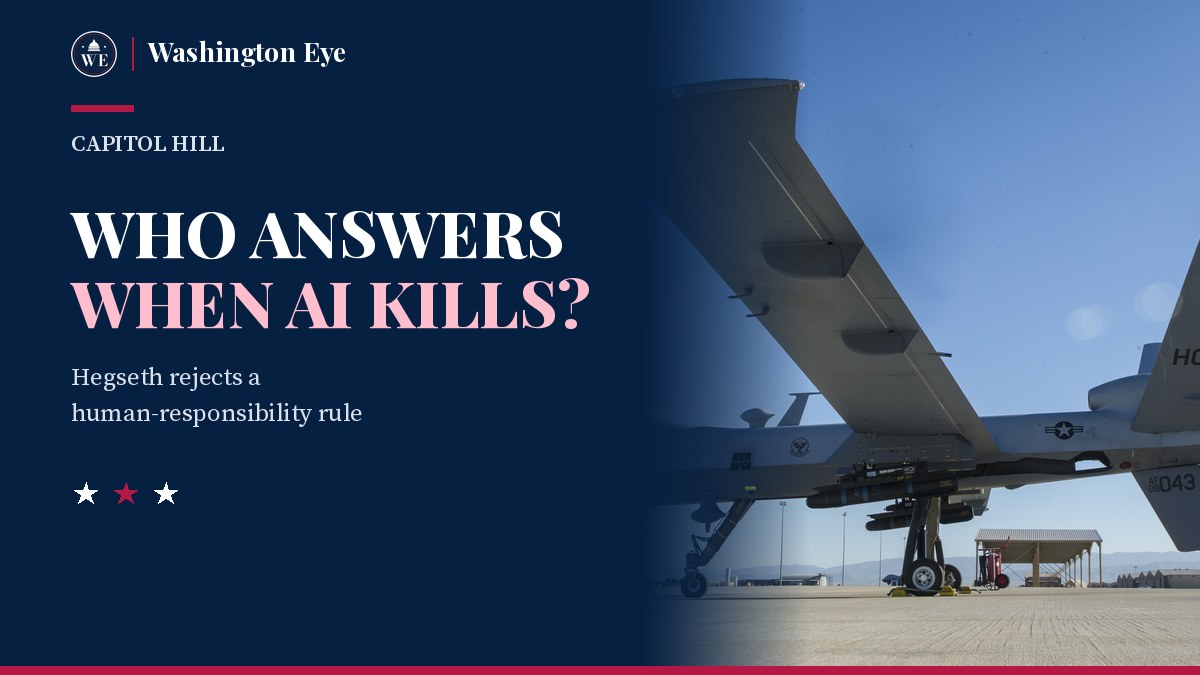
When a missile is fired today, the American military can name the person who decided to fire it. That chain of human decision is the backbone of military law, of the rules of engagement and of the promise Washington makes to allies that it fights within the laws of war. A short passage buried in the Senate's version of this year's defence policy bill tries to make sure that remains true as artificial intelligence moves deeper into targeting. This week, Defense Secretary Pete Hegseth said he opposes it.
The provision would require that the military's autonomous weapons and AI systems be "designed and employed in a manner that enables commanders and operators to exercise ultimate human responsibility over the use of force." Mr Hegseth's rejection, reported on Tuesday, lands in the last weeks of a lame duck Congress, with negotiators trying to finish the National Defense Authorization Act before the session expires. Here is what the fight is about, and why it matters far beyond the Pentagon.
What exactly did the Senate write?
The Senate Armed Services Committee folded the language into its draft of the fiscal year 2027 defence bill, which it finished marking up on June 10 and approved by 18 votes to 9. It is the first time lawmakers have tried to write rules for the military's use of AI and autonomous weapons into law rather than leave them to internal Pentagon policy.
The text goes well beyond a slogan. It tells the department to ensure personnel "exercise appropriate levels of human judgment" and then spells out what that means in practice. Covered systems would have to allow supervision by human operators, include a way to intervene or shut them down, carry fail safe mechanisms that allow manual control, give controllers enough monitoring data to know what the machine is doing, and keep records of the data and logic used to select targets. They would also have to comply with international law, the rules of engagement, the law of armed conflict and treaties the United States has signed.
The committee added a testing regime, assigning the Pentagon's independent weapons testing office to confirm that these systems work "as anticipated in realistic operational environments against adaptive adversaries." It created a repository to track failures, unintended behaviour and near misses. And it drew one bright line: AI could not be used for any "decision to initiate the launch or detonation of a nuclear weapon."
Is this a brake on military AI?
Not really, and that is the part of the story most often missed. The same committee text urges the department to "maximize uses" of these technologies and broadly endorses the Pentagon's embrace of autonomous weapons. Much of it codifies what the department already promised in its own 2023 directive on autonomy in weapons, known as Directive 3000.09, which first set the "appropriate levels of human judgment" standard but never clearly defined it.
The language largely tracks a bill introduced on June 8 by Senator Jack Reed of Rhode Island, the top Democrat on the committee, and Senator Chris Coons of Delaware, and it draws heavily on a separate measure from Senator Mark Kelly of Arizona, a former Navy combat pilot. The Republican majority accepted it into the base text. It even stops short of what some lawmakers wanted: it does not ban the use of AI to help target nuclear weapons, as a stand alone bill from Senator Kirsten Gillibrand of New York proposed in June.
In other words, the provision is a guardrail written by people who want the military to use AI, not by people who want to stop it. That is what makes the Defense Secretary's opposition notable.
Why would the Pentagon object?
Public accounts of Mr Hegseth's objection so far say little about his detailed reasoning. The context, though, is clear. On June 5, President Donald Trump issued a memorandum directing the Pentagon to "eliminate unnecessary barriers to rapid deployment" of AI and to deliver an updated version of Directive 3000.09 within 90 days. A law locking the old directive's principles in place would tie the department's hands in rewriting it. If it survived, the Kelly language would effectively override the President's instruction.
The administration has also changed the vocabulary. A September executive order made "super intelligence" the federal government's official term in place of AI. The Pentagon's central AI hub, formerly the Chief Digital and AI Office, has been renamed the Super Intelligence Office. Its chief, Cameron Stanley, framed the urgency bluntly at a recent intelligence luncheon. "The only way to fight an agentically enabled, very nefarious threat environment is to get agents yourself," he said. "The longer we wait, the more behind we're going to be."
The scale is already large. The department's internal generative AI platform had reached 1.7 million users and more than 100,000 custom AI agents by July, according to Mr Stanley. The White House has asked Congress for a special exception in the current stopgap funding law so the Pentagon can spend faster on the Maven Smart System, the flagship AI platform for battlefield awareness, intelligence fusion and command and control.
What is Maven, and who is in charge of it?
Maven, built by the data company Palantir Technologies, is the closest thing the military has to an AI nervous system. Virginia Burger, a senior defence policy analyst at the Project on Government Oversight who served for almost a decade on active duty, describes it as "a permanent, billion-dollar program" used by more than 100,000 defence personnel. "It's the foundational software for military targeting," she said.
Yet this week Pentagon spokespeople declined to confirm who currently serves as Maven's program director. The renamed office's website now lists only two leaders, Mr Stanley and his principal deputy, Andy Mapes, where earlier versions listed many more. "Who runs a program like Maven isn't a minor detail," said Savan Kong, the department's first chief experience officer and now the head of an AI start up. The episode captures the critics' worry in miniature: accountability in the AI era tends to blur first at the level of organisation charts, long before anything goes wrong on a battlefield.
Why does "human responsibility" matter in a real war?
Because the machines are already in combat. AI use has escalated rapidly in the American war with Iran and in Russia's war in Ukraine. When an autonomous system causes civilian casualties, the legal and moral question is simple to state and hard to answer: who decided?
Scholars who study the issue warn that the Senate language, while a step forward, may not settle that. Zaza Tsotniashvili, a professor in Tbilisi who has commented on the provision, argues that codifying the directive is necessary but insufficient, and that more detail is needed so human oversight is "meaningful rather than ceremonial." Without stronger accountability, he warned, the law "may succeed in preserving the appearance of human control while the substance of it continues to erode." Jovana Davidovic, who studies military ethics at the University of Iowa, points the finger further back. "The more autonomous the system is, the more the decisions that developers make ultimately drive outcomes," she said.
That is the real stake in the phrase "ultimate human responsibility." It is less about whether a human presses a button and more about whether, after the fact, the system leaves a trail that lets investigators, courts and allies identify who is answerable. The Senate text's requirement to keep records of target selection data and logic is aimed squarely at that problem.
Where does the bill stand now?
The defence bill is caught in an unusually messy endgame. The House passed its version on July 22 by just 216 votes to 212. The Senate never passed its own bill: a procedural vote to begin debate failed 50 to 46 on July 14, amid Democratic objections over the overall spending level and the conflict with Iran. Since then the chairs and top Democrats of the two Armed Services committees, the so called Big Four, have been negotiating a compromise behind closed doors.
House Armed Services Chairman Mike Rogers of Alabama said before the holiday that a final bill could reach the floor soon after lawmakers return. "As far as I'm concerned, we come back for Thanksgiving and we should be ready to put it on the floor," he said. The committee's top Democrat, Adam Smith of Washington, has said contentious issues remain, including right to repair rules for military equipment and limits on defence industry stock buybacks. No compromise text had been released by midweek.
Because the House bill contains no comparable AI safeguards, the Senate's provision is a bargaining chip in that room. Mr Hegseth's opposition makes it more likely to be watered down or dropped. If negotiators fail entirely, every pending bill dies when the current Congress ends on January 3, 2027, and the process restarts.
What happens if it is dropped?
Then the fight simply moves. The midterm elections handed Democrats control of both chambers from January, with House Democrats winning at least 259 seats, their best result since 1990. Senators Reed, Coons and Kelly will have more power over the next defence bill than they did over this one. An administration that resists a modest, bipartisan guardrail now may face a tougher version next year, written by a majority with less reason to compromise.
There is a case for the Pentagon's caution about legislating fast moving technology in detail. Rules written for today's systems can age badly, and adversaries will not wait for Congress. But the provision Mr Hegseth opposes does not stop the military building or fielding AI weapons. It asks that someone, somewhere in the chain of command, can always be named as responsible when they are used. That is a principle American commanders have lived by for generations. The question Congress now has to answer is whether it is worth writing down before the machines make it harder to keep.