
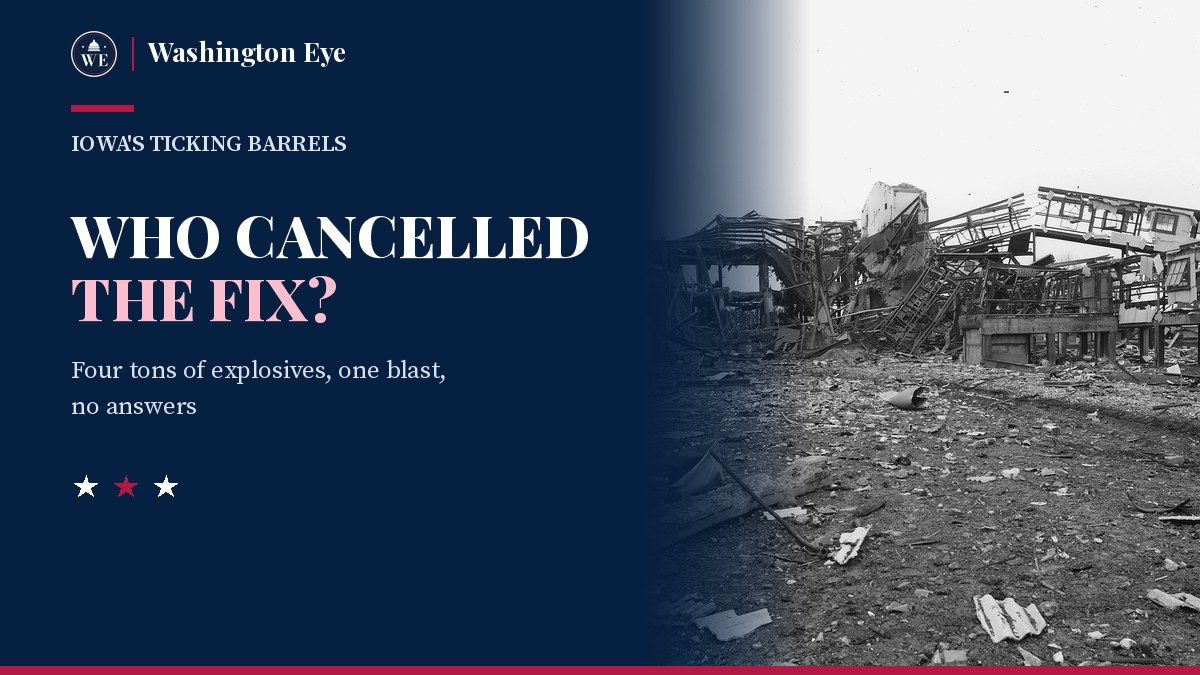
On Wednesday, if the weather holds and nobody changes their mind again, the United States Army will blow up more than four tons of its own explosives in a corner of southeastern Iowa. The material is lead azide, a primary explosive used to set off other munitions. It sits in 68 drums inside two earth covered magazines at the Iowa Army Ammunition Plant in Middletown, where it has been stored for more than two decades. Somewhere along the way the liquid meant to keep it stable changed, the lead azide recrystallised, and it became dangerously sensitive to shock and friction.
Army maps show that the plume from a detonation could carry lead particles close to 100 miles, across parts of southeastern Iowa and northwest Illinois. Residents and local officials say they learned of the plan only days before it was meant to happen. Since then the country has watched a week of court filings, postponements and, on Monday, an attempt by the President to make a man who does not yet hold office responsible for whatever happens next.
Our view is simple, and it will satisfy neither side fully. The blast should go ahead, because on the evidence now public every bad option left is worse. But Washington should not be allowed to treat Wednesday's explosion as the end of the story. The real question is why a chemical fix, ordered in the spring, was quietly cancelled, and why Iowans were told about the consequences only at the last minute.
How Middletown got here
The timeline is set out in a published order from the Eighth Circuit Court of Appeals. In March the Army determined that the drums had deteriorated and that the material inside had become unstable. Over the following nine months it operated under emergency storage authorisations while it worked on a disposal method. On 13 November the Environmental Protection Agency issued an emergency permit that, for the first time, allowed the lead azide to be detonated in place. The permit runs until 11 February 2027. Two days later the Army announced two controlled detonations for noon on 20 November.
Then the dates began to slide. On 19 November the Iowa Environmental Council and the Sierra Club asked the court to stop the blast, arguing that the permit would let the Army create a plume of lead dust over homes and communities with less than a week of public notice. The same day the Acting Secretary of the Army, Adam Telle, pushed the blast to 23 November, which he described as "the latest possible moment prior to a forecasted temperature drop." The court froze the permit on 20 November while it considered the case. On 21 November government lawyers told the judges the Army could proceed anyway, under a separate emergency exclusion in federal hazardous waste rules, and intended to act on 24 November. A day later the date moved again, to Wednesday 25 November.
On Monday a three judge panel lifted the freeze. In an unsigned opinion it found that the permit contained real safeguards, including containment barriers, weather restrictions, updated air modelling, advance public notice, soil and surface sampling within 24 hours of the blast, and a required plan for cleanup. "We are mindful of the very real risks presented by the Army's planned detonation," the judges wrote. "However, we must acknowledge the realities of the situation: the degraded explosives present a risk of an uncontrolled and unplanned explosion, which would occur without the benefit of the safety measures that the Permit puts in place."
Why we say let it happen
The case for detonation rests on a grim comparison. The government's lawyers argued that as temperatures fall the crystals can break more easily, and that a break could set off a chain reaction. The Environmental Protection Agency's regional administrator, Jim Macy, wrote to Governor Kim Reynolds that the Army had weighed chemical treatment, building a structure around the drums, moving them, and leaving them where they are, before concluding that a controlled detonation in place, with extensive mitigation, was "the only viable option." The plan includes extra barrier walls to channel the blast and a misting system to damp down dust.
Late on Monday, Mr Telle said the decision reflected "the unanimous judgement" of every agency involved, listing the Army, the Navy, the Environmental Protection Agency, the Bureau of Alcohol, Tobacco, Firearms and Explosives, the FBI, the Centers for Disease Control and Prevention and others. A federal appeals court has reviewed the permit and found it reasonable. When the experts, the regulator and the judges line up behind the same choice between a planned explosion and an unplanned one, the planned one is the responsible call.
That does not make the risks trivial, and officials have not helped themselves by talking as if they were. An Army spokeswoman, Justine Barati, described the exposure as "the equivalent of living in a mining town for one hour." The Centers for Disease Control and Prevention says no safe blood lead level has been identified in children. An explosives engineer working with the environmental groups, Ranajit Sahu, warned in a court declaration that the blast would also release toxic gases such as hydrazoic acid, and that the permit review appeared to focus on lead alone. Those concerns are a reason for rigorous monitoring and fast, transparent results after Wednesday, not a reason to leave unstable explosives sitting through an Iowa winter.
The blame game nobody needed
What happened on Monday afternoon was harder to defend. In a post online, President Donald Trump said the controlled detonation was "the proper course," then announced he had ordered the military not to proceed until the appeals court agreed and until the incoming governor, Rob Sand, signed off. If either said no, he wrote, the administration would be "forced to hold the incoming Governor responsible for any and all death or destruction caused by this very unfortunate, and longterm, situation."
Mr Sand, a Democrat, will not be sworn in until January. He has no authority over a federal Army installation, no command over the experts on site and no say over a federal permit. Asking him to carry the political risk of a federal decision, with a threat attached, is not leadership. It is an attempt to pre-assign blame. Mr Trump also blamed the Obama administration, saying it "improperly stored" the explosives in 2009, yet the court's own account says the drums had been in storage for more than two decades, well before that administration took office. Whatever went wrong began long before any of the current players, and it worsened this year on this administration's watch.
To his credit, Mr Sand declined the bait. He said the administration should decide "based on the information they have from the people they brought in to do the job months ago," and asked that the public get the same briefings he has received. "Everyday Iowans are entitled to know how Middletown came to this situation," he said. According to Mr Telle, Governor Reynolds, a Republican, has likewise said the call belongs to the experts. On this evidence, both of Iowa's governors, current and incoming, behaved more like grown ups than the White House did.
The question that will not go away
Here is the part of the story that deserves far more attention than the President's post. According to reporting by a major American newspaper, the Army awarded a contract in late March to MuniRem Environmental, a Georgia company that uses a sulphur based solution to neutralise explosives chemically. The firm proposed spraying the magazines and the drums to cut the risk of a spontaneous explosion. About two months later the Army cancelled the contract. A contracting officer told the company in an email that the cancellation "was not based on deficiencies" in its plans. The company's founder says it has filed public records requests asking why, and has had no answer.
We do not know why the contract was dropped. There may be a sound technical reason. The Army now says the material has degraded so far that the drums cannot be moved or even opened safely, so a chemical approach may no longer be possible. But that is exactly the point. If a non explosive option existed in the spring and was abandoned without explanation, and the months that followed turned a disposal job into an emergency, then the public is owed an account of who made that decision and on what basis. Mr Sand has asked that question in public. So should Congress.
There is also the matter of the Army's warning that it could go ahead without the permit, under an emergency exclusion, while a federal court was still weighing whether the permit was lawful. The government was careful to argue that the court's freeze did not reach that separate authority, and the environmental groups' lawyer has said their case was about the permit rather than the exclusion. Even so, telling judges that their pause does not really bind you sends a corrosive message, especially when the Army's own "latest possible moment" kept moving by a day at a time.
What should happen after Wednesday
Three things. First, the Army and the Environmental Protection Agency should publish their air, soil and surface sampling results as they come in, in plain language, for every town under the plume, including those across the river in Illinois. Independent researchers are planning their own monitoring, and their findings should be welcomed, not resisted.
Second, the Army should release the file on the cancelled neutralisation contract, including the internal reasoning, and answer the outstanding records requests. If the reasons are good, publishing them costs nothing. If they are not, Iowans deserve to know.
Third, when Congress returns, the armed services committees should ask a broader question: how many other aging stockpiles of sensitive explosives are sitting in storage across the country, and how many of them are being checked often enough that the next problem is caught in time for a quiet fix rather than a loud one.
Wednesday's blast may well be the least bad choice left. Nobody in Washington should pretend it was the only choice the government ever had.