
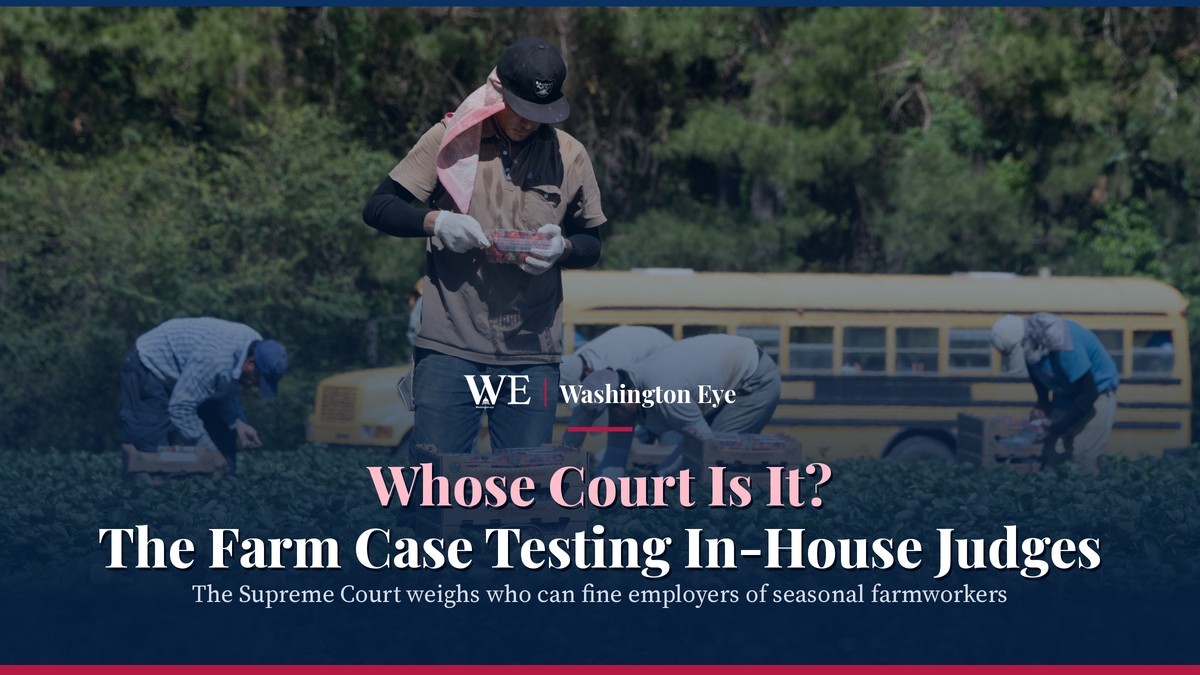
On a fruit and vegetable farm in southern New Jersey in the summer of 2015, federal labor investigators found window screens missing from worker housing, insects throughout the camp, sinks without hot water and mattresses lying directly on the floor. They found that workers who had been promised free kitchens so they could cook for themselves were instead being charged for meals, and that a supervisor was selling them drinks at a profit. Eleven years later, that inspection has become one of the most consequential cases of the Supreme Court's term, and the question at its heart has little to do with mattresses or meals. It is about who gets to decide.
On Tuesday the justices hear Department of Labor v. Sun Valley Orchards, a dispute over whether the government can use its own administrative judges, employed inside the Labor Department, to order an employer to pay civil penalties and back wages for breaking the promises it made to seasonal farmworkers. The farm says the Constitution requires that kind of case to be heard by a real federal court. The government says the case belongs to a long tradition of immigration enforcement that has never needed one.
The H-2A visa programme lets American farms hire foreign workers for seasonal jobs when they cannot find enough local labour. It has no annual cap, and it has grown quickly. In fiscal year 2025 the Labor Department certified 398,258 positions, out of 415,496 requested, according to the department's own figures. Agricultural economists at a California university estimate that roughly 330,000 H-2A workers are in the country at any time for an average stay of about six months, accounting for around a fifth of average employment on American crop farms.
The bargain at the centre of the programme is simple. A farm that wants foreign workers must first try to recruit American ones, and it must offer both groups the same wages and conditions, so that guest workers never become a cheaper substitute that drags down local pay. The rules require free housing that meets federal safety standards, either meals or free cooking facilities, transport to the fields and a guarantee of at least three quarters of the promised hours. Those terms go into a job order that serves as the employment contract. Congress authorised the Secretary of Labor "to take such actions, including imposing appropriate penalties and seeking appropriate injunctive relief and specific performance of contractual obligations, as may be necessary to assure employer compliance." For about four decades the department has enforced those promises through its own system: investigators bring charges, an administrative law judge hears the case, and the department's Administrative Review Board hears any appeal.
Sun Valley Orchards, which grows asparagus, zucchini, cucumbers, eggplant, peppers and peaches, joined the programme for the first time in 2015. It hired 96 foreign workers and 51 American workers in corresponding jobs and promised 40 hours a week for 26 weeks. Its lawyers say the Marino family, which has run the farm for four generations, turned to the programme because local workers had become hard to find. After the season, the department told the farm that it owed hundreds of thousands of dollars. The largest share related to the meals: investigators concluded that the farm had denied workers meaningful kitchen access, charged them for food without proper notice and profited from drink sales. The department also cited the housing, the vehicles and workers who were let go before receiving the hours they had been guaranteed.
The farm fought the charges inside the department and lost. An administrative judge largely sided with investigators and set the bill at $211,800 in civil penalties and $344,945.80 in back wages. The review board affirmed in full. Only then could the farm go to a federal court, and under the governing law that court owed considerable deference to the agency's findings. A federal district judge in New Jersey dismissed the farm's challenge in 2023, holding that the case fell within what lawyers call the public rights doctrine.
That doctrine is the key to the whole dispute. Article III of the Constitution gives the judicial power of the United States to federal courts whose judges have life tenure and protected salaries, precisely so that they are independent of the other branches. The Supreme Court has long held that Congress cannot strip those courts of cases that, by their nature, were the subject of ordinary lawsuits. But it has also allowed a category of public rights cases, involving matters that historically belonged to the executive and legislative branches, to be decided by agencies instead. Customs, taxes, public lands, veterans' benefits and immigration fall on that side. Where exactly the line runs has never been clear. The late Chief Justice William Rehnquist once compared the court's decisions in this area to "landmarks on a judicial 'darkling plain' where ignorant armies have clashed by night."
In 2024 the court sharpened the test in SEC v. Jarkesy, ruling that the Securities and Exchange Commission could not impose civil penalties for securities fraud through its in-house tribunal. Fraud, the majority reasoned, was a traditional claim at common law, civil penalties were a traditional legal remedy, and so the defendant was entitled to a jury in a real court. The question, the court said, is whether a claim is "made of the stuff of the traditional actions at common law tried by the courts at Westminster in 1789."
Applying that test, the US Court of Appeals for the Third Circuit sided with the farm in July 2025. Writing for a unanimous panel, Judge Thomas Hardiman said the department had framed and litigated the case as a breach of contract, the classic common law action, and had sought civil penalties and back wages imposed partly to deter, which are legal remedies. The court accepted that immigration is a public right but said the tradition behind that exception concerns the admission and exclusion of foreigners. "Rules about worker hours, housing, cooking, and transportation regard employment law," the panel wrote, noting that the same rules protect American workers too. The department could still use its own tribunals to bar the farm from the programme, the judges said, but that "does not give it carte blanche to do so for all violations."
The government asked the Supreme Court to reverse, and its brief makes two main arguments. The first is about the nature of the right. A private contract suit, it argues, enforces bargained-for terms between two parties, while this proceeding enforces "the United States' public right to compliance with government-imposed terms of an immigration program." The farm received a government benefit, permission to bring in foreign labour, and agreed to conditions in return. Enforcing those conditions, in this view, is no different in kind from policing other government privileges. The second argument is about consequences. Upholding the appeals court, the government warns, would "wreak significant disruption": at a minimum it threatens the system the department has used for 40 years to enforce the programme, and it could reach similar agency systems for the H-1B programme for specialised workers and the H-2B programme for non-farm seasonal jobs, and potentially civil penalties assessed in taxation, customs and government benefits.
Sun Valley, represented by the Institute for Justice, a libertarian public interest law firm, answers that the government is describing the wrong tradition. The farm concedes that the department may decide in-house whether to take away its privilege of hiring guest workers. What it may not do, the farm argues, is take money from it, much of it payable to private workers, without a hearing before an independent judge. The firm frames the case as being about "whether the federal government needs to provide a fair day in court when imposing ruinous fines on a business."
Worker advocates see the stakes very differently. At the appeals stage, the consumer group Public Citizen filed a brief supporting the department. Farmworkers in the programme are often far from home, depend on their employer for housing and transport and rarely bring lawsuits themselves. Agency enforcement is faster and cheaper than federal litigation, where cases can take years. If every disputed penalty must go to federal court, critics warn, enforcement will slow, settlements will shrink and the promises written into job orders will become harder to keep. For farm employers, the same change looks like a long overdue check on a system in which the agency investigates, prosecutes and judges its own case.
There are reasons to think the farm has the stronger hand with this court. When the justices agreed to hear the case in April, they reworded the questions the government had proposed and added a second one: whether the statute authorises the department to adjudicate these money claims at all. That gives the court a narrower path. It could rule that Congress never clearly gave the department power to impose such penalties in-house, avoiding a broad constitutional holding while still handing the farm a victory. The current majority has also shown a steady appetite for limiting agency power, from Jarkesy to Loper Bright, the 2024 decision that ended judicial deference to agencies' readings of ambiguous statutes. One veteran court analyst expects Justice Neil Gorsuch, who has pressed the issue for years, and Chief Justice John Roberts, who has written several of the modern opinions in this area, to be central figures at the argument.
Yet the government's case is not weak. Jarkesy itself listed immigration among the classic public rights, and the H-2A programme sits squarely at the junction of labour and immigration law; it is administered jointly with the Department of Homeland Security, and the State Department and Homeland Security decide which countries may take part. One legal scholar writing ahead of the argument suggested that both sides may be right about their histories, since this is a breach of an agreement that only exists because of an immigration programme, and that the court will have to decide which tradition should govern. Justices who are wary of disrupting large parts of the federal enforcement machinery could look for a line that protects immigration adjudication while still limiting money penalties.
Several things are worth listening for when the hour of argument begins. Whether the justices treat the job order as a private contract or as the price of a government privilege. Whether they press the government on why the department cannot simply bring these cases in federal court, as other agencies do. Whether they show interest in the statutory question as an exit. And whether any justice tries to separate the back wages, which go to workers, from the civil penalties, which go to the Treasury.
A decision is expected by the end of the term next summer. If the farm wins broadly, the ruling would extend Jarkesy from securities fraud into labour and immigration enforcement and invite challenges to in-house penalty systems across the government. If the department wins, it would mark a rare limit on the court's recent push against the administrative state and confirm that programmes built on government permission can be policed by the government itself. Either way, the outcome will be felt on thousands of farms that rely on seasonal workers, and by the workers who depend on someone enforcing the promises made to them.