
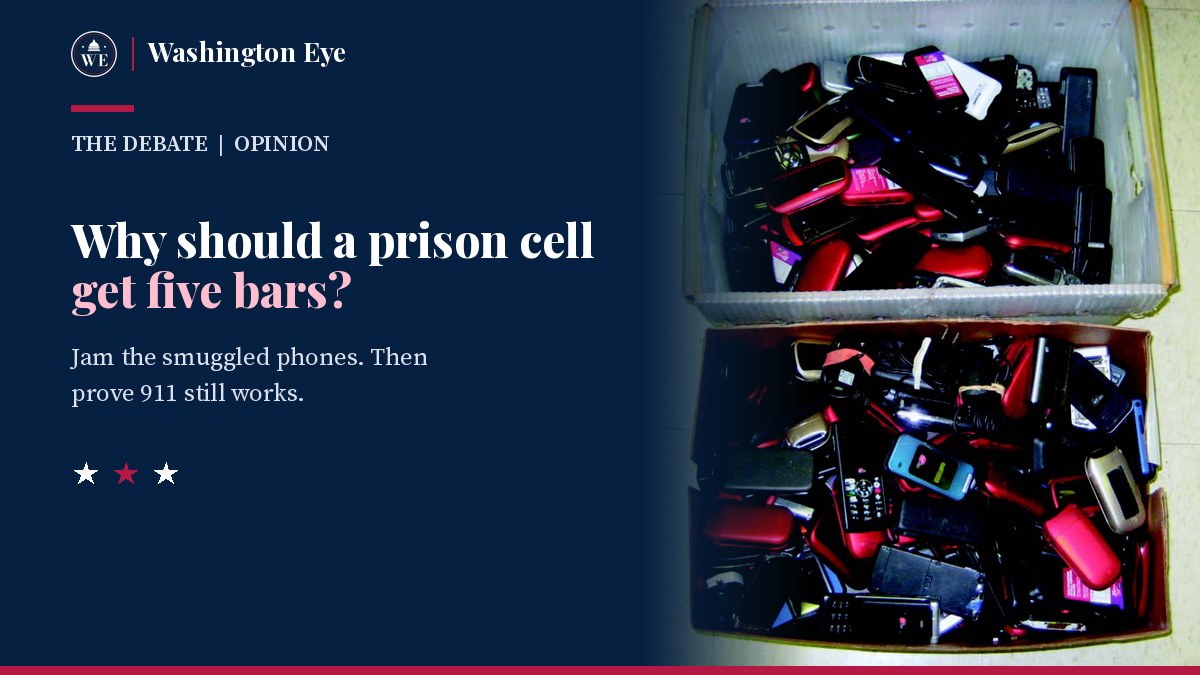
On Wednesday afternoon in Columbia, South Carolina, the chairman of the Federal Communications Commission stood behind a table covered in seized cellphones and the drones used to fly them over prison fences. Brendan Carr told reporters he had the votes. On Thursday his three-member commission is expected to do something state prison chiefs have begged Washington to do for the better part of two decades: let state and local prisons and jails jam the signals of contraband phones.
We think the commission is right, and we think it is late. But we also think the people cheering loudest should want this rule to be the most careful one the agency has written in years, because a rule that knocks out a neighbour's 911 call, or one that a court throws out next spring, would hand the phones straight back to the gangs.
Start with the problem, because it is not abstract. Carr said this week that about 25,000 contraband phones are pulled out of state and local prisons every year and that roughly 500,000 inmates have had access to one. Prison officials call the devices the single biggest security threat inside their walls. They are smuggled in by corrupt staff, hidden in packages and dropped by drone, and once inside they become tools for running drug networks, organising violence and running scams on people outside.
South Carolina knows the cost better than anyone. Robert Johnson, a former state corrections captain who ran the contraband team at Lee Correctional Institution, was shot six times at his home in 2010 by gunmen hired through an inmate's illegal phone. He survived and, according to the state attorney general's office, has endured 38 surgeries since. He stood with Carr on Wednesday. "This man is a walking miracle," said Alan Wilson, the outgoing attorney general and governor-elect.
The chief of the state's law enforcement division, Mark Keel, put the logic of jamming in one sentence: "If a cellphone can't get a signal, an inmate can't order a hit, conduct a scam, stalk their victim, orchestrate a riot, or continue acting as the kingpin of their money-making drug trafficking organization." Carr added a newer and darker worry, saying there has been an increase in inmates using the devices to target and victimise young girls, including the creation of child sexual abuse material.
There is a basic question of fairness here too. Federal prisons are already allowed to jam. State and local prisons and jails have been shut out by a federal law written for a world of radio towers, not smuggling drones. An inmate in a state prison can enjoy a level of wireless freedom that an inmate in a federal prison does not. That makes no sense, and nobody has offered a good reason why it should.
The draft order is narrower than its critics sometimes suggest. Based on the commission's own description, it does not require any state to jam. It lets a prison or jail apply for authorisation to jam only inside a defined "jamming containment area" where phone use is already banned, and the system must not cause harmful interference outside that area. Operators must first test under an experimental licence to prove the signal stays inside the zone, and face more testing after a licence is granted. Facilities that prefer managed access systems, which identify and shut off unauthorised phones, can keep using them. A further notice will ask about unlicensed spectrum, satellite phones and extra safeguards.
So far, so sensible. Now the hard part, which conservatives in particular should take seriously.
The wireless industry has fought this for months, and not every objection is self-serving. In a filing last week, the industry's main trade group asked the commission to tighten the draft, warning that jamming could disrupt 911 calls and emergency alerts, and pointed to a recent test at a South Carolina prison that it says showed interference both inside and outside the facility. One major carrier told regulators that jamming "will interfere with legitimate 911 calls, first responder communications, emergency alerts, crash notifications" in the affected area. Satellite companies warned of risks to aircraft radios flying overhead and drivers dialling for help nearby. A consumer advocate at the group Public Knowledge, John Bergmayer, listed the same fears and one more: jammers "spreading beyond the use for which they were approved."
State officials dismiss the spillover worry. Wilson called it one of "the most ridiculous excuses" he has heard in ten years, arguing that the technology can be targeted "down to a room." Carr said the fears are greatly overblown and that the technology already works in federal prisons. Maybe so. But the honest answer to a disputed test result is not a press conference. It is better testing, published openly.
That is why the most useful voice in this fight may be the one that sounds least political. The association representing 911 call centre officials has backed careful jamming and asked for specific protections: at least 30 days' notice to local 911 authorities before testing, live checks that 911 calls can be placed and completed from several spots just outside the jamming zone, and round-the-clock monitoring with someone always on call to fix interference. The industry wants site-by-site approval and an emergency off switch. None of that is a poison pill. All of it should be in the final rule or written into every licence.
There is a hard-headed reason for the right to insist on this. The commission's legal theory is that service to a smuggled phone inside a prison is simply not authorised, so blocking it does not count as illegal interference under Section 333 of the Communications Act, the provision that bars jamming. The industry argues that theory is unlawful and that Section 333, if anything, prohibits exactly this. Commissioner Anna Gomez voted to advance the idea in 2025 but warned about unintended consequences. A rule built on a clever reading of a 1934 law is a rule that invites a lawsuit. Every documented case of spillover would be an exhibit in that lawsuit.
Which brings us to Congress. Senator Tom Cotton of Arkansas, who joined Carr at a similar event in Little Rock last month, says he will keep pushing his Cellphone Jamming Reform Act to write the change into federal law. He should, and a Congress that is about to change hands should treat it as one of the rare bills that can pass with votes from both parties. Prison violence is not a red state or blue state problem. A statute would end the argument over Section 333 and spare state prison systems the risk of spending millions on equipment that a judge could switch off.
Money matters here as well, and it cuts in favour of jamming. South Carolina already runs cell signal interdiction systems at six medium and maximum security prisons. The state corrections director, Joel Anderson, estimates they work "about 80 to 85 percent of the time." The annual cost at those prisons alone is put at just under $13 million in the department's latest budget request, before installation, and lawmakers there have spent $18.5 million over two years on technology that tracks cell signals behind bars. One Republican budget writer in the state House, Phillip Lowe, who was once reluctant to fund the program, said this week: "I think jamming will be a whole lot less expensive." Arkansas's attorney general, Tim Griffin, argues that legal certainty would draw private investment and push prices down as vendors compete. That is a market argument conservatives should welcome.
Carr himself has been careful not to oversell. "This isn't going to be a silver bullet at the end of the day," he said. He is right. Jamming does nothing about the officers who carry phones in for cash, or the packages and drones that deliver them. A serious state will pair it with tougher prosecution of corrupt staff, better screening at the gate and counter-drone tools. The commission is, by coincidence, also voting on Thursday on spectrum rules meant to support drones and counter-drone technology. Those two items belong in the same conversation.
There is one more objection worth answering, because it comes from people who are not on the side of the gangs. Prisoner rights groups have argued that illicit phones sometimes serve as a watchdog, letting inmates expose abuse and dangerous conditions when the official, monitored tablets they are given would not. That concern deserves a real reply rather than a sneer about inmates wanting to "call mama." The reply is that the answer to abuse inside a prison is lawful, reliable channels to report it, from inspectors general to legal counsel to family calls, not a black market run by the very people most likely to abuse other prisoners. States that jam should be expected to strengthen those channels at the same time.
Put it all together and the case is clear. A prison cell should not get five bars. A man who ordered a hit from behind razor wire should not be able to do it again with a phone that someone paid hundreds or thousands of dollars to smuggle in. The FCC is right to open the door, and states like South Carolina are right to walk through it quickly.
But the rule's champions should be its strictest auditors. Publish the containment tests. Prove the 911 calls go through outside the fence. Keep an off switch within reach. And let Congress put the whole thing on solid legal ground. Do that, and Thursday's vote will be remembered as the day the prison phone problem finally started to shrink, not the day it moved to a courtroom.